The Labors of Hercules get referenced constantly, “a Herculean task,” “a real labor of Hercules,” but ask most people to actually name all twelve and you’ll get maybe three before things get fuzzy. Fair enough, honestly. Twelve impossible missions is a lot to keep straight, especially with a couple of near-identical names and at least one giant with three separate bodies to remember.
So here they all are, in order, explained simply, with the backstory that explains why a demigod famous for his strength ended up doing errands for a king he couldn’t stand and clearly wanted to see fail.
Table of Contents
Wait, Why Did He Have to Do This Again?
Quick context, because the labors don’t make much sense in isolation without it. Hercules, or Heracles in the original Greek, was Zeus’s son with a mortal woman named Alcmene, which made Hera, Zeus’s long-suffering wife, absolutely furious for his entire life, well before the labors even started.
Hera’s anger eventually drove Hercules into a fit of madness, during which he killed his own wife and children, not knowing what he was doing until the episode had already passed and it was far too late to undo any of it. Horrified once he came back to his senses, he sought atonement, and the Oracle at Delphi told him to serve King Eurystheus for twelve years, completing whatever tasks the king assigned him without complaint.
Eurystheus, thrilled to have a chance to humiliate the famous demigod, handed him twelve missions designed to be impossible. Hercules did all twelve anyway.
Here’s a detail that rarely makes the short version: it wasn’t originally supposed to be twelve. Eurystheus assigned ten labors at first, then disqualified two after Hercules completed them, the Hydra for using Iolaus’s help, and the Augean Stables because Hercules had briefly accepted payment for it. To make up the difference, Eurystheus tacked on two more brand-new tasks, bringing the final count to twelve. Even the number itself was Eurystheus moving the goalposts partway through.
The Full List at a Glance
| # | Labor | The Short Version |
|---|---|---|
| 1 | Nemean Lion | Kill a lion with skin no weapon could pierce |
| 2 | Lernaean Hydra | Defeat a multi-headed serpent that regrows heads when cut |
| 3 | Ceryneian Hind | Capture a sacred deer without harming it |
| 4 | Erymanthian Boar | Bring back a monstrous wild boar alive |
| 5 | Augean Stables | Clean 30 years of filth in a single day |
| 6 | Stymphalian Birds | Drive off man-eating birds with metal beaks |
| 7 | Cretan Bull | Capture a fire-breathing bull terrorizing Crete |
| 8 | Mares of Diomedes | Tame four flesh-eating horses |
| 9 | Belt of Hippolyta | Retrieve a warrior queen’s belt |
| 10 | Cattle of Geryon | Steal cattle guarded by a three-bodied giant |
| 11 | Apples of the Hesperides | Steal golden apples guarded by a hundred-headed dragon |
| 12 | Capture of Cerberus | Drag the three-headed guard dog of the underworld to the surface |
1. The Nemean Lion
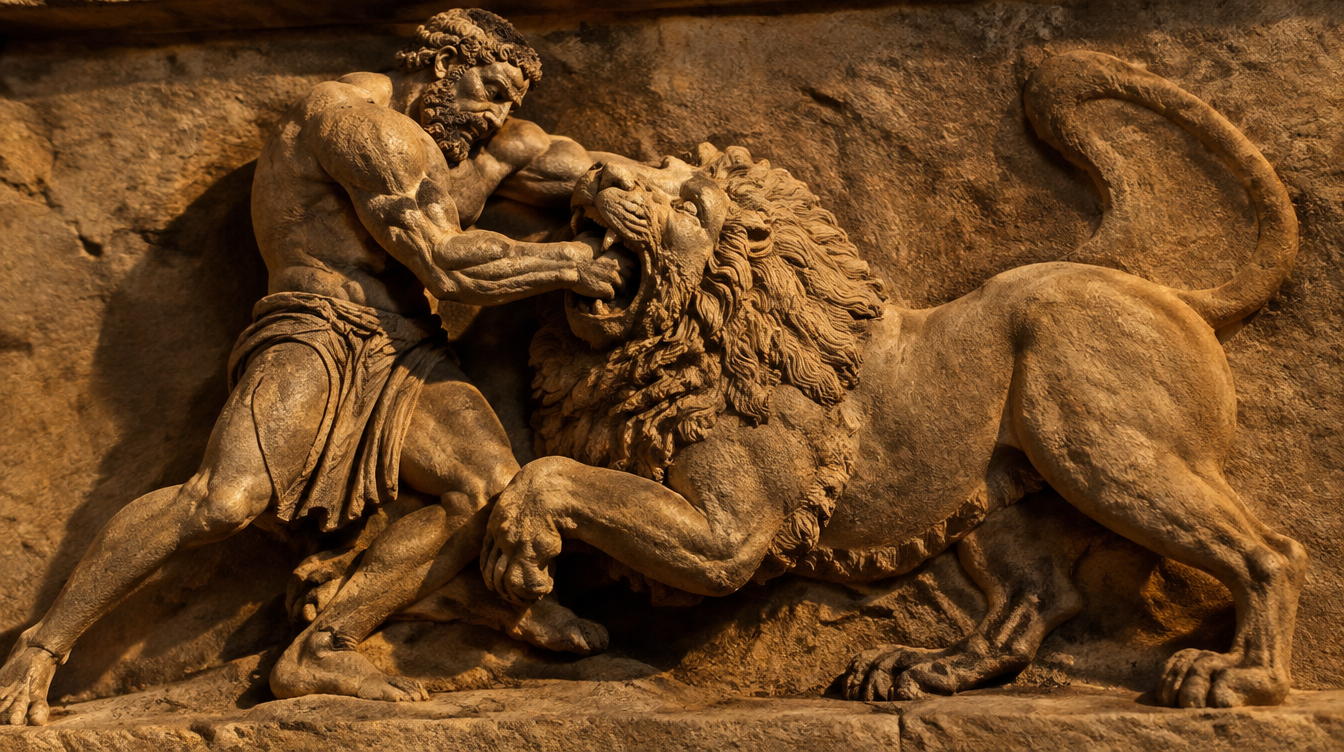
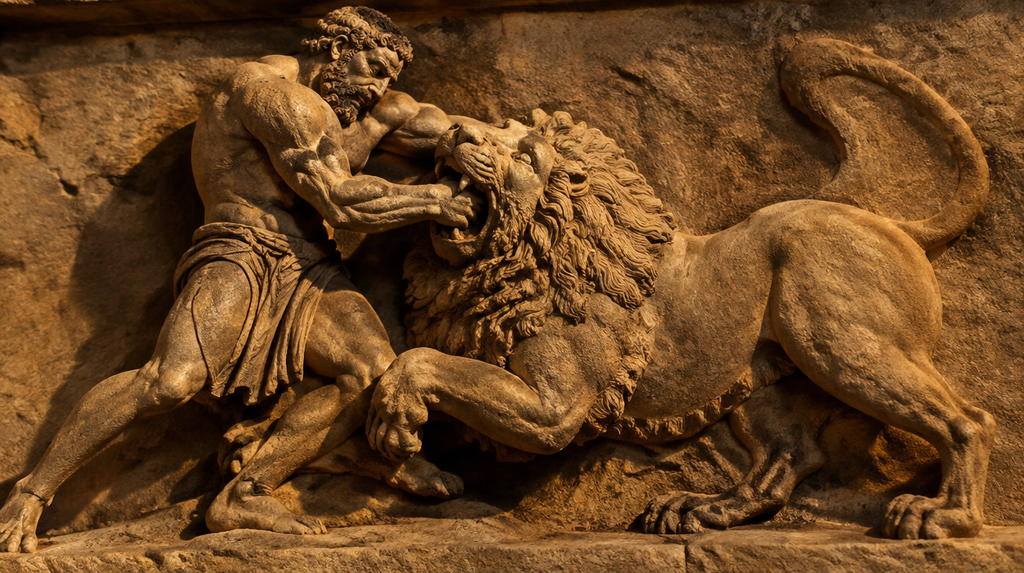
First task, and already a trick question. This lion’s hide couldn’t be pierced by any weapon, arrow, sword, or spear, so Hercules’s arrows just bounced right off it without so much as a scratch. He ended up wrestling the thing barehanded and strangling it, then skinned it using its own claws, since nothing else could cut through the hide either, not even the sharpest blade available. He wore that lion skin as armor for the rest of his life, which is exactly why he’s usually depicted wrapped in a lion pelt in ancient art, head included, worn like a hood over his own.
2. The Lernaean Hydra
A serpent with multiple heads, and here’s the catch: cut one off, two grow back in its place. Hercules figured out the workaround with help from his nephew Iolaus, who cauterized each neck with fire immediately after a head came off, stopping the regrowth cold before it had a chance to start. One head was immortal, so Hercules buried it under a massive boulder instead of trying to kill it outright, a workaround that solved the problem without technically requiring him to actually destroy that piece of it entirely.
3. The Ceryneian Hind
This one wasn’t about brute force at all. The hind belonged to Artemis, sacred and untouchable, and killing it would have meant serious trouble with an Olympian who did not forgive slights easily. So Hercules spent an entire year chasing the deer on foot across mountains and rivers before finally catching it without harming a hair, a labor that rewarded patience over muscle for once, and one of the few on the whole list where nothing actually died.
4. The Erymanthian Boar
A massive, destructive boar terrorizing the countryside around Mount Erymanthos, and Hercules’s job was to bring it back alive, not dead, which made the whole task considerably trickier. He chased it into deep snow, where the boar’s own bulk worked against it, trapping it in drifts it couldn’t push through, then hauled it back to Eurystheus, who reportedly got so scared at the sight of it that he hid inside a large storage jar and begged Hercules to take it away again.
5. The Augean Stables
Thirty years of accumulated filth from thousands of cattle, and Eurystheus gave Hercules a single day to clean it, fully expecting an impossible, humiliating failure. Rather than shoveling, Hercules rerouted two entire rivers, the Alpheus and Peneus, to flow directly through the stables, flushing everything out in hours through sheer force of water. Clever, efficient, and exactly the kind of solution nobody expected from a labor designed purely to humiliate him, which may be part of why Eurystheus tried so hard to disqualify it afterward on a technicality.

6. The Stymphalian Birds
Flocks of birds with sharp metal feathers and beaks, capable of firing their feathers like darts at anyone who came near, had taken over a marsh near Lake Stymphalia and were terrorizing the surrounding region, killing livestock and people alike. Athena stepped in with a set of bronze rattles, or krotala, loud enough to startle the entire flock into the air at once, where Hercules picked them off with his bow as they scattered in panic across the open sky above the marsh.
7. The Cretan Bull
A monstrous, fire-breathing bull was rampaging across Crete, sent originally by Poseidon as a gift to King Minos and later abandoned by Minos, who refused to sacrifice the animal back to the sea god as originally promised in exchange for the gift. Hercules wrestled it into submission with his bare hands and dragged it all the way back to Eurystheus, who, predictably, let it go afterward rather than dealing with it himself. The freed bull reportedly kept causing chaos for years, eventually becoming the same Marathonian Bull that Theseus dealt with in Athens, tying two separate hero myths together through one very persistent animal.
8. The Mares of Diomedes
Four horses that ate human flesh, kept by King Diomedes specifically to feed them unwelcome visitors who wandered too close to his kingdom. Hercules fed Diomedes himself to his own horses after a brutal fight, and once they’d eaten their owner, the mares calmed down considerably, calm enough to be led away without further struggle, a detail modern retellings tend to soften considerably compared to the original account.
9. The Belt of Hippolyta
Hippolyta, queen of the Amazons, actually agreed to hand over her belt willingly once Hercules explained the task and his reasons for needing it, no fight required at all. Hera, still furious and looking for any excuse to sabotage him, disguised herself as an Amazon and spread a rumor through the ranks that Hercules intended to kidnap the queen, triggering a battle that hadn’t needed to happen at all and that ended, in most versions, with Hippolyta’s death, a genuinely unnecessary tragedy caused entirely by Hera’s meddling rather than anything Hercules actually did.
10. The Cattle of Geryon
Geryon was a giant with three bodies fused together at the waist, guarding a herd of striking red cattle on a distant island near the very edge of the known world, as far west as any Greek myth ever ventured. Hercules killed him with a single arrow, dipped in the Hydra’s poisonous blood from an earlier labor, that pierced all three bodies at once, an almost absurdly efficient solution to what should have been an enormous, drawn-out fight against a genuinely terrifying opponent.
11. The Apples of the Hesperides
Golden apples guarded by a hundred-headed dragon named Ladon, growing in a garden Hercules couldn’t even locate at first, tended by nymphs called the Hesperides who guarded its exact location as a closely kept secret from outsiders. He eventually convinced the Titan Atlas, who was condemned to hold up the sky for eternity, to fetch the apples himself while Hercules temporarily held the sky in his place, an almost unbearable burden even for someone of his strength. Once Atlas returned with the apples, he briefly considered leaving Hercules stuck holding the sky forever, but Hercules tricked him into taking the burden back by asking for a moment to adjust his cloak for better padding, then simply walked off with the apples once Atlas had resumed the weight.
12. The Capture of Cerberus
The final labor, and the most impossible-sounding one of all twelve: bring back the three-headed guard dog of the underworld, alive, unharmed, using no weapons of any kind whatsoever. Hercules got Hades’s permission first, a genuine sign of respect between the two, wrestled Cerberus into submission with his bare hands despite the dog’s three snapping heads and serpent-tipped tail, dragged him to the surface to prove it was done to a horrified Eurystheus, then returned him safely to the underworld afterward exactly as promised. For more on Cerberus’s actual job guarding that gate, our piece on Hades and the Underworld covers the full geography Hercules was navigating during this one.
Why This List Still Gets Quoted Today
The phrase “Herculean task” exists because of this exact list, twelve missions specifically engineered to be impossible, completed anyway through a mix of brute strength, clever problem-solving, and occasional outside help that Eurystheus tried very hard to pretend didn’t count. That combination, not just raw muscle, is probably why the labors have stuck around in everyday language for as long as they have, describing anything from a home renovation to a work deadline as “Herculean” without anyone needing to explain the reference.
They also tie together a huge chunk of the wider Greek mythological world, reaching into far more corners of the pantheon than most people expect from what looks, on the surface, like a simple monster-hunting checklist. The labors touch Hera’s ongoing feud with Zeus’s children, cross paths with Athena, Poseidon, and Hades directly, and even brush up against the story of Atlas holding the sky. If you want to keep pulling on those threads, our guides to the 12 Olympian Gods and Zeus, King of the Gods cover the wider family behind all twelve of these missions in far more detail than a single article could manage. For further reading, Wikipedia’s entry on the Labours of Hercules walks through the ancient sources behind each one in more detail.
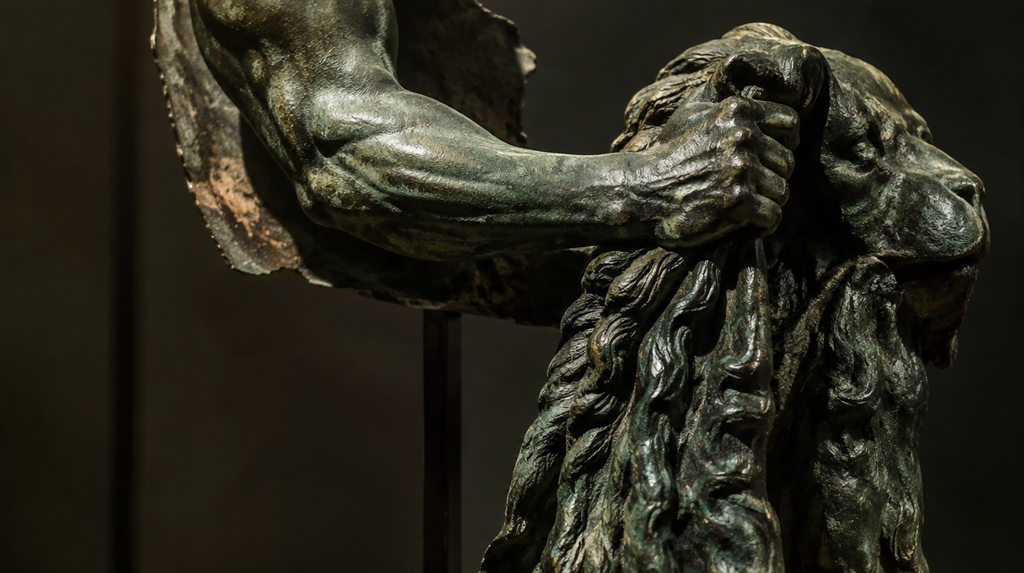
Illustrations in this article were created using AI in a photorealistic style.
Want to hold a piece of this history in your hands? Visit our official shop for digital albums, CDs, and restored vinyl records celebrating the golden era of rebetiko.