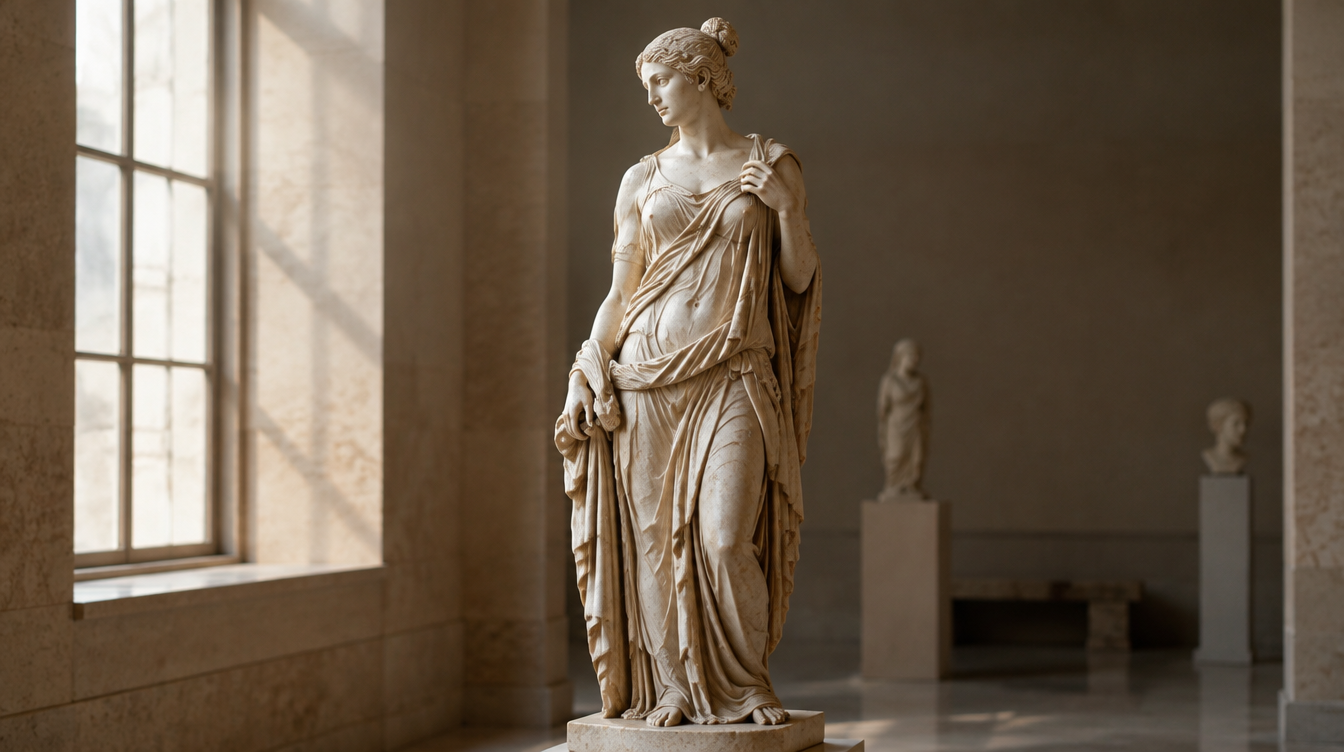
Aphrodite Goddess of Love is probably the most recognizable name in all of Greek mythology after Zeus himself. Everyone knows the broad strokes: beauty, romance, a seashell, maybe a few scandalous affairs. But the real Aphrodite is far stranger, older and more interesting than the pretty postcard version.
She was born in a way that makes every other Greek birth story look tame. She was worshipped from Cyprus to Corinth. She could inspire a war, ruin a hero, or save a lover with one gesture. And despite the soft reputation, the ancient Greeks treated the goddess of love as a force to be respected, a little feared, and never, ever ignored.
Table of Contents
So let’s meet Aphrodite properly, the way a good storyteller would introduce her at a long table on a warm evening.

The Birth Story That Still Shocks People
Most Greek gods are born the usual way, or at least a mythological version of the usual way. Aphrodite is the exception. According to the poet Hesiod, who wrote down the story around the 8th century BC, she was born from sea foam after the Titan Cronus cut down his own father, Uranus, and threw part of him into the ocean.
Yes, really. Greek mythology has a flair for the dramatic.
The word “aphros” means foam in Greek, and that’s where her name is usually traced. The foam gathered, shimmered, and took the shape of a fully grown goddess. She stepped out onto the shore already radiant, and the winds carried her toward land.
There’s a second version, too. In Homer’s Iliad, Aphrodite is simply the daughter of Zeus and a goddess named Dione. It’s a tidier family tree, and the Greeks happily kept both stories side by side. Nobody felt the need to pick a winner. That’s part of the charm of mythology: the stories were told by many voices, in many places, and they didn’t always agree.
| Version | Source | Her Parents |
|---|---|---|
| Sea-foam birth | Hesiod, Theogony | Born from the foam, no mother or father in the usual sense |
| Olympian birth | Homer, Iliad | Zeus and Dione |
Where She Landed: Cyprus and the Cult of Aphrodite
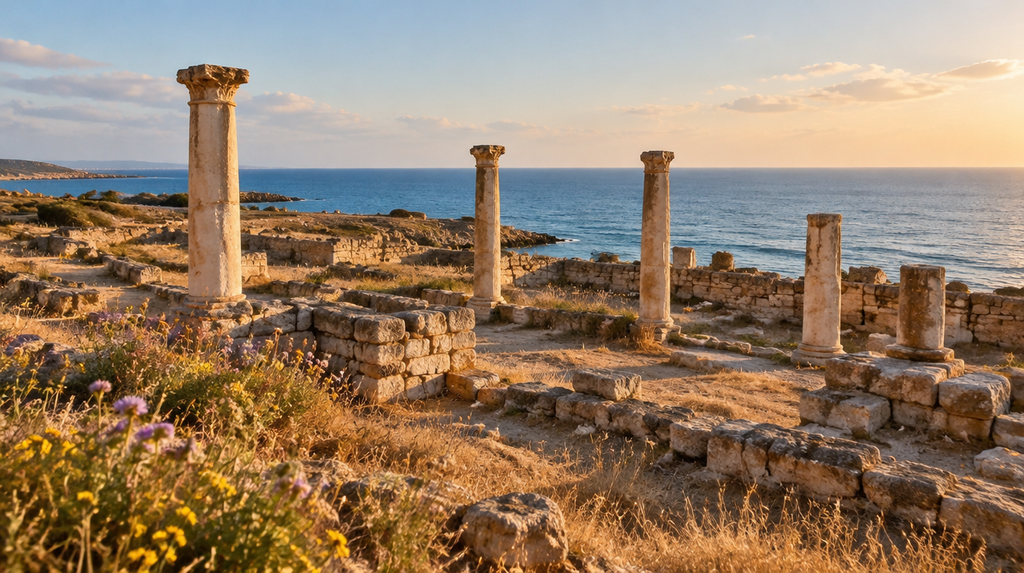
Every version of the story agrees on one thing: the goddess came ashore somewhere in the eastern Mediterranean. The most famous answer is Cyprus. Ancient writers often called her “Cyprian” or “the Lady of Cyprus,” and the island’s southwest coast near Paphos still carries her legend.
Here’s where it gets interesting for anyone who loves the deeper history behind the myth. Many scholars believe Aphrodite grew out of much older goddesses of love and fertility worshipped across the Near East, figures like the Mesopotamian Inanna and Ishtar and the Phoenician Astarte. The Greeks didn’t simply invent her. They inherited, adapted and made her their own.
That fits the wider story of this region perfectly. The Eastern Mediterranean has always been a crossroads, where gods, songs, foods and ideas traveled along the same sailing routes as merchants and refugees. Aphrodite is one of the earliest proof points that Greek culture was never isolated. It was always in conversation with its neighbors.
Her sanctuary at Paphos became one of the most important religious sites in the ancient world. Pilgrims traveled there for centuries. Worship at the site went on well into the Roman period.
Aphrodite Goddess of Love: What Was She Really in Charge Of?
Here’s a common mistake: thinking Aphrodite Goddess of Love is the whole job description. The Greek idea was much wider than that. Aphrodite oversaw:
- Love and romantic desire, including the kind that arrives without warning and refuses to leave
- Beauty, both personal and in nature
- Pleasure, in a broad sense that included music, festivals and good company
- Fertility and the renewal of life, especially in spring
- Sailing and the sea, which makes sense for a goddess born from the waves, and sailors prayed to her for safe passage
That last one surprises people. In many coastal towns, she was protector of harbors and travelers. Sailors left small offerings to her before long voyages. Think of it as a lovely mix: the goddess of the heart and the goddess of the horizon.
She also had a famous companion, the little winged figure of Eros, her son in most versions of the story, along with the Graces and the Seasons who attended her. Her sacred animals were doves, sparrows and swans, and her sacred plants included myrtle, roses and apples.
1. Aphrodite and Hephaestus: The Mismatched Marriage
Now for the part where mythology starts to feel like a soap opera.
Aphrodite was married to Hephaestus, the god of fire and the forge. He was the craftsman of Olympus, skilled beyond measure, but lame in one leg and often the target of jokes among the other gods. It was, to put it politely, an unusual pairing.
The myth goes that Hephaestus was sometimes offered the goddess as a kind of compensation, depending on which poet tells it. And the marriage wasn’t happy. Aphrodite’s heart was elsewhere, namely with Ares, the god of war.
The most famous story from The Odyssey tells how the sun god Helios spotted the lovers together and told Hephaestus. The furious craftsman forged an invisible net of bronze, fine as spider silk, and hung it over his own bed. When Aphrodite and Ares next came together, the net dropped and trapped them in plain sight. Hephaestus then invited the other gods to come and look.
The goddesses stayed home out of politeness. The gods came to laugh. The story has been retold for nearly three thousand years, and it still works because it’s so human: vanity, jealousy, humiliation and a very public mess.
2. Aphrodite and Ares: Love Meets War
The pairing of Aphrodite Goddess of Love and Ares fascinated the Greeks, and it isn’t hard to see why. Love and war look like opposites, yet each can overturn a life in a heartbeat. The myths gave the couple several children, including Harmonia, the goddess of harmony, who in some versions married the founder of Thebes.
It’s a neat idea when you think about it: from love and conflict together comes harmony. Whether the poets meant it as philosophy or just a good story, it has stuck around.
3. The Judgment of Paris: How One Apple Started a War
This is the myth with the highest stakes. It begins at a wedding, which is always a risky start.
All the gods were invited to the marriage of the mortal Peleus and the sea goddess Thetis, except Eris, goddess of discord. Offended, she tossed a golden apple onto the table, marked “for the fairest.” Three goddesses reached for it at once: Hera, Athena and Aphrodite.
Zeus, wisely, refused to choose. He sent the three of them to a young Trojan prince named Paris, who was herding sheep on Mount Ida. Each goddess offered a bribe:
- Hera promised power over kingdoms
- Athena promised wisdom and victory in battle
- Aphrodite promised the most beautiful woman in the world
Paris chose Aphrodite. The woman she promised was Helen of Sparta, already married to King Menelaus. When Paris carried her off to Troy, the Greeks sailed after her in a thousand ships.
That’s the short version of how the Trojan War began. Of all the myths about her, it shows best that Aphrodite’s power was not decorative. It was strong enough to move armies.
If you want to see how she fits among the other Olympians, our guide to the 12 Olympian gods lays out the whole family and who ruled over what.4. Aphrodite and Adonis: A Love Story With a Sad Ending
Not all of her stories are comedies. One of the most moving is the tale of Adonis, a young man of remarkable beauty whom Aphrodite adored.
Adonis loved to hunt, and Aphrodite worried constantly. She warned him to avoid dangerous animals, but he didn’t listen. One day a wild boar gored him, and he died in her arms. The goddess was heartbroken. According to the myth, red anemones bloomed from the drops of his blood, a small flower that appears each spring.
The Greeks even held an annual festival, the Adonia, where women mourned his death with small potted gardens that sprouted quickly and withered just as fast. It’s a lovely, melancholy image: a reminder that beauty and life are brief.
It also echoes the seasonal myth of Persephone, another story about loss and return that explained the turning of the year. Our article on Persephone and the origin of the seasons takes a closer look at that parallel.
5. Aphrodite and Psyche: The Trials of Love
There’s another tale, this one from later Roman writing, and it’s one of the oldest known love stories in the Western tradition. Psyche was a mortal woman so beautiful that people began to worship her instead of Aphrodite. The goddess, naturally, was furious.
She sent her son Eros to punish the girl, but he fell in love with Psyche himself. Aphrodite then set Psyche a series of impossible tasks: sorting an enormous pile of mixed grains in a single night, gathering golden wool from dangerous sheep, and even fetching a jar of beauty from the underworld.
Psyche completed them all, helped by ants, reeds and a friendly eagle. In the end Zeus made her immortal so she could marry Eros. The Greek word “psyche” means soul, so the story is often read as a tale of the soul finding love.

6. Her Famous Symbols, Explained
Aphrodite shows up in art in some very consistent ways. If you spot these in a museum, you can probably guess who you’re looking at.
- The scallop shell: a nod to her birth from the sea. It became the most famous symbol of the goddess, especially in later European art.
- The dove: a bird of tenderness and devotion, often shown beside her
- The rose and myrtle: flowers of love, used in wedding wreaths across the ancient world
- The golden apple: from the Judgment of Paris, and later a popular symbol of love and desire
- The magic girdle: a belt she owned that made anyone wearing it irresistible. In the Iliad, Hera borrows it to distract Zeus.
That last story is a fun one. Even the queen of the gods needed a little help from Aphrodite when she wanted something done.
7. How the Greeks Actually Worshipped Her
Temples and festivals were the heart of daily religion, and Aphrodite had plenty of both. Worship wasn’t confined to one place. Different cities honored different sides of her character.
| Title | What It Honored |
|---|---|
| Aphrodite Ourania | Heavenly, spiritual love and beauty |
| Aphrodite Pandemos | Love of the people, common to all |
| Aphrodite Euploia | Protector of sailors and calm seas |
| Aphrodite of Knidos | Famous for a celebrated statue by an ancient sculptor |
In Athens, the festival of the Aphrodisia honored her each summer, and in Corinth her temple on the heights above the city was celebrated across the Greek world. Brides often made offerings to her before the wedding day. For ordinary people, she was less a distant celestial figure and more a presence you spoke to about the matters closest to the heart.
Aphrodite in Art: From Marble to Modern Times
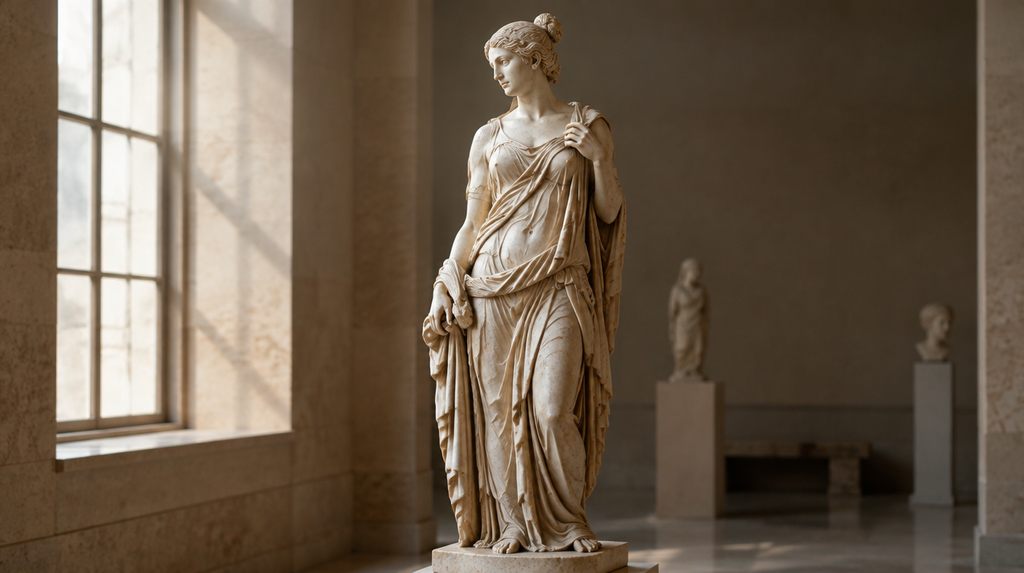
Few figures shaped Western art like Aphrodite Goddess of Love. Ancient sculptors made her one of their favorite subjects, and the idea of the graceful, idealized female form owes a lot to those statues. The famous marble from the island of Milos, discovered in 1820 and now in Paris, is probably the most recognized example of how the Greeks imagined her.
Later, Renaissance painters rediscovered the myth. Her birth from the sea became one of the most reproduced scenes in European art. She returned again and again in poetry, theater and music. And she is still here today: the planet Venus is named for her Roman counterpart, and the goddess keeps turning up in films, books and even product names.
For anyone curious about the wider history of the goddess, Wikipedia’s entry on Aphrodite offers a good overview of the sources and the different traditions.
Aphrodite and Venus: Same Goddess, Different Name
When the Romans absorbed Greek culture, they adopted many of its gods and gave them Latin names. Aphrodite Goddess of Love became Venus. The Romans even built on the myth: Venus was considered the mother of Aeneas, the legendary ancestor of Rome, which made her a symbol of the Roman people themselves.
The two goddesses are closely linked, but they aren’t perfectly identical. Venus took on more political meaning, tied to victory and the state. The Greek Aphrodite stayed closer to the personal and the poetic. If you’re visiting museums, the label might say either, depending on where the sculpture was made.Myth vs. Truth: What People Get Wrong About Aphrodite
A few ideas about the goddess tend to stick around even when they shouldn’t.
- Myth: She was only a goddess of romance. Truth: She also protected sailors, marriage, fertility and the renewal of spring.
- Myth: The Greeks invented her from scratch. Truth: Many scholars see links to older Near Eastern goddesses, which fits Cyprus’s role as a crossroads.
- Myth: She was always gentle. Truth: Her stories include jealousy, revenge and some pretty harsh punishments for people who insulted her.
- Myth: The famous seashell painting is ancient. Truth: That image comes mostly from the Renaissance. The ancient Greeks told the birth story, but the shell became a popular symbol later.
Why Aphrodite Still Matters
It’s easy to treat Greek myths as museum pieces, interesting but far away. Aphrodite Goddess of Love resists that. Her stories are about jealousy, longing, vanity, loyalty and loss, the same things people still write songs about.
And that’s the thread that connects this goddess to the music we love on this site. The great Greek songs of the 1930s, the rebetiko of the Piraeus taverns, are full of the same themes: love that hurts, love that heals, and the beauty that can’t be held on to. Aphrodite would have felt right at home at one of those late-night tables.
So the next time you see a seashell on a Greek island, or hear a bouzouki line aching with longing, remember where much of that feeling began. A goddess stepped out of the foam, and the Greeks never stopped singing about her.

Illustrations in this article were created using AI in a photorealistic style.
Want to hold a piece of this history in your hands? Visit our official shop for digital albums, CDs, and restored vinyl records celebrating the golden era of rebetiko.