Ask someone from Crete where they’re from, and there’s a decent chance the answer comes out as “Crete” first and “Greece” second. It’s half a joke and half completely serious. Spend a few days on Crete Island and you start to understand why.
It’s the biggest island in Greece, with its own dialect, its own music, its own food rules, a history that began thousands of years before Athens had a name, and a stubborn pride you can feel from the very first coffee you order. Visiting here doesn’t feel like hopping to “one more Greek island.” It feels like crossing into a small country that happens to share a flag.
Grab a coffee. Here’s what makes Crete Island so different, and how to see it without rushing past the good parts.
Crete Island at a Glance
Before the stories, a few numbers worth keeping in your head. They explain a lot about why one week here never feels like enough.
| Fact | The Number |
|---|---|
| Rank among Greek islands | Largest, by a wide margin |
| Length, west to east | Roughly 260 km (160 miles) |
| Year-round population | Around 600,000 people |
| Four main regions | Chania, Rethymno, Heraklion, Lasithi |
| Oldest civilization | The Minoans, over 4,000 years ago |
That length is the first surprise. Crossing from one end to the other is a proper road trip, not a quick ferry hop. A drive from Chania in the west to the far eastern tip takes the better part of a day once you add stops, winding roads, and the occasional goat crossing.
1. It Had a Great Civilization Before Athens Did
Long before the Parthenon, long before anyone in Athens wrote a word of philosophy, the Minoans were building multi-story palaces on Crete. Their civilization flourished roughly between 2700 and 1450 BCE, which makes it one of the oldest in Europe.
The star attraction is Knossos, a sprawling palace complex just outside Heraklion. It had running drainage, storage rooms big enough to hold small oceans of olive oil, and walls covered in bright frescoes: dolphins, ladies in elaborate dresses, and young acrobats somersaulting over charging bulls.
Here’s the fun part for myth lovers. Those bull-leaping scenes, plus the palace’s maze of rooms and corridors, are probably the seeds of the Minotaur legend. The same island gave us the bull Poseidon sent to King Minos, the one Hercules later wrestled in the Labors of Hercules.
Honest note: much of what you see at Knossos today was reconstructed in the early 1900s by the archaeologist Arthur Evans, who used concrete and a good dose of creative imagination. Scholars still argue about how accurate his version is. It’s still an unforgettable place. Just go knowing it’s part ruin, part interpretation.
The Minoans also had a rough ending. A massive volcanic eruption on nearby Santorini around 1600 BCE is widely thought to have badly weakened them, a story that connects to our piece on Santorini beyond the postcards.
2. Zeus Supposedly Grew Up Here
Remember how Zeus’s mother, Rhea, hid her baby from his child-swallowing father? In Greek myth, that hiding place was a cave on Crete. You can actually visit the caves tied to the story.
Two sites compete for the honor: the Diktaean Cave, up on the Lasithi Plateau, and the Idaean Cave, on the slopes of Mount Ida, the island’s tallest peak. Ancient pilgrims left offerings at both. Today you’ll find tour buses at one and serious hikers at the other.
It’s a small reminder of something easy to forget. Greek mythology wasn’t set in a fantasy world. It was set in real places, with real caves and real mountains, and Crete has more than its share of them.
3. Even the Language and Music Sound Different
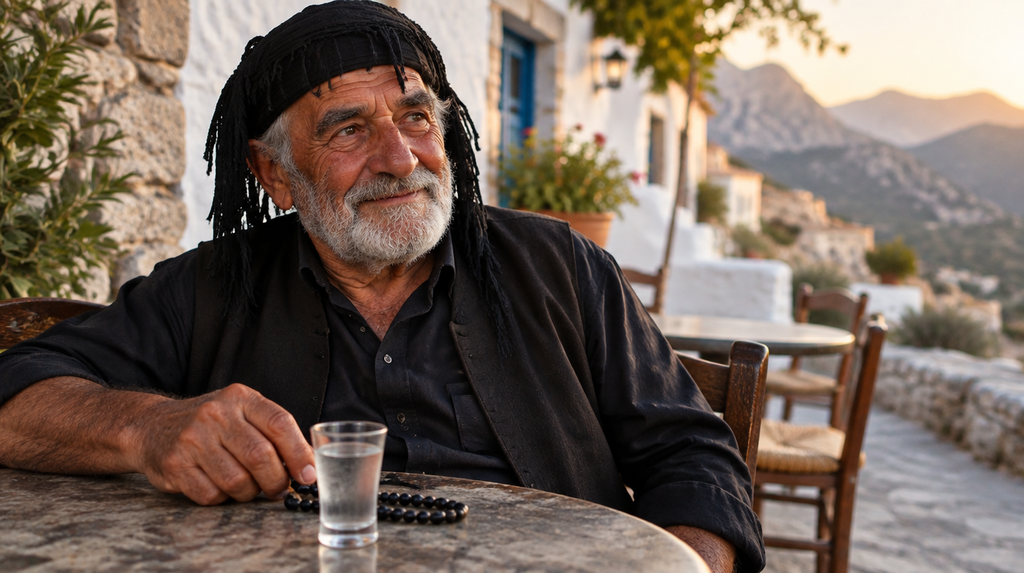
Greeks from other regions will tell you Cretans have a distinct way of speaking, and they’re right. The Cretan dialect has its own vocabulary, its own rhythm, and a singsong quality you pick up on even if you don’t speak a word of Greek. Cretans, for their part, take quiet pride in it.
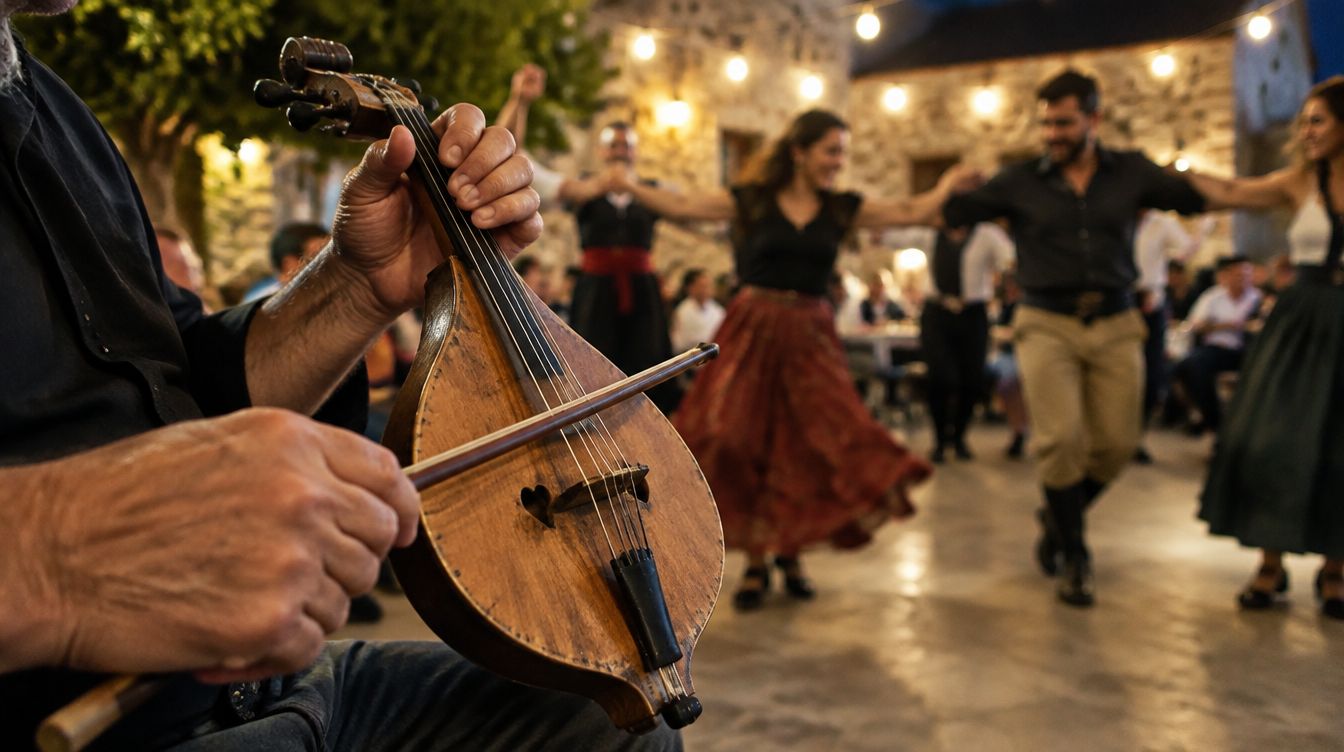
Then there’s the music. The signature instrument is the lyra, a small, pear-shaped, bowed instrument held upright on the knee and played with a fast, wiry energy. It’s usually joined by a laouto, a big lute that holds the rhythm underneath. Together they drive dances like the pentozali, a fast, athletic line dance that looks effortless until you try it.
Lyrics are often improvised on the spot as mantinades, rhyming couplets about love, pride, grief, and village gossip. A good mantinada can make a whole table go quiet, then roar.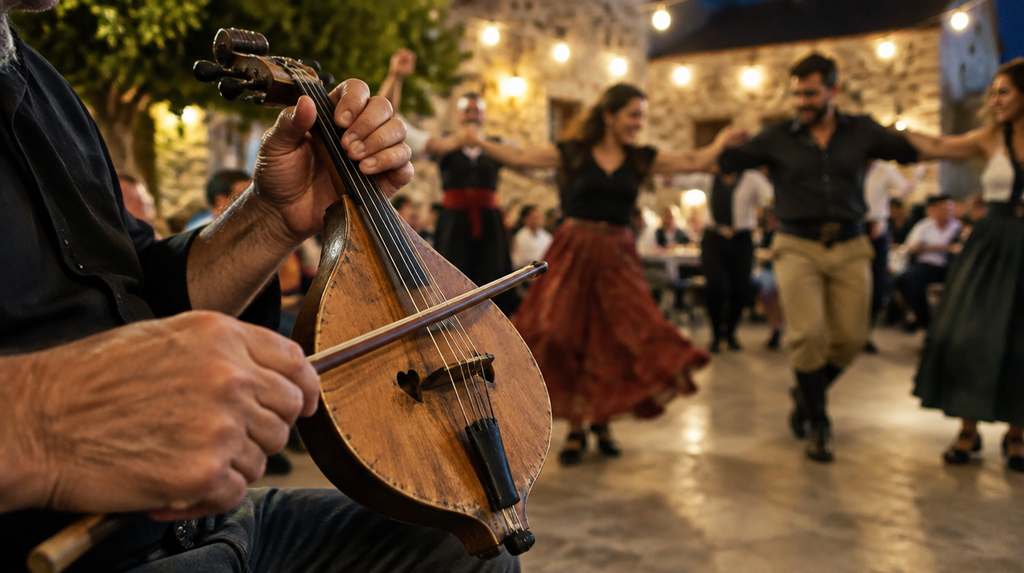
4. A Very Stubborn History of Not Giving In
Part of what gives Crete Island its independent streak is that it spent centuries being ruled by outsiders and never quite accepting it. The Venetians held it from the early 1200s until the 1600s, leaving behind the beautiful harbors and fortresses you still see in Chania and Rethymno. The Ottomans took over in 1669 and stayed until the late 1800s. Crete finally joined Greece in 1913.
Rebellion was a constant thread. The story every Cretan child learns is the 1866 stand at Arkadi Monastery, where hundreds of villagers sheltered during an Ottoman siege. According to the account that has become part of national memory, when defeat was certain, the powder store was set off rather than surrender. The monastery remains a place of quiet pilgrimage today.
The island’s resistance resurfaced in World War II. During the 1941 Battle of Crete, German paratroopers dropped from the sky, and local civilians fought alongside Allied soldiers, sometimes with little more than hunting rifles and kitchen knives. That memory still shapes how Cretans talk about courage and pride.
One more chapter worth knowing: after the 1923 population exchange between Greece and Turkey, Crete’s Muslim residents left, and refugees from Asia Minor arrived in their place. We unpacked the bigger picture in our piece on the Asia Minor refugees, and it’s one reason Cretan towns carry layers of cultural influence you can still taste in the food.
5. The Food Is Its Own Cuisine
If Greece had to pick one region as the poster child for the Mediterranean diet, Crete would win. Researchers in the mid-twentieth century were struck by how healthy older Cretans were, and the connection to their diet, heavy on vegetables, wild greens, beans, olive oil, and a modest amount of meat, helped popularize the idea worldwide.
But forget the health talk. The real reason to come hungry is flavor:
- Dakos, a hard barley rusk soaked just enough to soften, topped with chopped tomato, crumbled soft cheese, and olive oil
- Graviera, a nutty, slightly sweet local cheese that tastes nothing like the feta people expect
- Kalitsounia, small cheese or herb pies, sometimes sweet, sometimes savory, depending on the village
- Wild greens, called horta, gathered from the hillsides and boiled or baked into pies
- Snails, cooked with rosemary or vinegar, which sounds intimidating and tastes surprisingly good
Olive oil here is practically a food group. Crete is covered in olive trees, and some are astonishingly old. The ancient tree of Vouves, near Chania, is estimated to be at least two thousand years old, and it still produces olives.
Then comes the part you won’t find on a menu. When you finish a meal at a Cretan taverna, the owner often brings out a small carafe of tsikoudia, a clear grape-based spirit also called raki, plus a plate of fruit or a sweet. No bill attached. It’s called a kerasma, a treat, and refusing it is almost an insult.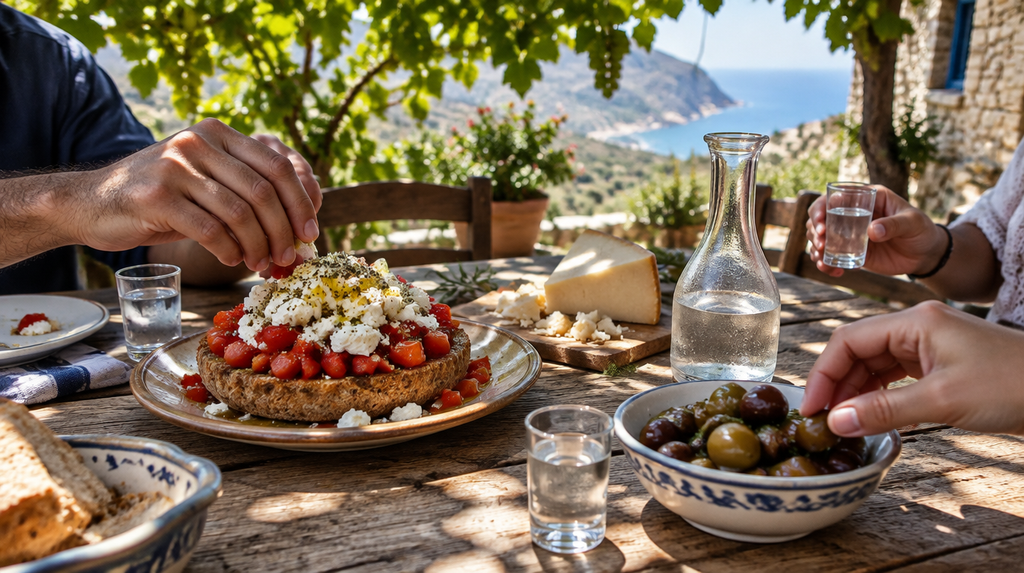
6. One Island, A Dozen Different Landscapes
This is the part that really makes Crete Island feel like a country. In a single week you can swim in warm, clear water in the morning, hike through a canyon at noon, and drive up to a mountain village for dinner where the air feels ten degrees cooler.
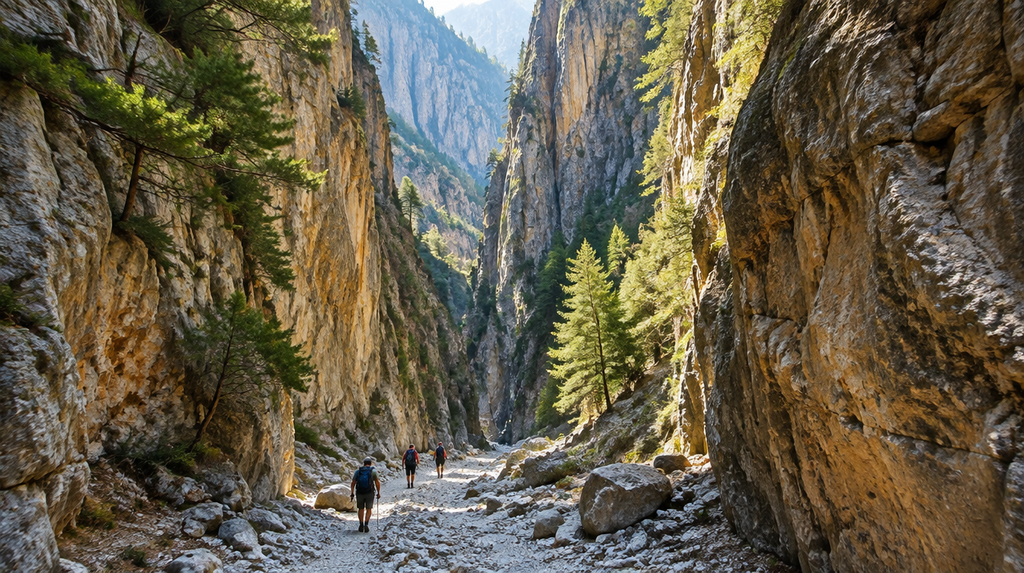
The White Mountains in the west hold snow into spring, and cut through them runs the famous Samaria Gorge, around sixteen kilometers of towering limestone walls, one of the longest gorge hikes in Europe. It’s strenuous, rewarding, and ends at the sea, where a cold drink and a swim feel like winning a medal.
The beaches are another story entirely:
- Elafonissi, in the southwest, known for its pale pink-tinted sand and shallow turquoise lagoons
- Balos, a dramatic lagoon in the northwest, often photographed from above
- Vai, in the far east, famous for its natural palm grove right on the beach
Where to Base Yourself
Because Crete Island is so long, where you stay changes the whole trip. Here’s a quick map of the four main regions:
| Region | Best For | The Vibe |
|---|---|---|
| Chania (west) | Old harbor, beaches, gorges | Venetian charm, atmospheric evenings |
| Rethymno (center) | Old town, central location | Quieter, relaxed, good base for day trips |
| Heraklion (center-north) | Knossos, the archaeological museum | Busy city, best for culture stops |
| Lasithi (east) | Calmer villages, Spinalonga | Slower pace, fewer crowds |
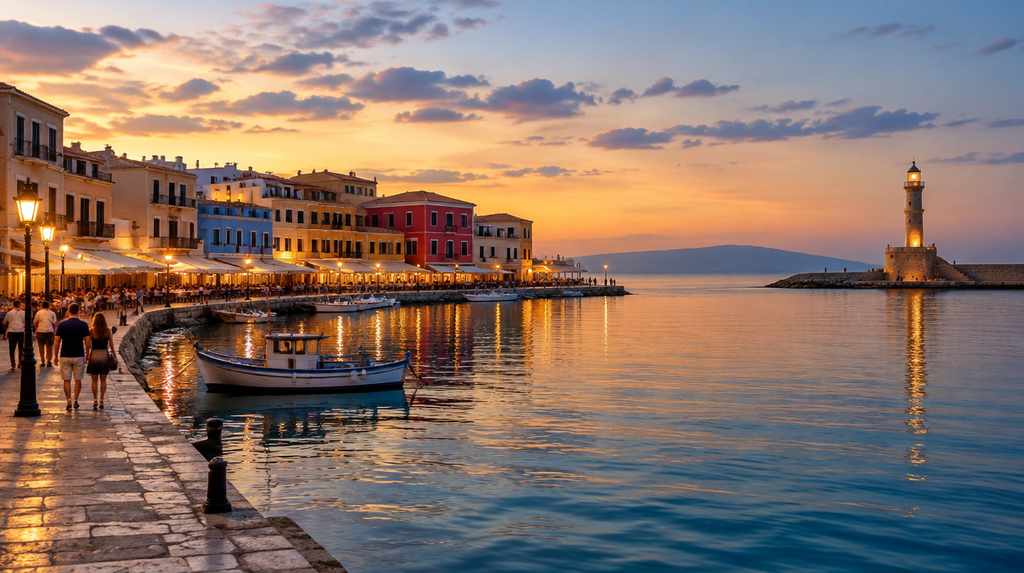
Chania’s Venetian harbor is the postcard everyone knows, with a photogenic lighthouse and a maze of lanes behind it. In the east, the small island of Spinalonga, just offshore, operated as a leper colony until 1957 and still carries a haunting, quiet atmosphere.
Getting There and Getting Around
Most visitors fly into Heraklion or Chania, both of which have international connections in the warmer months. But there’s a more atmospheric option: overnight ferries from Piraeus, the same port at the heart of our rebetiko stories, run to Heraklion and Chania, and the crossing takes roughly eight to nine hours. You board in the evening, sleep in a cabin, and wake up in sight of Crete.
Once you’re on the island, a rental car is the easiest way to see the places that matter. Public buses connect the main towns reliably, but they won’t take you to a mountain village or a quiet cove at your own pace. Plan on slow driving. Roads that look short on a map often wind through hills, and the scenery is a good excuse to stop more often than you planned.
When to Go
Crete has a long season, which is part of its appeal:
- April to early June: Wildflowers, comfortable hiking weather, and swimming water that’s still brisk
- September to October: Warm sea, thinner crowds, and a golden light that photographers love
- July and August: Hot, busy, and perfect if beach time is the priority
- Winter: Mild compared to much of Europe, but many seasonal businesses close, and mountain roads can be tricky
Mistakes First-Timers Make
A few patterns show up again and again with people planning their first trip to Crete Island:
- Trying to see the whole island in four days. Crete is big. Pick one or two regions and enjoy them properly instead of living in a rental car.
- Skipping the villages. The coastal resorts are lovely, but the mountain villages are where the island’s character lives.
- Eating only on the harbor. Walk two streets inland and prices drop, and the food usually improves.
- Ignoring the distances. A map makes everything look close. Winding roads make it feel anything but, so plan more driving time than the numbers suggest.
- Booking one hotel and “day tripping” to the other end. It’s a long road each way, and you’ll spend more time in the car than on the beach.
- Rushing the table. Meals on Crete Island are slow by design. If the raki and a small plate of fruit arrive after dinner without you ordering them, that’s not a mistake on the bill, that’s hospitality. Sit back, accept it, and let the evening run as long as it wants to.
- Skipping the small chapels and village museums. Almost every village has a whitewashed church or a one-room folk collection, and whoever holds the key usually has a story worth hearing.
So, Is It Really Like Visiting a Different Country?
Not literally, of course. But the way a place carries its history, its voice, its food, and its landscape all at once, that’s what makes Crete Island feel bigger than its map. It’s an island where an old man at a village cafe, a lyra player at a wedding, and a two-thousand-year-old olive tree all seem to be telling the same long story.
If you only have time for one thing, make it a slow meal in a mountain village, ending with that free carafe of tsikoudia. The rest of the trip will arrange itself around it.
For further reading, Wikipedia’s entries on Crete and Knossos cover the history in more depth.
Illustrations in this article were created using AI in a photorealistic style.
Want to hold a piece of this history in your hands? Visit our official shop for digital albums, CDs, and restored vinyl records celebrating the golden era of rebetiko.