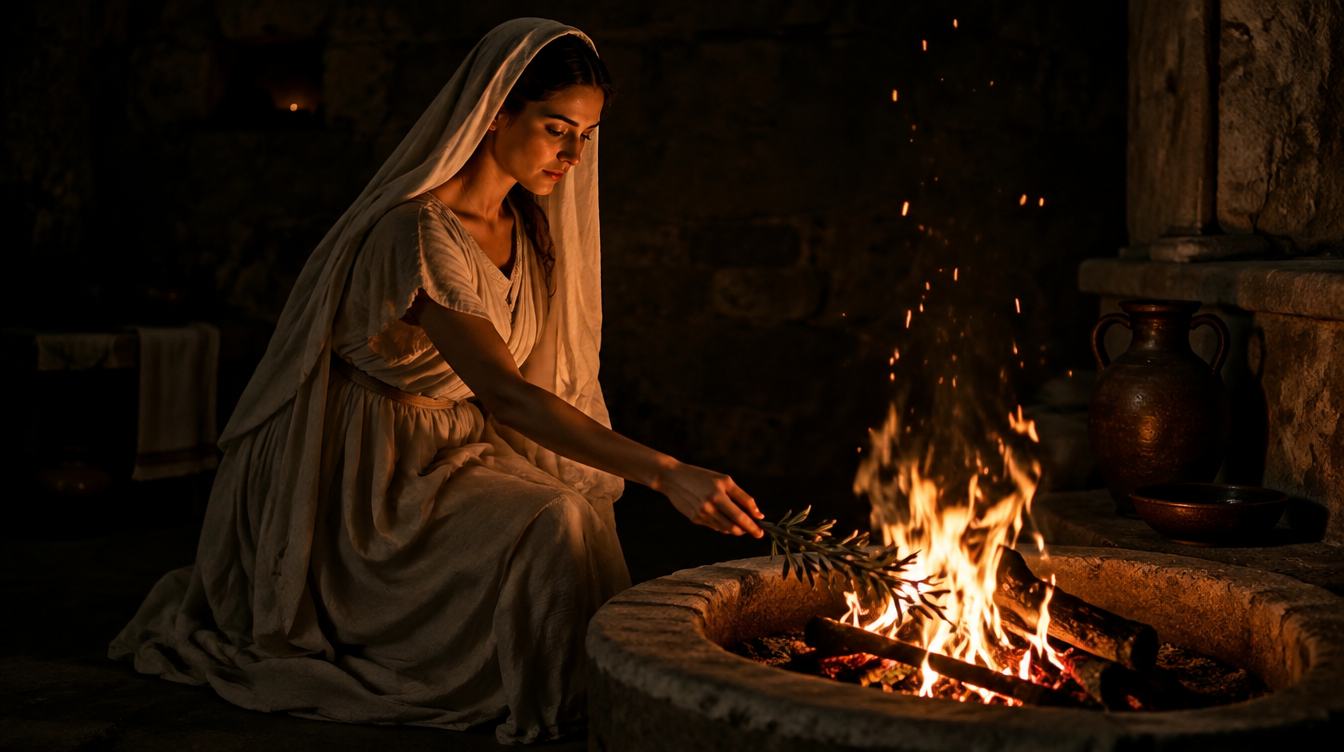
Hestia Goddess of the hearth is the quietest name among the Olympians, and that’s exactly why most people skip right past her. There are no epic battles in her stories, no scandalous affairs, no monsters slain. While Zeus threw thunderbolts and Aphrodite started wars, Hestia stayed home and tended a small fire.
And yet the ancient Greeks honored Hestia Goddess of the hearth above almost everyone. Every sacrifice began and ended with a prayer to her. Every home had her flame at its center. Every city kept her fire burning in its town hall. The goddess who never left home turns out to be the one who held the whole Greek world together.
Let’s get to know her properly, because the story of Hestia Goddess of the hearth is one of the most surprising in all of Greek mythology.
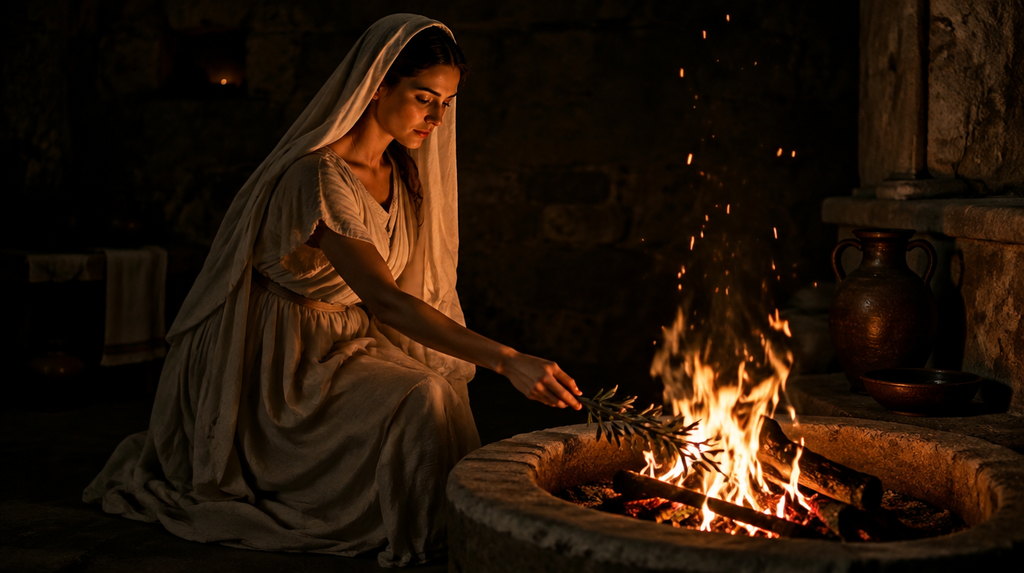
Who Was Hestia, Really?
Hestia was the eldest daughter of the Titans Cronus and Rhea, and so one of the first generation of Olympians. Her siblings were Demeter, Hera, Hades, Poseidon and Zeus. If you’d like the full family picture, our guide to the 12 Olympian gods lays it all out.
Here’s the strange part of her origin. Cronus, afraid that his children would overthrow him, swallowed each one as soon as it was born. Hestia was the first to be swallowed. And when Zeus later forced his father to bring them back up, she was the last to emerge.
So Hestia is both the oldest and the youngest of her siblings: first in, last out. It’s a neat bit of mythology, and it hints at what she came to represent: the beginning and the end of things, the steady center that is there before and after everything else.
What Was Hestia the Goddess Of?
The name of Hestia Goddess of the hearth literally means “hearth” in Greek. In a world without electricity or central heating, the hearth was the heart of the home. It cooked the food, warmed the family, lit the room and, in a symbolic sense, gathered everyone together.
So Hestia Goddess of the hearth ruled over:
- The home and the household: the place where family life happens
- The sacred fire: both in the house and in the city
- Hospitality: a guest who sat by the hearth was under the family’s protection
- Family unity: the people gathered around a shared flame
- Sacrifices and offerings: she received the first and the last portion in rituals
The Goddess Who Turned Down Poseidon and Apollo
Hestia Goddess of the hearth was beautiful, and two of the most powerful gods wanted to marry her: Poseidon, god of the sea, and Apollo, god of light and music. Both pursued her, and the competition between them threatened to cause serious trouble on Olympus.
Hestia solved the problem in the most dramatic way possible. She put her hand on the head of Zeus and swore a great oath that she would never marry and would remain a maiden forever. Zeus, impressed, granted her a special honor: she would receive a place of glory in every home and every temple, and the first offering at every feast.
Think about what that means. Instead of becoming a trophy for a more famous god, she chose her own path, and the Greeks rewarded her with honor everywhere.
The Sacred Fire at the Heart of Every Home
For the ancient Greeks, the household hearth was not just a stove. It was an altar. The family prayed there, made offerings there and welcomed guests there.
A few traditions show how seriously it was taken:
- The first and last offering: at family meals and religious feasts, the first drop of wine and the first portion of food went to Hestia, and the last prayer was also hers
- Welcoming a new baby: in a ceremony known as the Amphidromia, the child was carried around the hearth to officially bring them into the family
- Welcoming a new bride: a bride entering her husband’s house was often led to the hearth to be introduced to the household
- Never letting the fire die: a hearth that went out was seen as a bad omen, and families took care to keep it alive
It’s easy to see why. In ancient times, losing your fire meant losing warmth, cooking and safety. The flame was life.
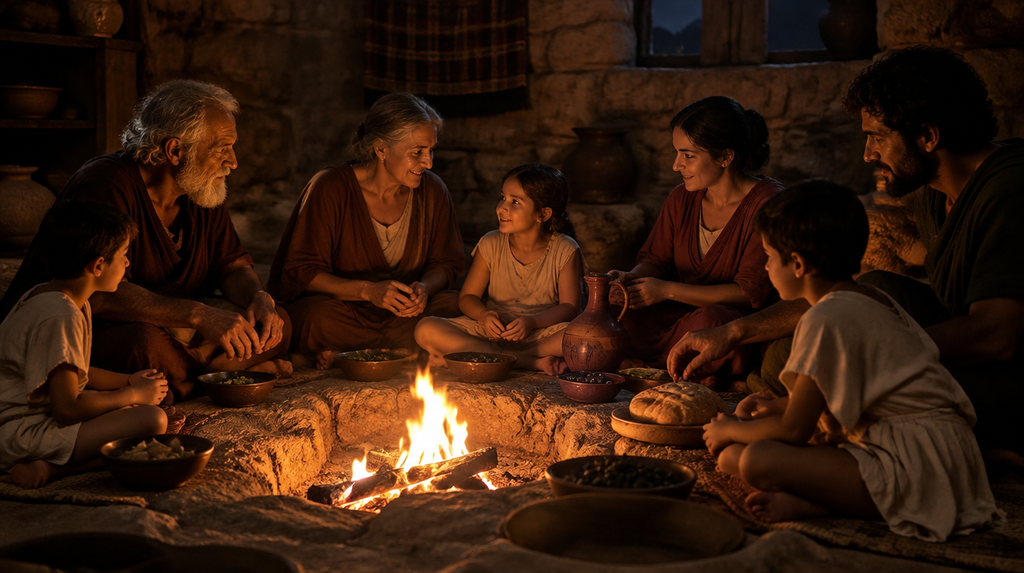
The City’s Eternal Flame
Hestia wasn’t only a household goddess. Every Greek city treated its public hearth as sacred too.
In the town hall, called the prytaneion, a fire burned continuously in honor of Hestia Goddess of the hearth. It represented the life of the entire community, a kind of shared household for the whole city. Visiting ambassadors and honored citizens were often welcomed and fed beside it.
And when a group of Greeks left to found a new colony overseas, they carried a flame from the hearth of their mother city. That fire lit the first hearth in the new settlement, a symbolic link to home. It’s a beautiful idea: wherever you went, you took a spark of where you came from.
You can still feel an echo of this today. Think of the Olympic flame, lit in Greece and carried around the world.
Did Hestia Give Up Her Seat on Olympus?
Here’s a story you may hear, and it deserves a careful note. In some versions of the myth, when the wine god Dionysus joined the Olympians, Hestia Goddess of the hearth gave up her throne among the twelve to make room for him. She chose to leave the great hall and tend the fire quietly instead.
Not every ancient source tells it that way, and in many accounts she remains among the twelve. But the story says something lovely about her character. She wasn’t interested in rank or recognition. She gave way gracefully, and kept doing the work that mattered.
Compare that with the other gods, who fought over honor and status constantly. If you want to see what that looked like, read our article on Zeus, king of the gods.Why Are There So Few Statues of Hestia?
If you walk through a museum of Greek art, you’ll find plenty of Zeus, Athena, Apollo and Aphrodite. Hestia Goddess of the hearth is much harder to spot.
There are a few reasons:
- She had no dramatic myths to illustrate. Artists loved scenes of battles, loves and transformations. A quiet fire-keeper didn’t offer much to paint.
- Her presence was the fire itself. In many temples and homes, the flame stood in for the goddess.
- She was shown simply. When she does appear, she’s usually a modestly dressed, veiled woman, calm and dignified.
The absence tells you something. The power of Hestia Goddess of the hearth didn’t need a statue. Her symbol was real, burning and present in every home.
From Hestia to Vesta: The Roman Version
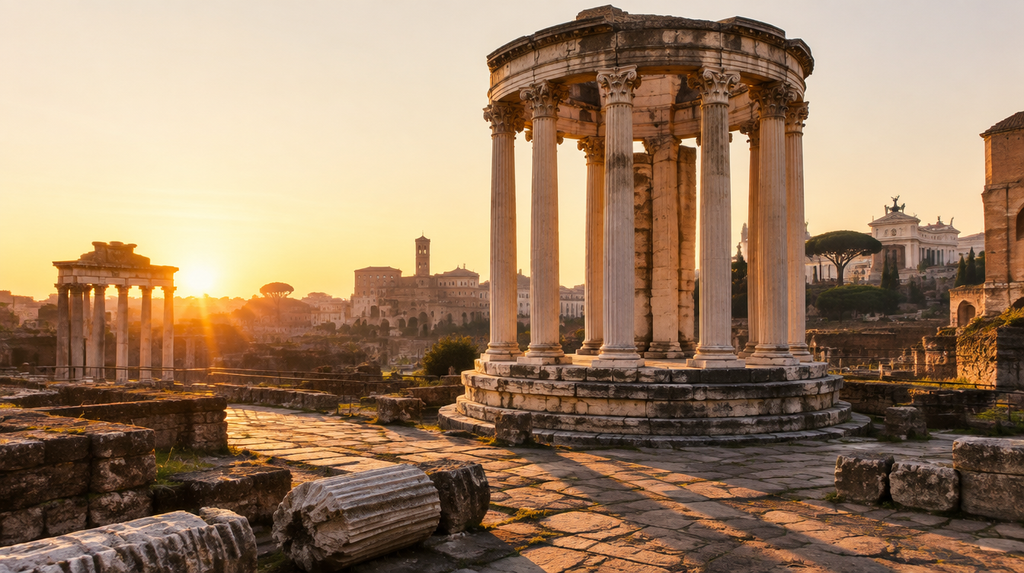
When the Romans absorbed Greek religion, Hestia became Vesta, and her cult grew even more famous. In Rome, a college of priestesses called the Vestal Virgins tended the sacred fire in the Temple of Vesta in the Forum. They were among the most respected women in the city.
The flame was believed to be tied to the safety of Rome itself. If it ever went out, it was seen as a terrible sign, and the priestesses were responsible for keeping it alive. The Roman devotion shows how deeply the idea of a protected, never-ending fire spoke to ancient people.
Hestia Goddess of the Hearth in Greek Traditions Today
The ancient religion is long gone, but you can still see traces of the values of Hestia Goddess of the hearth in everyday Greek life.
- Hospitality (filoxenia): Greeks still treat a guest as a gift. You will be offered food, coffee and something sweet whether you asked or not.
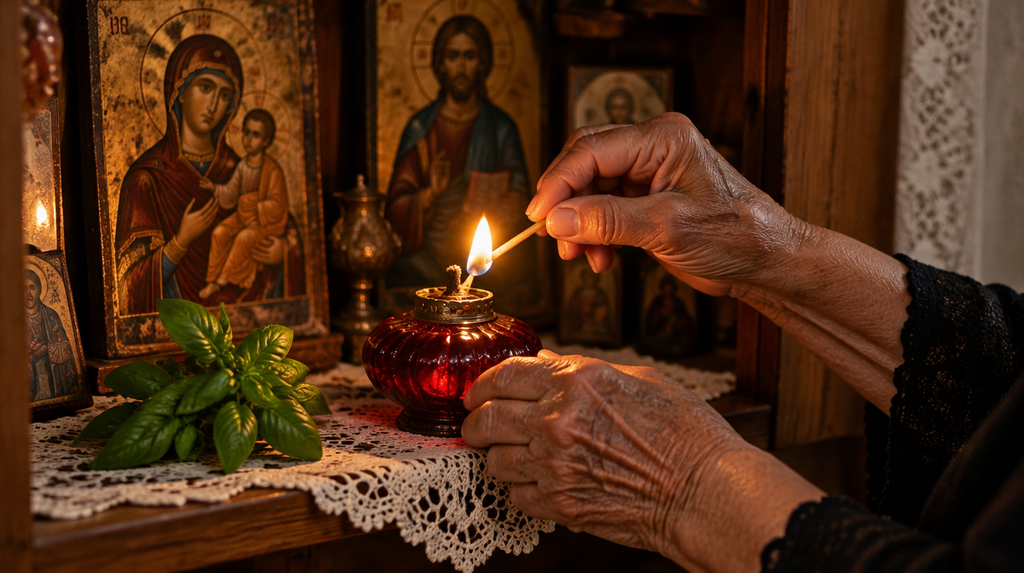
- Fire and light in faith: many Greek homes keep a small oil lamp, called a kandili, burning in front of the family icons
- The family table: Sunday lunches, name days and holidays still gather three generations around the same table
- The sacred threshold: welcoming people into the home remains a ritual, not just a courtesy
Those lamps, in particular, have a deep echo of the old hearth. A small flame, kept alive by someone in the family, quietly watching over the home. If you’re curious about how fire and light feature in Greek faith, our article on Greek Easter traditions shows the beautiful midnight candle ceremony.
The Hymn That Praised Her
The Greeks wrote poems of praise for their gods, known as hymns, and Hestia has one of her own among the collection traditionally called the Homeric Hymns. It’s short and tender. It asks the goddess to dwell in the house, to bring grace and prosperity, and to be remembered at the start of every song.
What stands out is the tone. Other hymns celebrate victories, voyages and thunder. Hers asks for something quieter: a home where the fire is warm and the people inside are at peace. It tells you what ordinary Greeks truly valued.
How to Honor the Spirit of Hestia Goddess at Home
You don’t need an altar to borrow a little of Hestia’s wisdom. A few simple habits capture the same idea:
- Make a center for your home. It could be a table, a candle or a favorite chair. Somewhere people naturally gather.
- Offer the first bite. Greeks traditionally honor the guest first. Serve visitors before yourself.
- Light a candle in the evening. A small flame slows the day down and makes any room feel kinder.
- Cook something for someone. Food is the oldest language of welcome.
- Keep the door open. In Greece, an unexpected visitor is a reason for coffee, not an inconvenience.
None of this costs much, and all of it works. It’s Hestia’s whole philosophy in a handful of small acts.
What Hestia Can Teach Us
It’s easy to overlook the quiet gods. But Hestia offers something we could all use: the reminder that the most important work is often invisible.
Someone cooks the meal. Someone keeps the house warm. Someone remembers the birthdays, keeps the family together and makes strangers feel welcome. None of it makes headlines. All of it holds the world up.
The ancient Greeks understood this. They gave Hestia Goddess of the hearth the first and last word in every ritual, because nothing else works without a place to come home to.
Myth vs. Truth About Hestia
- Myth: Hestia was a minor, unimportant goddess. Truth: She received the first offering at every sacrifice, which made her one of the most honored.
- Myth: She had no myths because nobody cared about her. Truth: Her calm role simply didn’t offer dramatic stories. Her worship was constant and everywhere.
- Myth: She was always among the twelve Olympians. Truth: Some sources say she gave up her seat to Dionysus, while others keep her on the list.
- Myth: She was only about housework. Truth: She represented hospitality, unity, community and the sacred bond between people.
For further reading, Wikipedia has useful entries on Hestia and on Vesta.
The Light Left On
If you think about it, Hestia Goddess of the hearth may be the most relatable god in the Greek pantheon. Most of us won’t wield thunderbolts or sail the seas. But we all know what it means to want a place where someone has left the light on.
That, in the end, is her gift. Not glory, but welcome. Not conquest, but a warm room at the end of a long day.
So tonight, when you walk through your own front door, spare a thought for the quiet goddess who started it all. She’d be pleased to see the fire still burning.

Illustrations in this article were created using AI in a photorealistic style.
Want to hold a piece of this history in your hands? Visit our official shop for digital albums, CDs, and restored vinyl records celebrating the golden era of rebetiko.