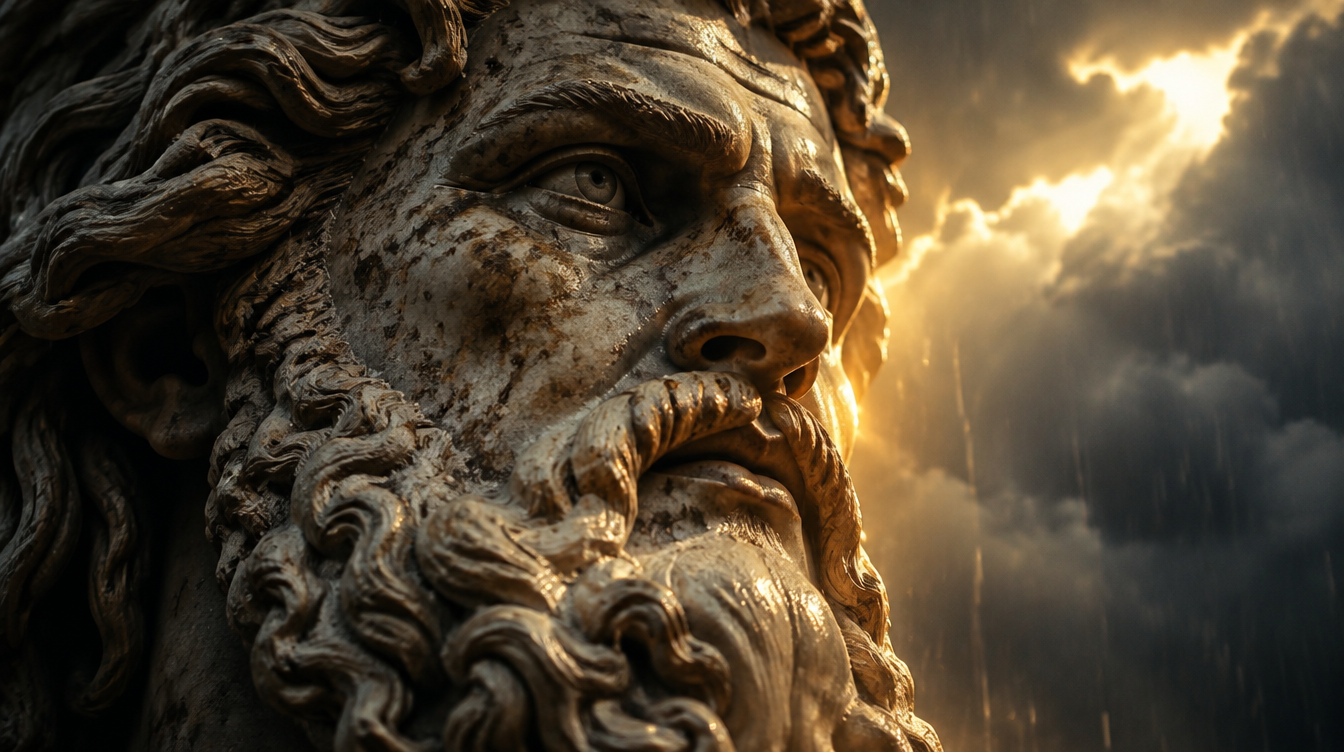
Ask most people to describe Zeus, King of the Gods, and you will likely get the same image: a bearded giant on a throne, hurling lightning bolts and chasing anything that moves. It is a caricature that has survived comic books, cartoons, and one very muscular Disney movie. But the Zeus that ancient Greeks actually prayed to, feared, and built entire cities around was a far stranger and more contradictory figure than the thunder-throwing stereotype suggests.
This article works through some of the most persistent misconceptions about Zeus by placing the popular myth next to what the ancient sources, and the archaeology of his worship, actually tell us. Some of what you think you know turns out to be accurate. Some of it is a much later invention. And some of it is far darker, and far more politically loaded, than the Saturday-morning-cartoon version ever let on.
The Zeus You Think You Know
Modern pop culture has flattened Zeus into two traits: raw power and reckless lust. Both traits are present in the ancient myths, but they were never the whole story, and the ancient audience who first heard these tales understood them very differently than a modern reader scrolling through a summary online.
The myths about Zeus were not written all at once by a single author with a consistent vision. They were compiled, edited, and reinterpreted over roughly a thousand years, from the oral traditions behind Homer’s Iliad and Odyssey in the eighth century BCE, through Hesiod’s Theogony, which first systematically laid out the family tree of the gods, all the way to Roman-era writers repackaging Greek myth for a Latin audience centuries later. Each era added its own emphasis, and by the time these stories reached the version most people learn today, a lot of nuance had been sanded away.
Myth vs. Truth: Was Zeus Born a King?
The popular myth: Zeus was simply born the king of the gods, destined for the throne from birth.
What the sources actually say: Zeus’s rise to power was neither automatic nor peaceful. According to Hesiod, Zeus was the youngest child of the Titans Cronus and Rhea, and his father had a habit of swallowing his own children whole out of fear of a prophecy that one of them would overthrow him. Rhea saved Zeus by hiding him in a cave on the island of Crete and tricking Cronus into swallowing a stone wrapped in cloth instead.
Zeus grew up in secret, eventually returned to force his father to disgorge his siblings, and then led those siblings, the future Olympians, into a brutal ten-year war against the Titans known as the Titanomachy. Only after winning that war, and then drawing lots with his brothers Poseidon and Hades to divide the universe, did Zeus become ruler of the sky and, by extension, the presiding authority over the other gods. Kingship, in other words, was seized and negotiated, not simply inherited.
Myth vs. Truth: Was Zeus All-Powerful?
The popular myth: Zeus could do absolutely anything, answerable to no one.
What the sources actually say: Zeus’s power was significant but not absolute, and Greek myth is full of moments where his authority is challenged, mocked, or outright limited. In one striking episode from the Iliad, Hera, Poseidon, and Athena conspire to bind Zeus in chains while he sleeps, and he is only freed when the sea nymph Thetis summons the hundred-handed giant Briareus to intimidate the rebels into backing down.
Zeus was also bound by Fate itself, a force even he could not override. In the Iliad, Zeus weighs whether to save his own mortal son Sarpedon from death in battle, and Hera reminds him that doing so would violate the natural order that even the king of the gods was expected to respect. He ultimately lets his son die. This tension between raw power and cosmic limitation was one of the more sophisticated ideas embedded in Greek religious thought: even the highest authority operated inside a larger structure it did not fully control.
Myth vs. Truth: The “Womanizer” Reputation
The popular myth: Zeus was a serial seducer who pursued women purely out of appetite.
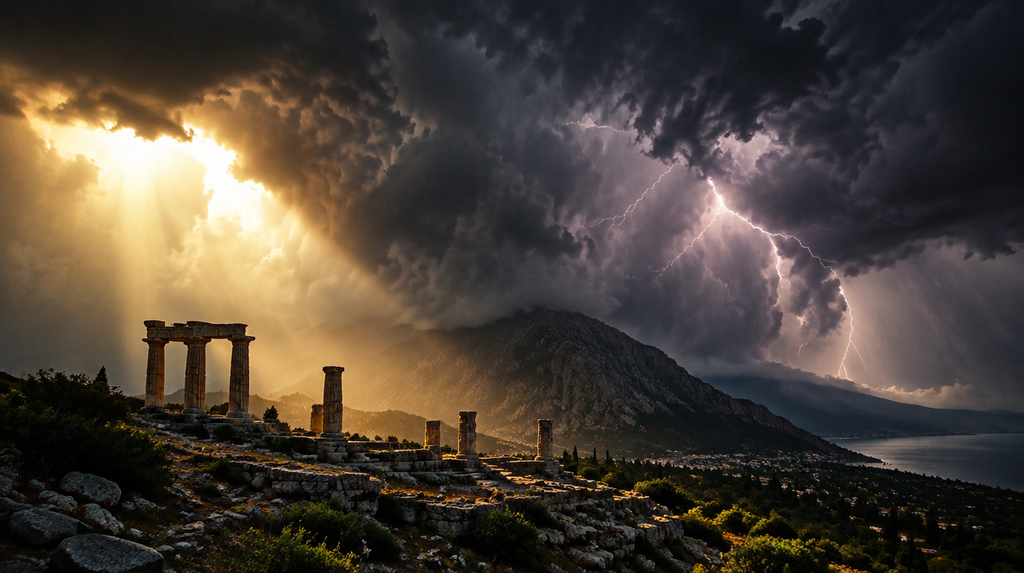
What the sources actually say: This is the part of Zeus’s mythology that modern retellings tend to either sanitize completely or lean into for shock value, and both approaches miss what these stories were actually doing. Many of Zeus’s affairs, with mortal women like Leda, Europa, Danaë, and Alcmene, were not romantic subplots. They were origin myths for entire royal bloodlines and city-states.
Greek aristocratic families and even whole regions frequently traced their ancestry back to a union between Zeus and a mortal woman, because claiming divine descent was a powerful tool for political legitimacy. The myth of Europa, for example, explains the mythic founding of Crete’s royal line and is tied to the very name of the European continent. Read this way, these stories functioned less like romance and more like a divine genealogy chart used to justify who got to rule where. That does not erase the deeply troubling power imbalance in many of these myths, several of which ancient sources themselves treat as abduction rather than romance, but it does explain why there are so many of them: they were doing genealogical and political work, not just characterizing Zeus’s personality.
It also helps explain why Hera’s anger, so often reduced to a punchline about a jealous wife, carried real narrative weight in the ancient versions of these stories. Hera was not simply reacting to infidelity in a modern romantic sense; she was frequently the only figure in these myths pushing back against the abuse of Zeus’s authority, punishing mortal women and demigod children who had no power to refuse a god in the first place. Ancient audiences did not necessarily read her as irrational. Many of the myths invite exactly the opposite reading: a wronged queen holding the most powerful being in the cosmos to some kind of account, even when the rest of the divine order preferred to look away.
Myth vs. Truth: Zeus as the God of Justice
The popular myth: Zeus was mainly a god of weather and war, a blunt instrument of force.
What the sources actually say: One of the most consistently emphasized aspects of Zeus in ancient religious practice, and one that rarely survives into modern retellings, is his role as the guardian of justice, hospitality, and oaths. He carried the epithet Zeus Xenios, protector of guests and strangers, and Zeus Horkios, enforcer of oaths. Breaking a sworn promise or mistreating a guest in your home was believed to invite Zeus’s direct punishment, regardless of your social status.
This mattered enormously in a world without a strong centralized legal system connecting scattered city-states. A traveling merchant, a stranded sailor, or a political envoy from a rival city depended on the assumption that hospitality was sacred, and Zeus was the enforcement mechanism behind that assumption. The famous myth of Baucis and Philemon, an elderly couple who unknowingly host Zeus and Hermes in disguise and are rewarded for their generosity while their inhospitable neighbors are destroyed, exists specifically to reinforce this social contract.
Myth vs. Truth: Was There Only One Zeus?
The popular myth: Zeus was a single, consistent character worshipped the same way everywhere in the ancient Greek world.
What the sources actually say: Ancient Greek religion had no central authority dictating a single, official version of any god, and Zeus was worshipped through dozens of distinct regional and functional identities, each attached to its own epithet and its own local rituals. Zeus Meilichios, “the kindly one,” was honored at small household shrines as a protector of the family and the wealth of the home, often depicted as a serpent rather than a bearded man. Zeus Ktesios watched over stored grain and household property. In North Africa, Greek travelers identified their own Zeus with the Egyptian ram-headed god Amun, worshipped jointly as Zeus Ammon at a famous oracle in the Siwa Oasis that Alexander the Great later visited to have his own divine parentage confirmed.
This patchwork of overlapping identities is easy to miss when Zeus is flattened into a single pop-culture character, but it reflects something important about how ancient religion actually functioned: gods were not fixed franchise characters with a single canon, but flexible frameworks that different communities adapted to their own local needs, fears, and hopes.
Where the Greeks Actually Worshipped Zeus
Unlike the version of Zeus preserved mostly through myth and literature, the archaeological record shows exactly how central he was to everyday religious life. The most famous cult site was Olympia, home not only to the ancient Olympic Games, held in Zeus’s honor every four years, but also to a colossal gold-and-ivory statue of the seated god crafted by the sculptor Phidias, once counted among the Seven Wonders of the Ancient World. Athletes competing at Olympia swore oaths before an altar of Zeus Horkios, tying the games directly back to his role as enforcer of sworn promises.
Athens had its own monumental tribute in the Temple of Olympian Zeus, known as the Olympieion, whose construction dragged on for over six hundred years across multiple rulers before the Roman emperor Hadrian finally completed it in the second century CE. Its towering Corinthian columns, a handful of which still stand near the Acropolis today, once supported a temple large enough to house another colossal statue of the god, reportedly rivaling the one at Olympia in scale.
Another major center was the oracle at Dodona, in northwestern Greece, considered by some ancient sources to be even older than the famous oracle of Apollo at Delphi. There, priests interpreted the will of Zeus through the rustling of leaves in a sacred oak tree, a much quieter and more atmospheric form of divine communication than the thunderbolt imagery usually associated with him.
| Aspect | Popular Myth Version | What the Sources Show |
|---|---|---|
| Rise to power | Born king automatically | Won the throne through war and negotiation |
| Authority | Absolute, unchallenged | Limited by Fate and occasionally by other gods |
| Affairs with mortals | Simple lust and romance | Often functioned as political and genealogical myth |
| Core religious role | Weather god who throws lightning | Guardian of justice, oaths, and hospitality |
| Main worship sites | Vague “Mount Olympus” | Concrete cult centers at Olympia and Dodona |

Why Zeus Still Rules Our Imagination
What makes Zeus endure, long after the temples fell silent and the oracles stopped speaking, is exactly the contradiction modern retellings tend to flatten out. He is simultaneously the most powerful being in his own cosmos and someone visibly constrained by forces bigger than himself. He punishes injustice while committing plenty of it. He is the guarantor of the social order and, in several myths, its most persistent disruptor.
That tension is precisely what made Zeus useful to the people who worshipped him. A god who was simply, uncomplicatedly powerful would have little to say about a world as morally messy as the one ancient Greeks actually lived in. A king of the gods who was still bound by Fate, still capable of grief over his own children, and still expected to answer for broken promises, offered something closer to a mirror than a fantasy. That complexity, more than the lightning bolts, is probably why his name is still recognizable three thousand years after the first version of his myth was ever sung aloud.
It is also worth remembering that the ancient Greeks themselves were not naive readers of these stories. Philosophers like Xenophanes were already criticizing the morality of Zeus’s myths as early as the sixth century BCE, arguing that attributing theft, deceit, and adultery to the gods said more about human storytelling than about divine nature. That critical distance between worship and literal belief existed long before modern readers started debating whether Zeus was a hero or a cautionary tale, which suggests the ancient relationship with these myths was always more thoughtful, and more argumentative, than the simplified textbook version tends to let on.
For readers who want to explore the wider family of gods Zeus presided over, our guide to the 12 Olympian Gods breaks down each of his fellow Olympians individually. For primary background on the sources discussed here, Wikipedia’s entries on Zeus and the Oracle of Dodona offer well-documented overviews of the literary and archaeological evidence.
Illustrations in this article were created using AI in a photorealistic style.
Want to hold a piece of this history in your hands? Visit our official shop for digital albums, CDs, and restored vinyl records celebrating the golden era of rebetiko.