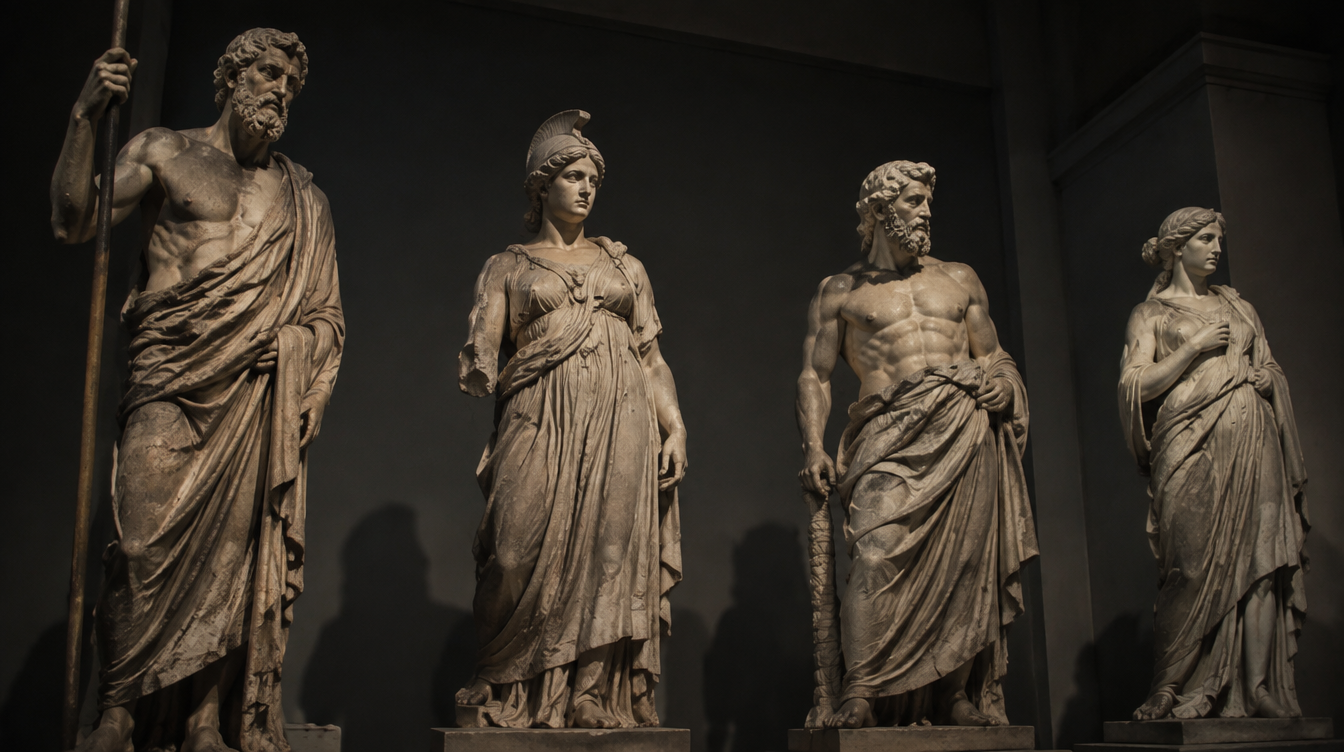
Long before Greece had a flag, a currency, or even a common written language, it had a family. Not a royal house in the ordinary sense, but a household of divine beings who were said to rule the sky, sea, and underworld from the summit of a single, snow-capped peak. The 12 Olympian Gods are the best-known cast of characters to come out of the ancient Mediterranean world, and nearly three thousand years after the first myths about them were sung around a fire, their names are still on ships, planets, perfumes, and psychology textbooks.
This guide is written for people encountering the Olympian pantheon for the first time, or for those who grew up hearing the names but never quite got the full family tree straight. We will walk through who these gods were, what they controlled, how they related to one another, and why a group of stories invented by shepherds and sailors managed to outlive every empire that ever tried to claim them.

Where the Gods Held Court
In Greek religion, “Olympian” did not simply mean powerful. It meant a god belonged to the ruling generation that had overthrown the older, more primal Titans in a ten-year war called the Titanomachy. Once victorious, this new generation of gods was said to have taken up residence on Mount Olympus, the tallest mountain in mainland Greece, standing on the border between Thessaly and Macedonia.
From there, the twelve were believed to govern nearly every aspect of human life: the harvest, the tides, love, war, wisdom, wine, and the boundary between life and death. Greek city-states did not always agree on which twelve deities deserved a seat at the table. Local cults sometimes swapped one god for another depending on regional loyalties, and the most famous point of debate concerns the twelfth seat itself, contested between the gentle hearth-goddess Hestia and the wilder, wine-drenched Dionysus. Most later traditions, including the version that dominates popular culture today, settled on Dionysus, and that is the lineup we will follow here.
What unites all twelve is not just power, but personality. Unlike more distant, abstract deities in other ancient religions, the Olympians quarreled, fell in love, held grudges, and occasionally acted with startling pettiness. That very human messiness is part of why their stories have survived so well. Below, each god gets their own introduction, along with the symbols the ancient Greeks used to identify them on pottery, temple friezes, and coins.
Zeus, King of the Sky
Zeus was the youngest son of the Titans Cronus and Rhea, and the one who eventually led the rebellion against his own father. After the Titans were defeated and cast into the underworld pit of Tartarus, the three victorious brothers divided the cosmos among themselves. Zeus claimed the sky.
- Domain: Sky, thunder, law, and the authority of kings
- Symbol: Thunderbolt, eagle, oak tree
- Roman name: Jupiter
- Family role: Husband of Hera, father to many of the other Olympians
Zeus was worshipped as the guarantor of oaths and hospitality, two values ancient Greek communities took extremely seriously. A guest who was mistreated, or a promise that was broken, was believed to invite his wrath directly. At the same time, Zeus’s own mythology is full of infidelities and disguises, which generated much of the drama involving the other gods and a long list of demigod children, including Heracles and Perseus.
Hera, Queen of Olympus
Hera was both Zeus’s sister and his wife, making her the presiding goddess of marriage, women, and family life. She is frequently portrayed in myth as jealous and vengeful, but that reading often obscures her original role as a powerful, independent goddess with her own ancient cult centers, particularly at Argos and Samos, that predate her marriage to Zeus in the stories we know today.
- Domain: Marriage, family, childbirth
- Symbol: Peacock, cow, diadem
- Roman name: Juno
- Family role: Wife and sister of Zeus
Many of the most dramatic Greek myths, from the labors of Heracles to the wanderings of Io, are set in motion by Hera’s anger at Zeus’s affairs. Rather than a simple villain, later scholars increasingly read Hera as the story’s moral center: the wronged party demanding accountability in a world where the king of the gods answered to almost no one.
Poseidon, Lord of the Sea
Poseidon drew the sea in the division of the cosmos, and with it came a personality as unpredictable as the water he ruled. Sailors prayed to him before every voyage, since a calm crossing or a shipwreck were both understood to be entirely in his hands.
- Domain: Sea, earthquakes, horses
- Symbol: Trident, horse, dolphin
- Roman name: Neptune
- Family role: Brother of Zeus and Hades
Poseidon was also, somewhat surprisingly to modern readers, the god of earthquakes and of horses, which the Greeks believed he created. His rivalry with Athena over patronage of Athens, which she won by gifting the city an olive tree instead of Poseidon’s saltwater spring, is one of the founding myths of the city itself.
Demeter, Goddess of the Harvest
Demeter governed agriculture, grain, and the fertility of the soil, making her one of the most practically important gods for ordinary Greek farmers. Her most famous myth explains the origin of the seasons: when her daughter Persephone was abducted by Hades, Demeter’s grief caused the earth to grow barren until a compromise was struck allowing Persephone to return each spring.
- Domain: Agriculture, grain, the harvest cycle
- Symbol: Wheat sheaf, torch, cornucopia
- Roman name: Ceres
- Family role: Sister of Zeus, mother of Persephone
Demeter’s cult was central to the Eleusinian Mysteries, one of the most important religious rites in the ancient Greek world, held annually near Athens and shrouded in such secrecy that its exact rituals remain only partially understood today.
Athena, Goddess of Wisdom and Strategy
Athena was born, according to myth, fully grown and armored, springing directly from the forehead of Zeus after he swallowed her mother, the Titaness Metis. She became the patron goddess of Athens, the city that still bears her name, and was worshipped as the embodiment of strategic warfare, wisdom, and skilled craftsmanship.
- Domain: Wisdom, strategic warfare, crafts
- Symbol: Owl, olive tree, aegis shield
- Roman name: Minerva
- Family role: Daughter of Zeus, no mother in the traditional sense
Unlike Ares, who embodied the chaos and bloodlust of battle, Athena represented war as a matter of discipline, planning, and defense. The Parthenon, still standing on the Acropolis of Athens, was built in her honor and remains one of the most visited ancient sites in the world.
Apollo, God of Light and Prophecy
Apollo was the twin brother of Artemis and one of the most multifaceted gods in the entire pantheon, associated with the sun, music, poetry, healing, and prophecy all at once. His oracle at Delphi was the most consulted prophetic site in the ancient Mediterranean, visited by kings and commoners alike seeking guidance from his priestess, the Pythia.
- Domain: Sun, music, prophecy, healing
- Symbol: Lyre, laurel wreath, bow
- Roman name: Apollo (name unchanged)
- Family role: Son of Zeus, twin brother of Artemis
Apollo is one of the few Olympians whose Greek name carried straight into Roman religion without translation, a fact that hints at just how deeply his cult had spread across the ancient world even before Rome adopted Greek mythology wholesale.
Artemis, Goddess of the Hunt
Artemis ruled over the wilderness, the hunt, and wild animals, and was also the protector of young women and childbirth, despite her own vow of eternal virginity. She is usually depicted with a bow and a pack of hunting dogs, moving through forests untouched by human settlement.
- Domain: Hunting, wilderness, the moon
- Symbol: Bow and arrow, deer, crescent moon
- Roman name: Diana
- Family role: Daughter of Zeus, twin sister of Apollo
Communities across the Greek world built major sanctuaries to Artemis, including the Temple of Artemis at Ephesus, once counted among the Seven Wonders of the Ancient World before it was destroyed and later rebuilt multiple times.
Ares, God of War
Ares embodied the brutal, chaotic side of combat, in sharp contrast to Athena’s disciplined strategy. He was not especially popular in Greek religion compared to gods like Zeus or Athena, and several myths depict him being humiliated or outwitted, a reflection of how ancient Greeks generally viewed reckless violence with suspicion.
- Domain: War, bloodshed, violence
- Symbol: Spear, helmet, vulture
- Roman name: Mars
- Family role: Son of Zeus and Hera
Interestingly, Ares found far greater favor in Roman religion, where his counterpart Mars became one of the most revered gods in the state pantheon, closely tied to Rome’s military identity and its founding legend involving Romulus and Remus.
Aphrodite, Goddess of Love and Beauty
Aphrodite’s origin story is one of the strangest in Greek mythology: she is said to have risen from sea foam formed after the castrated remains of the Titan Uranus fell into the ocean. Once born, she became the goddess of love, beauty, and desire, and her involvement in the judgment that triggered the Trojan War made her central to one of the most famous conflicts in Greek myth.
- Domain: Love, beauty, desire
- Symbol: Dove, myrtle, seashell
- Roman name: Venus
- Family role: Wife of Hephaestus, associated romantically with Ares
Aphrodite’s cult was especially strong on the island of Cyprus, where she was said to have first come ashore, and the island’s ancient ties to her worship still show up in tourism branding today.
Hephaestus, God of the Forge
Hephaestus was the master craftsman of Olympus, responsible for forging the weapons and armor of the other gods, including Zeus’s own thunderbolts. Unlike his flawless siblings, Hephaestus was traditionally depicted as lame, the result, in different versions of the myth, of either being thrown from Olympus by an angry parent or being born imperfect and rejected for it.
- Domain: Fire, metalworking, craftsmanship
- Symbol: Hammer, anvil, tongs
- Roman name: Vulcan
- Family role: Son of Hera, husband of Aphrodite
Far from being a minor figure, Hephaestus was essential to Olympian power itself, since nearly every legendary weapon and magical object in Greek mythology, from Achilles’s armor to Hermes’s winged sandals, is said to have come from his workshop.
Hermes, the Messenger
Hermes served as the messenger of the gods, moving freely between Olympus, the mortal world, and the underworld, a privilege almost no other deity shared. He was also the patron of travelers, merchants, thieves, and boundaries of every kind, reflecting his role as a figure who moved between categories rather than staying fixed in one.
- Domain: Communication, travel, trade
- Symbol: Winged sandals, caduceus staff, winged helmet
- Roman name: Mercury
- Family role: Son of Zeus, born in a cave on Mount Cyllene
According to myth, Hermes displayed his trickster nature almost immediately after birth, stealing a herd of cattle from Apollo before he was even a day old, a story that set the tone for how the ancient Greeks understood his character for centuries afterward.
Dionysus, God of Wine and Ecstasy
Dionysus held the most disputed seat among the twelve, and his inclusion reflects how much Greek religion could shift over time. As the god of wine, festivity, and ritual madness, he represented a release from the discipline that gods like Athena and Apollo stood for, and his worship often involved ecstatic rites that blurred the line between celebration and religious transformation.
- Domain: Wine, festivity, theater
- Symbol: Grapevine, thyrsus staff, panther
- Roman name: Bacchus
- Family role: Son of Zeus and the mortal woman Semele
Dionysus is also closely tied to the origins of Greek theater. The City Dionysia festival in Athens, held in his honor, was the setting where many of the surviving tragedies and comedies of ancient Greece were first performed.
The Twelve at a Glance
| God | Domain | Symbol | Roman Name |
|---|---|---|---|
| Zeus | Sky, thunder, law | Thunderbolt | Jupiter |
| Hera | Marriage, family | Peacock | Juno |
| Poseidon | Sea, earthquakes | Trident | Neptune |
| Demeter | Harvest, agriculture | Wheat sheaf | Ceres |
| Athena | Wisdom, strategy | Owl | Minerva |
| Apollo | Sun, prophecy, music | Lyre | Apollo |
| Artemis | Hunt, wilderness | Bow and arrow | Diana |
| Ares | War, bloodshed | Spear | Mars |
| Aphrodite | Love, beauty | Dove | Venus |
| Hephaestus | Fire, craftsmanship | Hammer | Vulcan |
| Hermes | Travel, communication | Caduceus | Mercury |
| Dionysus | Wine, festivity | Grapevine | Bacchus |
Why These Myths Still Matter
It would be easy to file the Olympians away as ancient entertainment, colorful stories with no relevance beyond a school textbook. But their staying power says something deeper about how the Greeks understood the world, and how that understanding still echoes through modern life, from the names of planets and psychological complexes to the branding of everything from shipping companies to sneakers.
For the communities of the Aegean and the wider Eastern Mediterranean, these myths were never entirely confined to the distant past. They shaped festivals, place names, and folk beliefs that carried forward long after formal worship of the Olympians ended, threading quietly into the culture that later produced everything from Byzantine icons to the smoke-filled rebetiko tavernas of early twentieth-century Piraeus. Understanding the gods is, in a small way, understanding one of the deepest layers beneath everything that came after.
For further reading on the historical and religious context of the Olympian pantheon, Wikipedia’s entries on the Twelve Olympians and Mount Olympus offer well-sourced overviews of the archaeological and literary evidence behind these traditions.
Illustrations in this article were created using AI in a photorealistic style.
Want to hold a piece of this history in your hands? Visit our official shop for digital albums, CDs, and restored vinyl records celebrating the golden era of rebetiko.