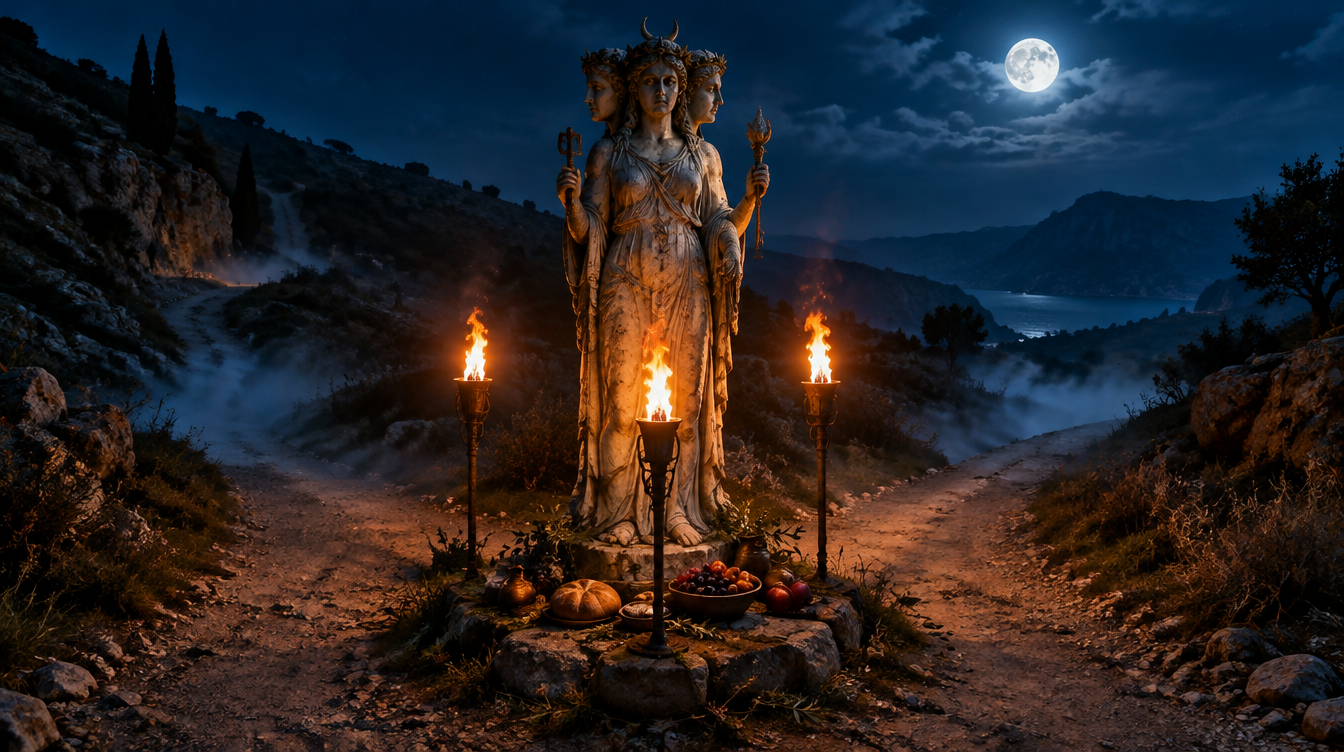
Hecate Goddess of the crossroads has one of the strangest reputations in Greek mythology. Ask ten people who she was, and you will probably get ten different answers: a witch, a ghost-queen, a protector of travelers, a moon goddess, a villain from a Shakespeare play, a patron of magic or a gentle guide who carried a torch into the dark.
The surprising truth is that the ancient Greeks saw her as all of those at once, and as something more. She was powerful, mysterious and widely respected, not just feared. Zeus himself honored her above almost any other minor deity.
So who was Hecate really? Let’s follow her torch and find out.
Table of Contents
Quick Facts
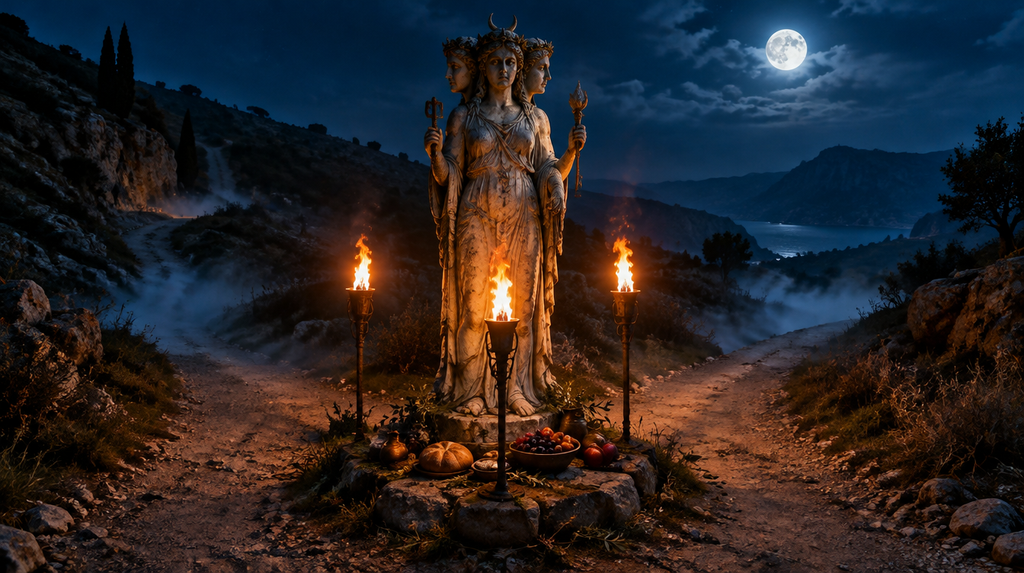
- Domain: crossroads, boundaries, night, torches, magic and the moon
- Symbols: torches, keys, dogs, the moon and the number three
- Parents: Perses and Asteria, in the oldest account
- Famous role: guide of Persephone out of the underworld
- Main home of worship: Caria, in Asia Minor
- Best-known image: a triple-formed statue at a crossroads
Who Was Hecate? The Short Version
Hecate appears in some of the oldest Greek poems. In Hesiod’s Theogony, written around the 8th century BC, she is praised at length as a goddess honored by Zeus above all others. According to the poem, Zeus allowed her to keep her old powers even after the Titans were overthrown, which is unusual, since most Titans lost their influence.
Hesiod says she can grant or withhold success in many parts of life: victory in battle, luck in the assembly, a good catch for fishermen and healthy herds for farmers. In other words, she was not originally a dark figure. She was a universal helper, a goddess of thresholds and turning points.
She was also a little hard to categorize. She was not one of the twelve Olympians, but she was never exactly an outsider either. If you want to see where she sits relative to the major gods, our guide to the 12 Olympian gods lays out the family.
The Goddess Who Carried the Torch
Her most famous myth is also one of the most moving. When Hades carried Persephone into the underworld, her mother Demeter searched the earth for her daughter, day and night. Hecate heard the girl’s cries from her cave, and when Demeter came searching, she told her what she had heard.
Then she did something extraordinary. She took a torch in each hand and joined Demeter in the search. Later, when Persephone was allowed to return to the surface, Hecate went to meet her and guided her back. From then on, she served as Persephone’s companion and attendant in the underworld.
This is why Hecate is so often shown with torches. She is the one who lights the way when everything is dark. If you’d like to read the whole story, our article on Persephone and the origin of the seasons tells it from the beginning.Hecate’s Symbols Explained
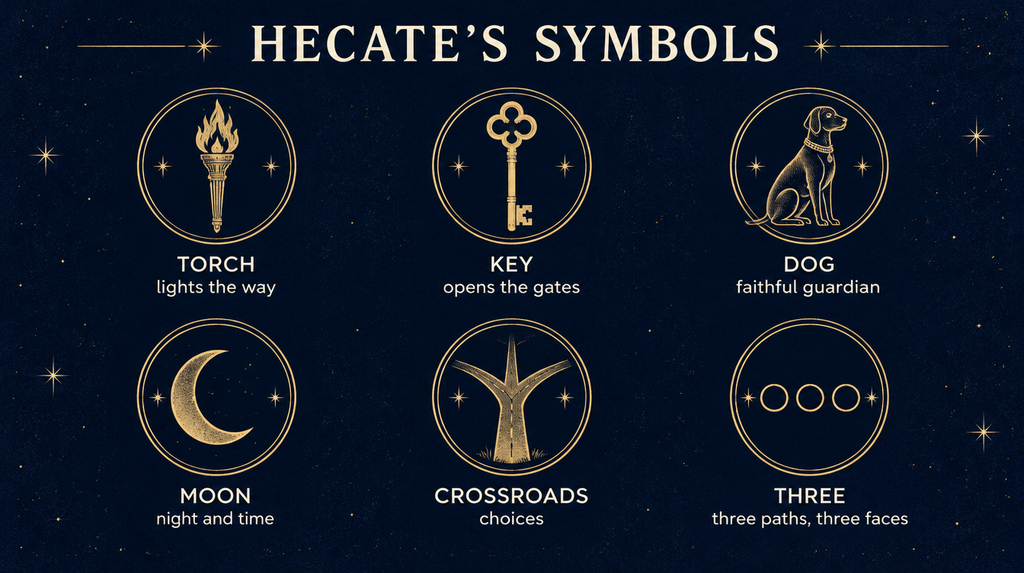
Every Greek god had signature objects. Hecate’s are easy to recognize once you know what they mean.
| Symbol | What It Meant |
|---|---|
| Torches | Lighting the way through darkness, guiding the lost |
| Keys | Opening and closing the gates between worlds |
| Dogs | Loyal guardians, travelers between the living and the dead |
| The moon | The night sky and the turning of months |
| The number three | Three roads, three faces, three phases of time |
| Crossroads | The place of choice, change and spiritual crossing |
Hecate Goddess of the Crossroads: Why Crossroads?
For the ancient Greeks, a crossroads was more than an intersection. It was a place where you had to decide, a place where travelers could meet strangers, and a place where ordinary rules felt less certain. A lonely junction at night was thought to be a spot where spirits might wander.
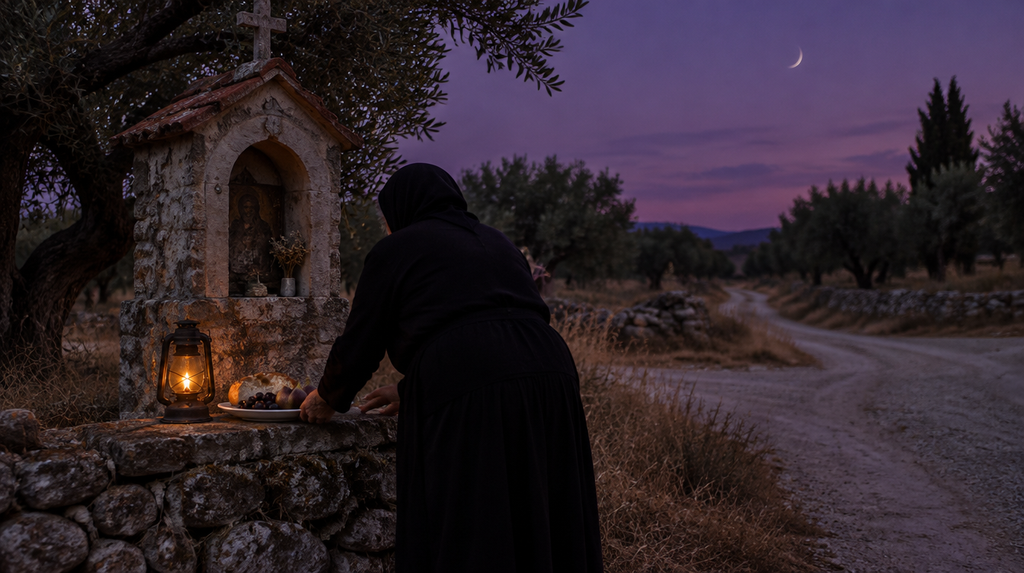
So it made sense to ask for protection there, and Hecate was the protector of such places. People left small offerings of food at the crossroads at the time of the new moon. These were sometimes called “Hecate’s suppers,” meant to honor her and keep restless spirits content.
Statues of Hecate, often shown with three bodies or faces back to back so she could look in every direction, stood at doors and junctions. The Romans called her Trivia, meaning “three roads,” which is where our English word “trivia” comes from.
Is Hecate Evil? Myth vs. Truth
This is the question that follows her everywhere. Let’s take it apart.
| Myth | Truth |
|---|---|
| Hecate was a witch goddess of evil | In early sources, she was a helper and protector honored by Zeus |
| She was always linked to the dead | She was linked to thresholds, which included the passage between life and death |
| Her image was always frightening | Early images show a dignified young woman holding torches |
| She was an outsider among the gods | She was respected and honored, though not one of the twelve |
Over time, especially in later centuries, writers started to emphasize her connection to magic, ghosts and night. By the time of the Roman era, she was often portrayed as a powerful and slightly sinister figure. That later image, rather than the ancient one, shaped her modern reputation.
Hecate and Magic: Where the Witch Image Comes From
The link to witchcraft grew stronger in the late classical and Hellenistic periods. In the epic Argonautica, written in the 3rd century BC, the sorceress Medea calls on Hecate for her magic, and the goddess becomes the patron of her spells.
Later Greek and Roman writers repeated the idea, until Hecate became the mistress of enchantments. By the time Shakespeare put witches on stage in Macbeth, Hecate was waiting in the wings: she appears briefly in the play as the queen of the witches, though scholars debate whether that scene was written by Shakespeare himself.
This is how a goddess of torches turned into a stock figure of Halloween. It’s an interesting case of a reputation changing over two thousand years.A Crossroads at Midnight: What the Ritual Might Have Looked Like
To make it concrete, here is a reconstruction based on ancient descriptions.
The new moon. At the end of the lunar month, a household gathers a simple meal: bread, cheese, eggs and fruit. There are no grand gestures. It is a quiet act of respect.
The walk. A servant or family member carries the food to the nearest crossroads after dark. A torch lights the path, and a dog may trot alongside.
The offering. The food is set down at the junction, and the person leaves without looking back. The idea was that the goddess and the wandering spirits would take what they needed.
The return. The family washes, and the household goes to bed, trusting that the thresholds around them are protected.
It is a small, human ritual. It asks for protection, not power.
Where Was Hecate Worshipped?
Hecate was honored in many places, but her strongest following was in the region of Caria, on the southwestern coast of Asia Minor, today part of Turkey. At a site called Lagina, she had a major temple, with a sacred festival and a priest who served her cult for years.
In Greece itself, she appeared at household shrines, at crossroads and in the great mystery rites at Eleusis, where her role as Persephone’s guide connected her to ideas of death and renewal.
That geography matters. It shows that Hecate may have come from Anatolia, or at least was deeply influenced by traditions there, before spreading across the Greek world. It’s another example of how the Greek pantheon grew by absorbing neighbors rather than staying isolated. For the wider picture of how ideas moved through this region, see our article on Balkan music and Greece, which tells the musical version of the same story.
Hecate, Selene and Artemis: Who Is Who?
Beginners often mix up the three great night-and-moon goddesses. Here is a quick way to tell them apart.
| Goddess | Best Known For | Typical Image |
|---|---|---|
| Hecate | Crossroads, thresholds, torches | Woman with torches, often triple-formed |
| Selene | The moon itself, driving across the sky | Woman with a crescent crowning her head |
| Artemis | The hunt, wild animals, young girls | Huntress with a bow |
In later periods the three were sometimes blended together, which is one reason Hecate Goddess of the night is so often described as a moon deity. In the earliest sources, though, she was a separate figure with her own domain.
Hecate and the Underworld
Because she accompanied Persephone and held keys to the gates, Hecate became linked to the world of the dead. She was never its ruler; that was Hades. But she could cross between worlds more freely than most gods.
You can think of her as a kind of guide or border guard at the edge of the underworld. For a closer look at that realm, read our guide to Hades and the underworld.
Rapid-Fire Questions About Hecate Goddess
Was Hecate a Titan or an Olympian? Neither, strictly. She belonged to the older generation through her parents, but Zeus honored her and let her keep her powers.
Did the Greeks fear her? They respected her. Fear came mostly from later writers who tied her to ghosts and spells.
Why does she have three faces? Because she watched over three-way junctions, and because the number three carried a sense of completeness: past, present and future, or sky, earth and underworld.
Why were dogs sacred to her? Dogs guard doorways and roam at night, so they suited a goddess of thresholds. Some stories also link them to the dead.
Is Hecate worshipped today? Some modern groups honor her, drawing on ancient sources. Historians, however, remind us that the ancient cult was very different from modern practice.
Can you visit her temple? Yes. The ruins at Lagina, near the modern town of Yatağan in Turkey, can still be visited, and the nearby site of Stratonikeia is well worth seeing too.
What is the best single story to read first? The Homeric Hymn to Demeter. It is short, vivid, and shows Hecate at her kindest.
Hecate in Art
Ancient artists showed her in several ways:
- A young woman with two torches, the earliest and most common form
- A triple figure, three women standing back to back, each holding a torch, key or snake
- A woman with dogs, especially in vase painting
- A figure beside the moon, linking her to the night sky
Many of these images survive in museums. If you want to see the triple form, look for small marble and bronze figures in the archaeological collections of Greece and Turkey.
Five Surprising Facts About Hecate
- Hesiod, one of the oldest Greek poets, praised her more than almost any other minor god.
- She was one of the few Titan-generation deities allowed to keep her powers after Zeus took charge.
- The English word “trivia” ultimately comes from the Roman name for her, Trivia.
- She appears in the Eleusinian story as a guide to Persephone, not a villain.
- Her darker reputation grew mainly in later centuries.
Why Hecate Goddess Still Matters
Hecate Goddess of the crossroads lasts because she speaks to something universal. Everyone reaches a crossroads sooner or later: a decision, a change, a night when the road ahead is hard to see. In those moments, the old image of a woman holding a torch is a comfort.
She doesn’t promise that the choice will be easy. She just promises light, one step at a time.

Illustrations in this article were created using AI in a photorealistic style.
Want to hold a piece of this history in your hands? Visit our official shop for digital albums, CDs, and restored vinyl records celebrating the golden era of rebetiko.