
Persephone and the Origin of the Seasons is one of the most quoted Greek myths, and also one of the most simplified in the retelling, its full complexity flattened down to a single, tidy line about why the leaves fall in autumn. Most people know the basic outline: a young goddess is taken to the underworld, her mother’s grief freezes the earth, and a compromise is struck that explains why winter exists. What tends to get lost in that summary is how strange, layered, and genuinely uncomfortable the full story actually is once you look past the tidy seasonal metaphor most textbooks settle for.
Here are seven things about this myth that rarely make it into the shortened, classroom-friendly version, from the political deal struck behind Persephone’s back to the religious movement that grew directly out of her mother’s grief and reshaped Greek religious life for over a thousand years.

1. It Is a Story About a Mother’s Grief as Much as a Story About Seasons
The most-quoted summary of this myth treats the change of seasons as the main event, but the earliest and most detailed surviving source, the Homeric Hymn to Demeter, spends far more time on Demeter’s grief than on any tidy seasonal explanation. After her daughter Persephone disappears while picking flowers, Demeter, goddess of the harvest, searches the earth for nine days without eating, drinking, or bathing, eventually disguising herself as an old woman and wandering in mourning.
Her grief is described in genuinely devastating terms, and it is only once she learns Hades has taken her daughter that her sorrow turns to anger, causing crops across the world to fail entirely, threatening humanity itself with starvation and, by extension, threatening the gods with the loss of the sacrifices and offerings that depended on a living, worshipping human population. Demeter refuses to return to Olympus during this period, instead wandering the earth disguised as an elderly woman and eventually taking a position nursing an infant prince in the city of Eleusis, a detail that later becomes directly tied to the religious rites founded in her honor.
Persephone and the Origin of the Seasons, read this way, is fundamentally a story about a parent’s loss before it is a story about winter, and the seasonal explanation functions almost as an afterthought to a much rawer emotional core. The famine itself is presented not as a natural consequence of the season changing, but as a deliberate act of protest by a goddess powerful enough to hold the entire world hostage to her own mourning, a detail that gives Demeter far more agency in this story than the simplified retellings tend to suggest.
2. The Abduction Was Sanctioned by Zeus Before It Happened
One of the more uncomfortable details often left out of simplified retellings is that Hades did not act alone or in secret, a fact that shifts blame in the story more heavily onto Olympus itself than onto the underworld. According to the Homeric Hymn, Zeus, King of the Gods and Persephone’s own father, agreed in advance to give her to his brother Hades as a bride, without informing Demeter or Persephone herself. Hades’ abduction of Persephone while she gathered flowers in a meadow was carried out with Zeus’s explicit prior approval, making it less a rogue act by Hades and more a family arrangement conducted entirely without the consent of the two people most directly affected.
This detail reframes much of what follows. Demeter’s fury is not simply grief over a disappearance; it is rage at having been deliberately excluded from a decision about her own daughter’s future, made by the most powerful god in the pantheon behind her back, a betrayal that cuts across both her role as a mother and her standing as one of the 12 Olympian gods in her own right. Ancient audiences hearing this detail would have understood it as a genuine political slight, not merely a private family disagreement, since marriage arrangements among ruling families carried enormous weight in how power and territory were understood to be distributed.

3. Pomegranate Seeds Are the Real Reason She Cannot Fully Return
Once Demeter’s grief brings the world to the edge of famine, Zeus intervenes, ordering Hades to release Persephone back to her mother, a reversal that suggests even Zeus recognized the arrangement had gone further than intended once the human cost became impossible to ignore. There is a catch, and it comes down to one small, specific detail: before she leaves the underworld, Persephone eats a handful of pomegranate seeds, offered to her by Hades.
In Greek mythology, eating food from the underworld created a binding tie to that realm, meaning Persephone could no longer return to the world above permanently, a rule that appears in several other Greek myths involving the land of the dead and reflects a broader ancient belief that consuming anything grown or offered in the underworld formed an unbreakable contract with that domain.
Some versions of the myth suggest Hades tricked her into eating the seeds, deliberately offering them at the exact moment Zeus’s messenger Hermes arrived to bring her home, while others leave her motivation ambiguous, raising a question ancient audiences themselves may have debated: was this an act of manipulation, or did some part of Persephone choose to remain connected to her new life as queen of the dead. The pomegranate itself carried loaded symbolism in the ancient world, frequently associated with marriage, fertility, and the irreversible transition from one stage of life to another, making the choice of fruit unlikely to have been accidental on the part of whoever first shaped this detail of the myth.
4. The Number of Seeds Determines How Long Winter Lasts
The specific number of pomegranate seeds Persephone eats varies depending on which ancient source you read, and that number directly determines the length of the season she is required to spend in the underworld each year, turning what looks like a minor culinary detail into the mechanism that literally sets the calendar. Most commonly, later tradition settles on six seeds, corresponding to six months spent below and six months returned to the surface with her mother, though earlier and regional versions cite different numbers, including some accounts describing only three or four months, closer to what many parts of the Mediterranean actually experience as a true dormant season.
This detail matters because it shows the myth was never treated as a single, fixed text even by the ancient Greeks themselves. Different regions and different storytellers adjusted small details, including something as specific as a seed count, to match their own local agricultural calendar and how long their particular growing season actually lasted, whether that meant a shorter, milder winter near the coast or a longer, harsher one further inland.
5. The Myth Became the Foundation of Greece’s Most Important Religious Mysteries
Persephone and the Origin of the Seasons was not simply a story told for entertainment or explanation. It became the founding myth behind the Eleusinian Mysteries, one of the most important and most secretive religious rites in the entire ancient Greek world, held annually near the town of Eleusis outside Athens for well over a thousand years.
Initiates into the Mysteries swore an oath of silence so absolute that almost nothing certain is known today about what actually happened during the ritual itself, despite it being attended by thousands of people annually, including prominent historical figures like Plato and Cicero, both of whom reportedly described the experience as profoundly meaningful without ever revealing its specific contents. The penalty for breaking this oath was reportedly death, a rare instance of a religious secret genuinely being kept for well over a millennium.
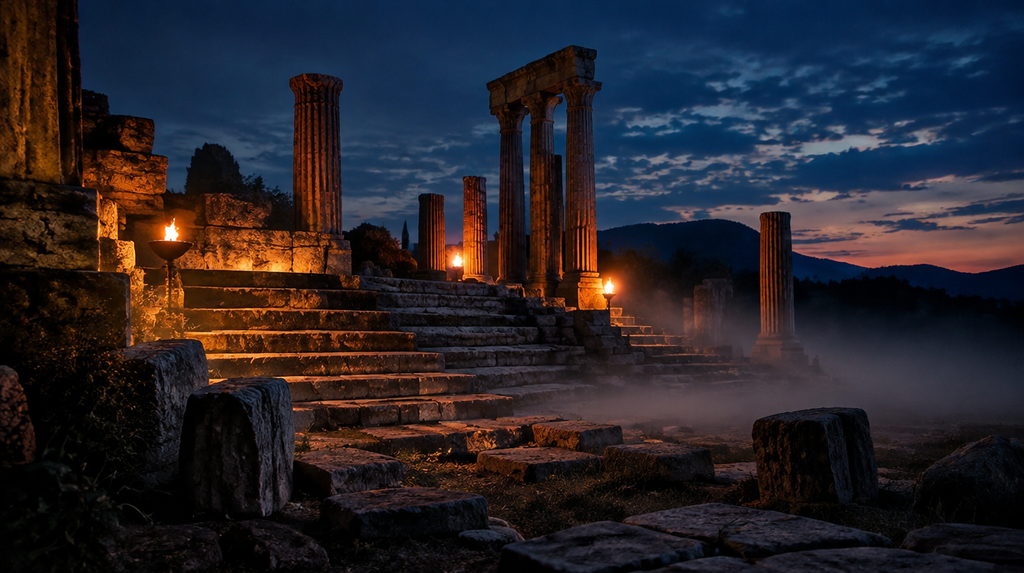
What scholars do know is that the ritual was directly built around Demeter’s search for her daughter and their eventual reunion, and that initiates were promised some form of comfort regarding their own fate after death, tied symbolically to Persephone’s own yearly journey between the underworld and the world above. Surviving fragments and later descriptions suggest the ceremony involved a period of fasting mirroring Demeter’s own grief, a torch-lit procession from Athens to Eleusis along a route still called the Sacred Way, and a final, climactic revelation inside a large initiation hall whose exact contents remain one of the genuine unsolved mysteries of the ancient world.
6. Persephone Becomes Queen of the Underworld, Not Just Its Prisoner
It is easy to read the second half of this myth as Persephone simply being trapped, but later Greek and Roman sources consistently depict her as ruling the underworld directly alongside Hades, not merely existing there as a captive waiting out her sentence each year. She is regularly addressed with the title queen of the dead, and multiple myths depict her exercising real authority in that role, including intervening on behalf of certain figures who plead their case before her at the threshold between life and death.
One notable example comes from the myth of Orpheus, who travels to the underworld to retrieve his dead wife Eurydice and pleads his case directly to Persephone and Hades together, with Persephone frequently credited in various retellings as the one moved to grant his request, softening long enough to allow the couple a chance at reunion even though the attempt ultimately fails. This authority complicates a purely victim-centered reading of her story; whatever the circumstances of how she arrived there, Persephone is consistently portrayed as a genuine co-ruler rather than someone stripped of all power once the abduction concludes, a detail that ancient audiences seem to have found just as compelling as the tragedy of her original abduction.
Later Greek religion also credits Persephone with real judicial authority over the dead alongside Hades, weighing in on the fate of souls arriving in the underworld and occasionally granting exceptions to mortals whose stories moved her, reinforcing that whatever her origins, the myth does not leave her powerless by its end, but instead hands her genuine, lasting authority over one of the most important domains in the entire Greek cosmos.
7. Modern Scholars Read the Myth as More Than a Weather Explanation
While the seasonal explanation is the detail most commonly repeated today, modern classicists and folklorists have proposed several additional layers of meaning behind the story, none of which fully replace the others but each of which adds a different lens for reading the same ancient text. Some read it as a symbolic account of a young woman’s transition into marriage and adulthood in ancient Greek society, where marriages were frequently arranged by fathers without the bride’s input, mirroring Zeus’s arrangement with Hades disturbingly closely, right down to the daughter’s own absence from the negotiation entirely.
Others connect the myth to agricultural cycles more literally tied to grain storage than to weather itself, since seed grain was traditionally stored underground between harvests in parts of the ancient Mediterranean, making Persephone’s descent and return a possible metaphor for the literal planting and sprouting cycle of grain rather than a general explanation of winter and summer. This reading fits neatly alongside Demeter’s identity specifically as a grain goddess rather than a generalized nature deity, since the timing of Persephone’s descent in several ancient sources lines up more closely with the Mediterranean planting calendar than with the arrival of cold weather itself, a technical detail that rarely survives into modern, simplified retellings of the myth.
Neither reading cancels out the other, and most scholars now treat Persephone and the Origin of the Seasons as a myth operating on several symbolic levels simultaneously, rather than existing solely as an ancient explanation for why leaves fall in autumn. What makes the story durable enough to survive nearly three thousand years of retelling is arguably this same layered quality: a grieving mother, a politically arranged marriage, an agricultural calendar, and a promise about the afterlife, all folded into a single narrative simple enough for a child to follow and rich enough for philosophers to spend a lifetime interpreting.
For more on the family Persephone belonged to, our guide to the 12 Olympian Gods and our closer look at Zeus, King of the Gods cover the wider divine politics behind her story. For further reading, Wikipedia’s entries on Persephone and the Eleusinian Mysteries offer detailed background on the ancient sources discussed here.

Illustrations in this article were created using AI in a photorealistic style.
Want to hold a piece of this history in your hands? Visit our official shop for digital albums, CDs, and restored vinyl records celebrating the golden era of rebetiko.