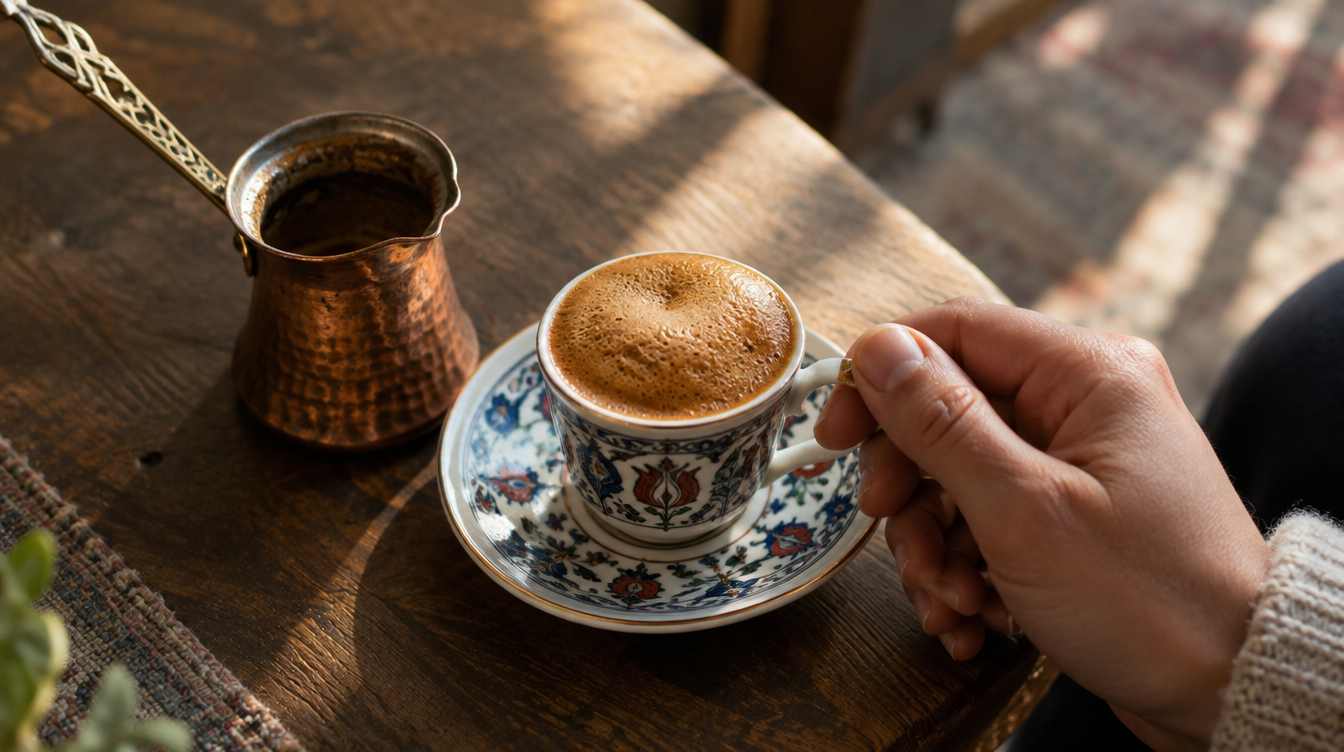
Greek Coffee isn’t just a drink. It’s a whole social event compressed into a tiny cup, thick, strong, and slow enough that finishing it fast basically defeats the point of ordering one in the first place. Order one anywhere in Greece and you’re signing up for at least twenty minutes at that table, whether you meant to or not, and probably closer to an hour once the conversation actually gets going.
Here’s where it actually comes from, why there’s mud at the bottom of the cup on purpose, and how to actually make it right at home without any fancy equipment or espresso machine getting involved.
Table of Contents
Where Did Greek Coffee Actually Come From?
Let’s address the elephant in the room first: Greek coffee, Turkish coffee, and Cypriot coffee are, brewing-method-wise, nearly identical to one another, right down to the exact same pot and technique used to make each one. All three trace back to the same Ottoman-era tradition of boiling finely ground coffee directly in water, no filter, no machine, just a small pot and a bit of patience.
The name is more about identity than technique. After centuries of Ottoman rule and plenty of political tension since, Greeks understandably wanted their own name for a drink they’d been making the same way for generations. So “Greek coffee” it became, and calling it anything else in the wrong company can still spark a surprisingly passionate debate, especially among older generations who lived through decades of tension over the name itself.
Greek Coffee vs. Frappé vs. Freddo (They’re Not the Same Thing)
Walk into any modern Greek cafe today, and you’ll actually see far more frappé and freddo orders than traditional Greek coffee, which surprises a lot of first-time visitors expecting the little copper pot everywhere they look.
Frappé, the foamy, iced instant-coffee drink, was invented completely by accident in 1957 at a trade fair in Thessaloniki, when a Nescafé employee couldn’t find hot water and improvised with a shaker, cold water, and ice instead, mixing the instant coffee vigorously enough to build that now-iconic thick foam layer on top. It became a national obsession almost overnight and remains one of Greece’s most popular everyday drinks, especially in the summer heat, when a hot cup of anything sounds like the last thing anyone wants.
Freddo espresso and freddo cappuccino, cold, foamy espresso-based drinks, are newer still, gaining massive popularity over the last couple of decades and now arguably outselling traditional Greek coffee among younger generations entirely, especially in the bigger cities where a quick grab-and-go order fits the pace of everyday life better than a slow, seated ritual.
Traditional Greek coffee hasn’t disappeared, though. It’s simply shifted into more of a slower, deliberate ritual, something ordered specifically for a long conversation or a quiet morning at home, rather than a quick daily caffeine fix grabbed on the way to work like frappé or freddo tend to be.
The Pot Matters More Than You’d Think
Greek coffee is brewed in a small, long-handled pot called a briki, narrow at the top, wider at the base, specifically shaped to help that prized foam form and hold rather than collapse back into the liquid. No filter, no pressure, no machine involved at any point in the process. Finely ground coffee, water, and sometimes sugar all go in together from the very start, cold, and heated slowly rather than added to already-hot water.
How to Actually Make It
Here’s the process, no special equipment required beyond a simple briki, which costs almost nothing and lasts essentially forever with basic care.
- Add one heaping teaspoon of finely ground coffee per cup into the briki, along with cold water, roughly one small cup’s worth per person, using the actual coffee cup itself to measure the water for the most accurate ratio.
- Add sugar now if you’re using it, never later, since it needs to dissolve while the coffee brews rather than getting stirred in afterward once the grounds have already settled.
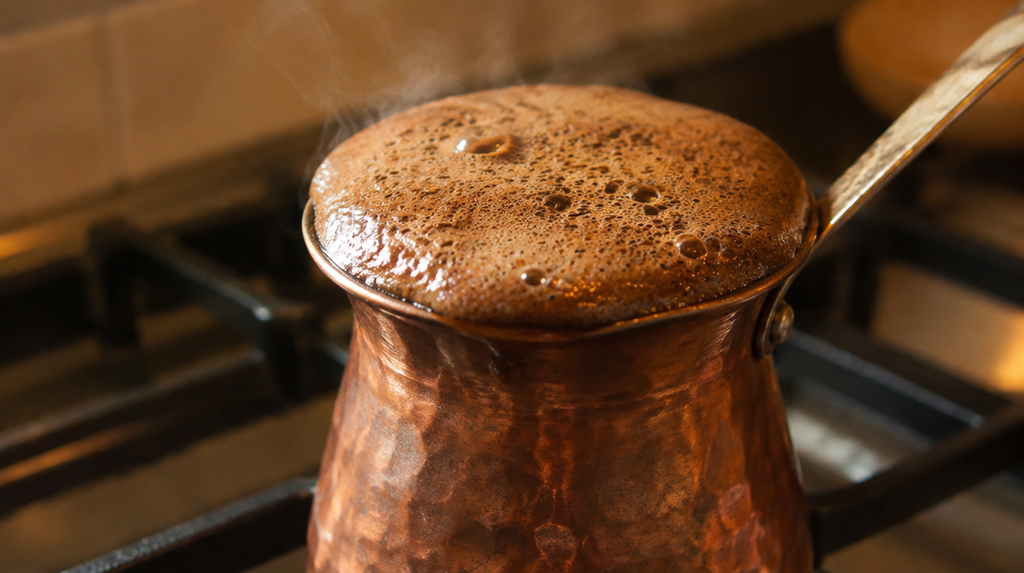
- Set the pot over low heat and don’t walk away. This is not a “start it and forget it” situation, and even thirty seconds of distraction can mean the difference between a perfect cup and a boiled-over mess on the stovetop.
- Watch closely as foam starts rising toward the rim, slowly at first and then surprisingly fast in the final few seconds. The second it’s about to overflow, pull it off the heat immediately.
- Pour slowly and gently, aiming to distribute that foam evenly across each cup rather than dumping it all into one lucky recipient’s cup and leaving everyone else foam-less.
- Let it sit for a minute before drinking, allowing the grounds to settle toward the bottom of the cup rather than staying suspended throughout.
That’s genuinely it. The whole process takes maybe five minutes, and most of the skill is just paying attention at the right moment rather than following any complicated technique.
Buying Your First Briki
A good briki costs surprisingly little and, if you take care of it properly, lasts essentially forever, often getting passed down from one generation to the next rather than replaced. A few things worth knowing before buying one, since not every briki on the shelf is created equal:
- Size matters more than most people expect going in. A briki is sized for a specific number of cups, and using one that’s too large for a single serving makes it much harder to build proper foam, since there’s simply too much surface area relative to the liquid for the foam to hold together.
- Copper and brass versions look beautiful sitting on a stovetop and conduct heat evenly, but stainless steel is easier to maintain long-term and won’t tarnish over time, making it the more practical choice for daily use rather than display.
- A narrow spout matters quite a bit for pouring, since it lets you control exactly how much foam lands in each individual cup rather than losing it all to one lucky recipient at the table.
Most households actually own two or three brikis in different sizes, since making coffee for one person requires a genuinely different pot than making it for a full table of four or five guests.
The Sugar Question (It’s Not Optional to Specify)
Ordering Greek coffee without specifying a sugar level is basically asking for trouble at any traditional cafe. There are three standard options, and getting this wrong means an unexpectedly bitter or shockingly sweet cup with no way to fix it after the fact.
- Sketos: no sugar at all, straight and strong
- Metrios: medium sugar, the most commonly ordered option
- Glykos: sweet, sometimes very sweet, not for the faint of heart
There’s technically a fourth option too, varyglykos, extra sweet, mostly ordered by people with a serious sweet tooth or a rough morning ahead of them. Some regions and older generations also recognize a fifth, even sweeter variant reserved for special occasions and holidays, though it’s rare enough these days that most younger baristas won’t recognize the term if you actually try ordering it.
Getting the sugar order wrong isn’t a small mistake either. Since the sugar goes in at the very start of brewing rather than being stirred in afterward, there’s no fixing a cup that comes out too sweet or too bitter once it’s made. Ordering “just coffee” without specifying a sugar level, especially with an older host or barista, will usually get you a raised eyebrow and a polite request to clarify before they start.
Don’t Drink the Bottom of the Cup
This trips up almost every first-timer. Greek coffee is unfiltered, meaning the fine grounds settle at the bottom rather than getting strained out during brewing the way most other coffee methods handle it. Drinking straight through to the bottom means a mouthful of gritty sediment, not a pleasant surprise for anyone expecting the cup to be entirely liquid all the way down.
Reading the Cup: Fortune-Telling in the Grounds
Once the cup is finished and flipped upside down onto its saucer to cool and drain, something genuinely fun happens in a lot of Greek households: cup reading, or tasseography. The leftover grounds form patterns inside the cup as they dry, and older generations in particular still take genuine pleasure in interpreting them, shapes that might suggest travel, money, love, or warnings worth paying attention to, all pulled from what is essentially wet coffee residue drying into random shapes.
Nobody’s claiming this practice is scientifically rigorous in any way. It’s closer to a fun, low-stakes tradition passed between generations than a serious divination practice, the kind of thing a grandmother does half-jokingly and half-seriously at the same time, usually to great entertainment for everyone else sitting at the table.
A few common shapes carry semi-standard meanings across different households, though interpretations vary wildly depending on who’s actually doing the reading that day.
- A shape resembling a bird often gets read as good news arriving soon, while a shape resembling a snake tends to carry a more cautionary meaning instead
- A ring or circle shape sometimes points toward an engagement or a wedding somewhere on the horizon, particularly welcome news among older relatives at the table
- A cross shape can be read either as a warning or as spiritual protection, depending entirely on the reader’s mood and interpretation that particular day, with no fixed rule either way
- Scattered, unclear patterns usually just get waved off with a laugh and a casual “we’ll see,” rather than any confident prediction about what’s actually coming next
The whole practice works best when treated exactly as it’s intended: a bit of fun stretched out over the last few minutes of a coffee visit, not a genuine window into anyone’s actual future.
Why It’s Really a Social Ritual, Not Just a Drink
Here’s what separates Greek coffee from a quick espresso shot at a counter: nobody drinks it standing up, and nobody drinks it fast. It’s slow by design, sipped over a long, unhurried conversation that can stretch well past the point the cup is actually empty.
Cafes across Greece are built entirely around this pace, tables meant for lingering, not turning over quickly for the next customer waiting outside. Ordering a Greek coffee is less “I need caffeine” and more “I have time to sit here for a while,” and treating it like a quick to-go order misses most of the point entirely.
How Strong Is It, Really?
People often assume Greek coffee must be a caffeine bomb given how thick and intense it looks sitting in the tiny cup. The reality is a little more nuanced than the appearance suggests. Because it’s unfiltered and finely ground, a single cup packs a genuinely strong, concentrated flavor, but the actual serving size is small, usually just a few ounces, meaning the total caffeine content per cup lands somewhere close to a single shot of espresso rather than dramatically exceeding it.
What makes it feel stronger is really the drinking experience itself: no milk diluting the flavor, no large volume to sip through slowly, just a small, intense, unfiltered hit of coffee flavor concentrated into a handful of sips. That intensity, more than the actual caffeine number on paper, is usually what catches first-timers off guard and leaves them assuming it’s far stronger than it technically measures out to be.
For more Greek food and drink traditions worth knowing, our pieces on the authentic Greek salad and tzatziki recipe cover other staples of a proper Greek table. For further reading, Wikipedia’s entry on Greek coffee covers its regional history in more detail.

Illustrations in this article were created using AI in a photorealistic style.
Want to hold a piece of this history in your hands? Visit our official shop for digital albums, CDs, and restored vinyl records celebrating the golden era of rebetiko.