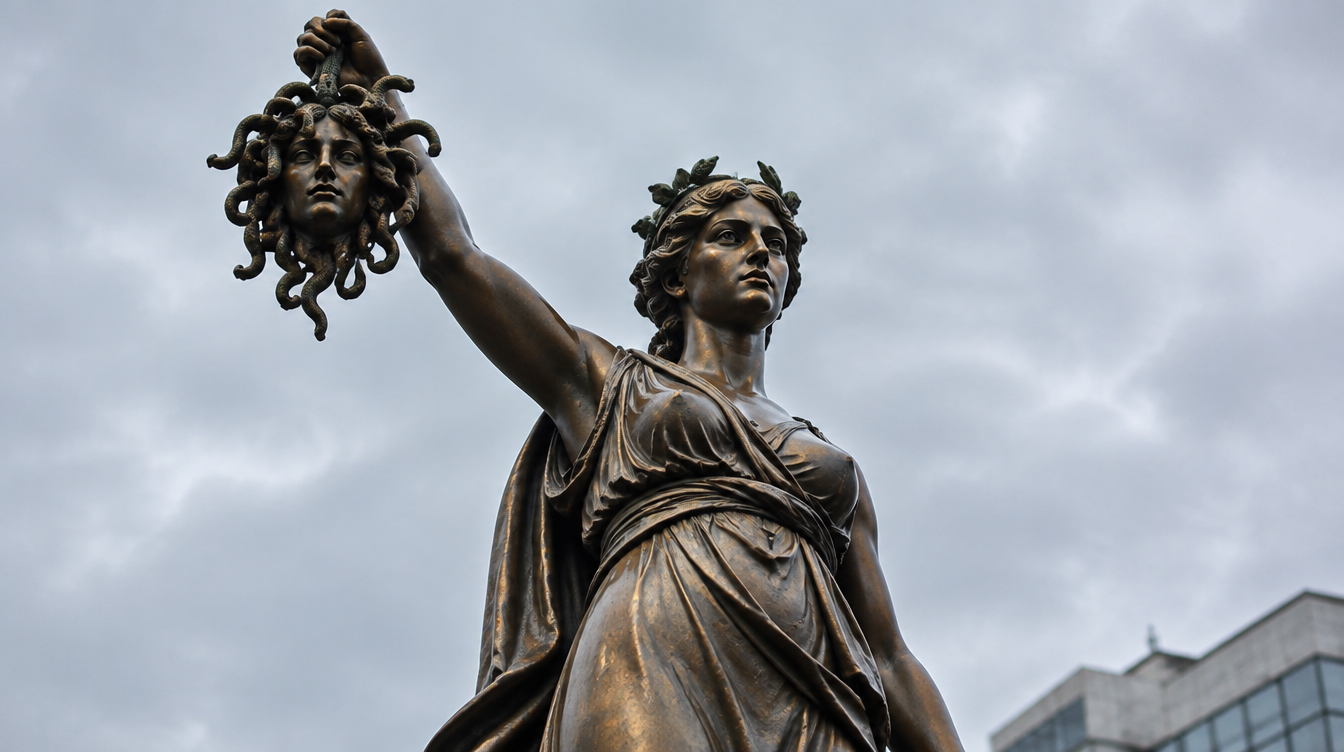
Medusa Victim or Monster is a question that would have genuinely puzzled the earliest Greeks who told her story. To them, she was neither exactly. She was a protective symbol, a face carved onto shields and temple doors specifically because it was terrifying enough to ward off evil. The idea that Medusa might deserve sympathy, that she could be read as a survivor rather than a threat, is a much newer interpretation, and understanding how we got from one version to the other says a lot about how myths change to fit the values, and the anxieties, of whoever happens to be retelling them.
This article traces Medusa’s story across three distinct eras: the earliest Archaic Greek understanding of her as a pure protective monster, the later Roman retelling that first introduced her tragic backstory, and the modern reading that has turned her into one of mythology’s most reclaimed and debated figures.
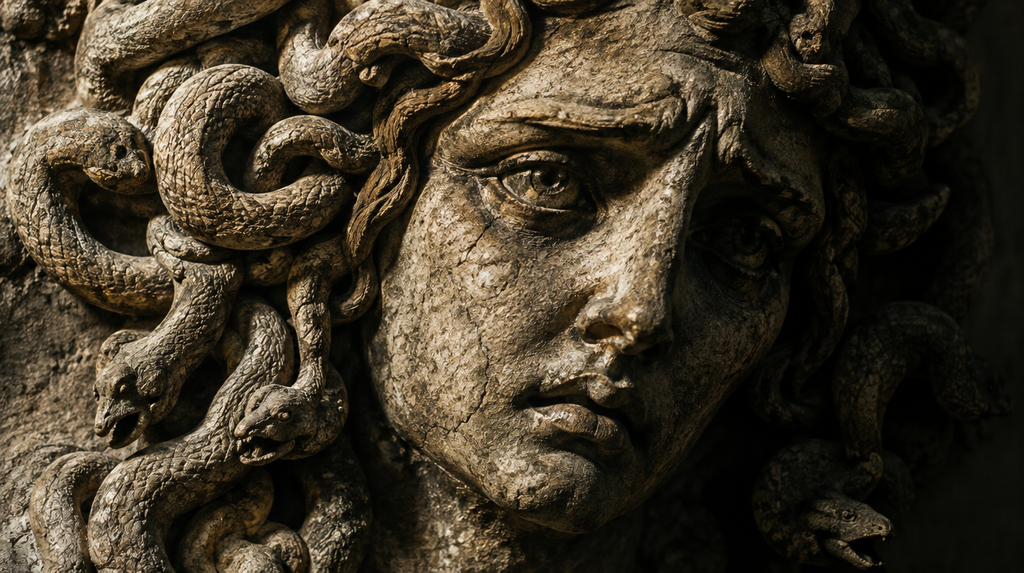
The Gorgon Everyone Recognizes
Most people know the basic shape of Medusa’s story even without knowing where it came from: a woman with living snakes for hair, a gaze that turns anyone who meets it to stone, eventually beheaded by the hero Perseus, who used her severed head as a weapon before it was mounted on Athena’s shield, the aegis. This is the version that shows up in modern films, video games, and retellings, and it captures the ending of her story without much interest in how she got there in the first place.
What most popular retellings skip entirely is that Medusa’s story changed dramatically over the roughly thousand years separating the earliest Greek sources from the version most people know today, and each version reflects very different ideas about what she actually represented.
How Perseus Actually Killed Her
The beheading itself, the part of the story most people already know, involved considerably more divine assistance than popular retellings usually mention. Perseus was sent to retrieve Medusa’s head as part of a nearly impossible task assigned by King Polydectes, who wanted Perseus out of the way so he could pursue Perseus’s mother. To survive the mission, Perseus received help from multiple gods: winged sandals from Hermes, a reflective bronze shield from Athena, a cap of invisibility from Hades, and a curved sword from Hephaestus.
The reflective shield was the key to the entire plan. Rather than looking at Medusa directly, which would have turned him instantly to stone, Perseus approached her while watching only her reflection in the polished bronze surface, allowing him to strike accurately without ever meeting her petrifying gaze directly. According to most versions of the myth, Medusa was asleep when he found her, meaning the famous beheading was less a dramatic face-to-face confrontation than an ambush carried out entirely through a mirror, a detail that complicates the traditional framing of Perseus as a straightforwardly heroic figure.
What happened immediately after her death is often left out of modern retellings entirely, but it directly ties back to the assault described in Ovid’s version. From Medusa’s severed neck sprang two beings she had been carrying since Poseidon’s assault: the winged horse Pegasus and a warrior named Chrysaor. Their sudden appearance at the moment of her death is one of the more striking details connecting the tragic Ovidian backstory to the older, more action-focused Perseus narrative, since it implies Medusa’s death and her earlier assault were never entirely separate stories, even in versions that otherwise treat her purely as a monster to be defeated. It is a detail easy to skip over in a fast-paced retelling, yet it quietly links the two halves of her myth that popular culture usually keeps apart.
Medusa’s Legacy in Art Across the Centuries
Medusa’s image has remained a favorite subject for artists for roughly 2,700 years, and the way she has been depicted has shifted almost as dramatically as the written myth itself. Renaissance and Baroque artists were especially drawn to the moment of her death. The Italian painter Caravaggio produced a famous depiction around 1597, painting Medusa’s severed head at the instant of decapitation, mouth open in a scream, snakes still writhing, mounted onto an actual shield rather than a flat canvas, a choice that put the viewer directly in the position of Perseus holding the trophy aloft. The sculptor Benvenuto Cellini created an enormous bronze statue of Perseus triumphantly holding Medusa’s head, still standing today in Florence’s Piazza della Signoria, celebrating the hero’s victory with no particular sympathy extended toward his victim, her body famously depicted slumped beneath his feet.
For centuries, these victory-focused depictions dominated Medusa’s visual legacy, treating her death as a triumphant conclusion rather than a tragedy. It is only in the last several decades that artists have begun consistently depicting her from the opposite angle, emphasizing her suffering, her assault, or, as in Garbati’s more recent sculpture, her triumph over the man who killed her rather than the reverse. This shift in artistic focus mirrors almost exactly the same reevaluation happening in how the written myth itself gets interpreted and retold, suggesting that the visual arts and the written tradition have moved through this reassessment together rather than one simply following the other.
Then: The Archaic Gorgon, a Protector, Not a Victim
In the earliest surviving Greek art and literature, dating back to the eighth and seventh centuries BCE, Medusa’s face, known as the Gorgoneion, appears constantly, but almost never as part of a narrative about her suffering. Instead, her wide-eyed, snarling image was carved onto temple pediments, painted onto shields, and mounted above doorways specifically because it was believed to frighten away evil spirits and enemies.
This apotropaic use, meaning an image meant to ward off harm through its own frightening power, treated Medusa’s monstrous face as a tool rather than a tragedy. She was not a character with an inner life in this earliest tradition; she was closer to a symbol, similar to how a gargoyle functions on a medieval cathedral, positioned to intimidate rather than to invite reflection on her own story. The question of whether Medusa deserved her fate simply was not part of how the earliest Greeks engaged with her image. She was useful precisely because she was terrifying, full stop.
Then: Hesiod’s Gorgon Sisters, Monstrous From Birth
The poet Hesiod, writing in the Theogony around the seventh century BCE, gives Medusa an actual genealogy for the first time. She is described as one of three Gorgon sisters, daughters of the ancient sea deities Phorcys and Ceto, monstrous beings from a much older, pre-Olympian generation of gods. Unlike her sisters Stheno and Euryale, who were immortal, Medusa alone was mortal, which is ultimately why Perseus was able to kill her at all.
In this early literary tradition, there is no assault, no punishment, and no transformation from beauty to monstrousness. Medusa is simply born a Gorgon, monstrous by nature rather than by circumstance, in the same way her sisters were. This version treats her fate as fixed from birth rather than something that happened to her, a framing worth remembering because it stands in such sharp contrast to the version that would eventually become far more famous, and which most people today assume was always the original story.
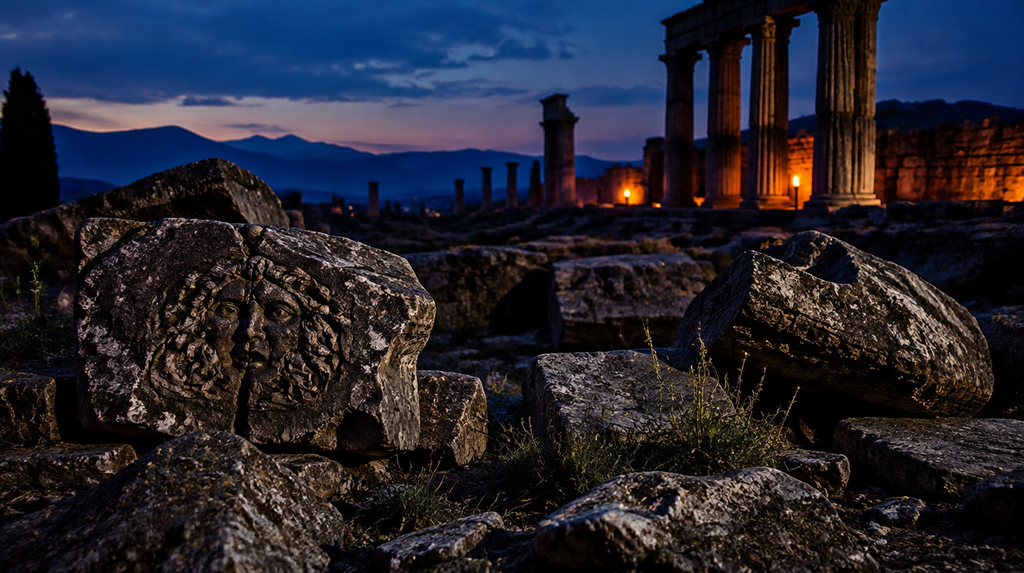
The Turn: Ovid’s Metamorphoses and the Birth of Medusa’s Tragedy
The version of Medusa most people recognize today, the one with a tragic backstory, comes almost entirely from a single source: the Roman poet Ovid, writing roughly seven hundred years after Hesiod, in his epic poem Metamorphoses. Ovid’s account, composed for a Roman audience rather than a Greek one, introduced a dramatically different origin story that had never appeared in earlier Greek sources.
In Ovid’s telling, Medusa was once a beautiful young priestess serving in Athena’s temple, renowned above all for her stunning hair. Poseidon, struck by her beauty, assaulted her inside the temple itself, a violation of sacred space that Athena, in Ovid’s account, chose to punish not by confronting Poseidon but by transforming Medusa. Her famous hair became a mass of living snakes, and her gaze was cursed to turn anyone who looked at her directly to stone.
This is the version responsible for the entire “Medusa Victim or Monster” debate, because it is the first time any source suggests Medusa did not simply start out as a monster. She became one, and specifically because of something done to her rather than something she chose or was born into. Ovid’s framing shifted the emotional center of the story dramatically, even if his own poem does not necessarily dwell on the injustice of Athena punishing the victim rather than the perpetrator, a detail that later readers would end up focusing on far more than Ovid himself seems to have intended.
Now: Why Modern Readers See Medusa Differently
Ovid’s version sat relatively quietly within the broader mythological tradition for centuries, often overshadowed by the more action-driven Perseus narrative that treats Medusa primarily as an obstacle to be defeated. That changed significantly in recent decades, as modern readers, particularly following renewed public conversations around sexual assault and how survivors are treated, began revisiting Ovid’s account and asking pointed questions about who actually deserved punishment in that story.
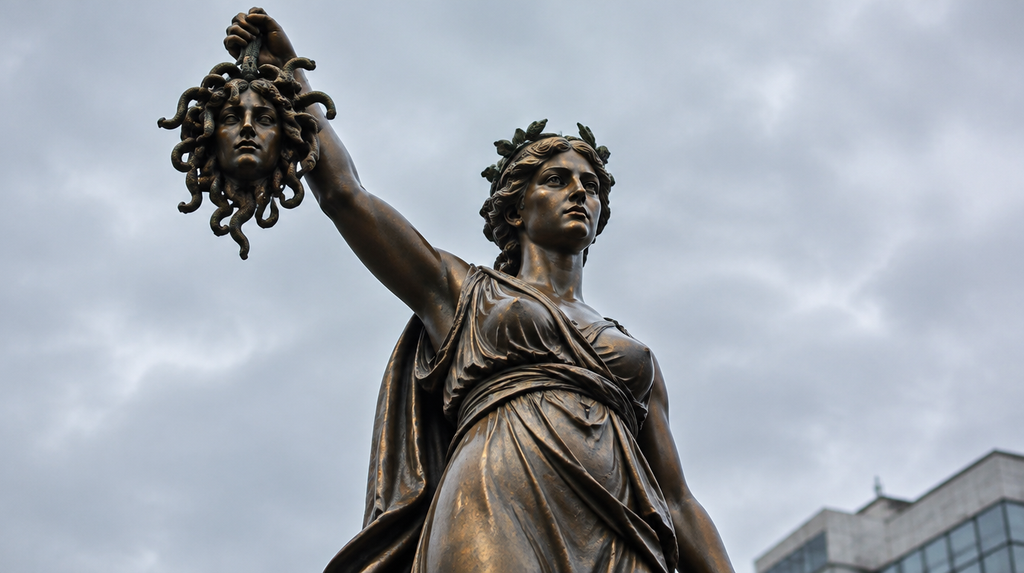
This modern reading treats Medusa less as a monster to be feared and more as a survivor failed twice over, first by Poseidon’s assault, and then by Athena’s decision to punish the victim rather than the person responsible for the crime, a pattern many modern readers recognize uncomfortably well from more recent, real-world accounts of how survivors are sometimes treated. Artists have engaged with this reinterpretation directly. Perhaps the most widely discussed example is Luciano Garbati’s sculpture “Medusa With the Head of Perseus,” which inverts the traditional imagery by depicting Medusa standing triumphant, holding the severed head of her killer rather than the other way around. Installed near a courthouse in Manhattan in 2020, the statue was widely interpreted as a direct commentary on the MeToo movement and on how survivors of assault are so often treated as the guilty party, a reading Garbati himself has openly acknowledged shaped the sculpture’s creation.
Victim or Monster? Why the Question Itself May Be the Wrong One
Part of what makes the Medusa Victim or Monster framing so persistent is that both readings are, in a sense, historically accurate, just to different periods of the myth’s long life. The earliest Greeks who carved her face onto their shields were not thinking about consent or punishment; they were thinking about protection and fear as a practical religious tool. Ovid, writing centuries later for an entirely different culture, introduced the tragic backstory that modern readers have since picked up and run with, using it to say something meaningful about how societies have historically treated survivors of assault.
Neither version is more “authentically Greek” than the other in any simple sense, since myths were never static texts with one fixed meaning even in antiquity. What changed was which version of Medusa’s story different generations found useful to tell, and why. The apotropaic Gorgon protected doorways. Hesiod’s monstrous Gorgon explained a strange creature’s place in the cosmic order. Ovid’s wronged priestess gave later readers, particularly modern ones, language for something the earlier tradition never directly addressed: the specific injustice of being punished for someone else’s crime.
Rather than trying to settle the debate permanently in one direction, it may be more useful to treat the different versions of Medusa as a kind of timeline of how one culture after another has used the same striking image to say something different about fear, punishment, and who gets to be seen as sympathetic. That layered history, spanning apotropaic doorway carvings, epic poetry, Baroque paintings, and a modern bronze statue outside a Manhattan courthouse, is arguably more interesting than any single, final answer to whether she was a victim or a monster.
For more on the goddess at the center of Ovid’s version of this myth, our coverage of Athena vs Poseidon explores the wider mythological relationship, often contentious, between these two gods. For primary background on the literary sources discussed here, Wikipedia’s entries on Medusa and Ovid’s Metamorphoses offer detailed overviews of how the myth developed across different eras.
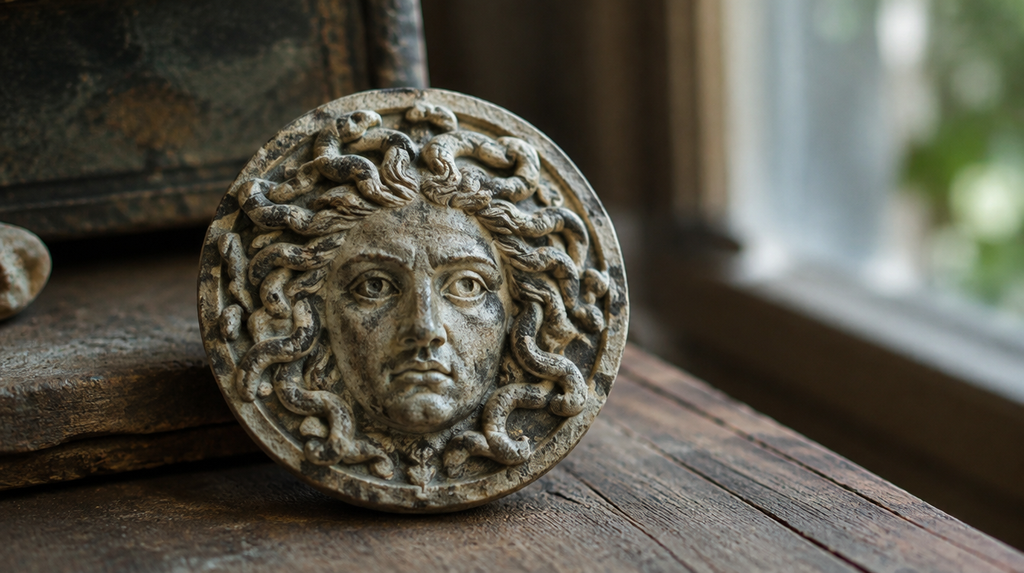
Illustrations in this article were created using AI in a photorealistic style.
Want to hold a piece of this history in your hands? Visit our official shop for digital albums, CDs, and restored vinyl records celebrating the golden era of rebetiko.