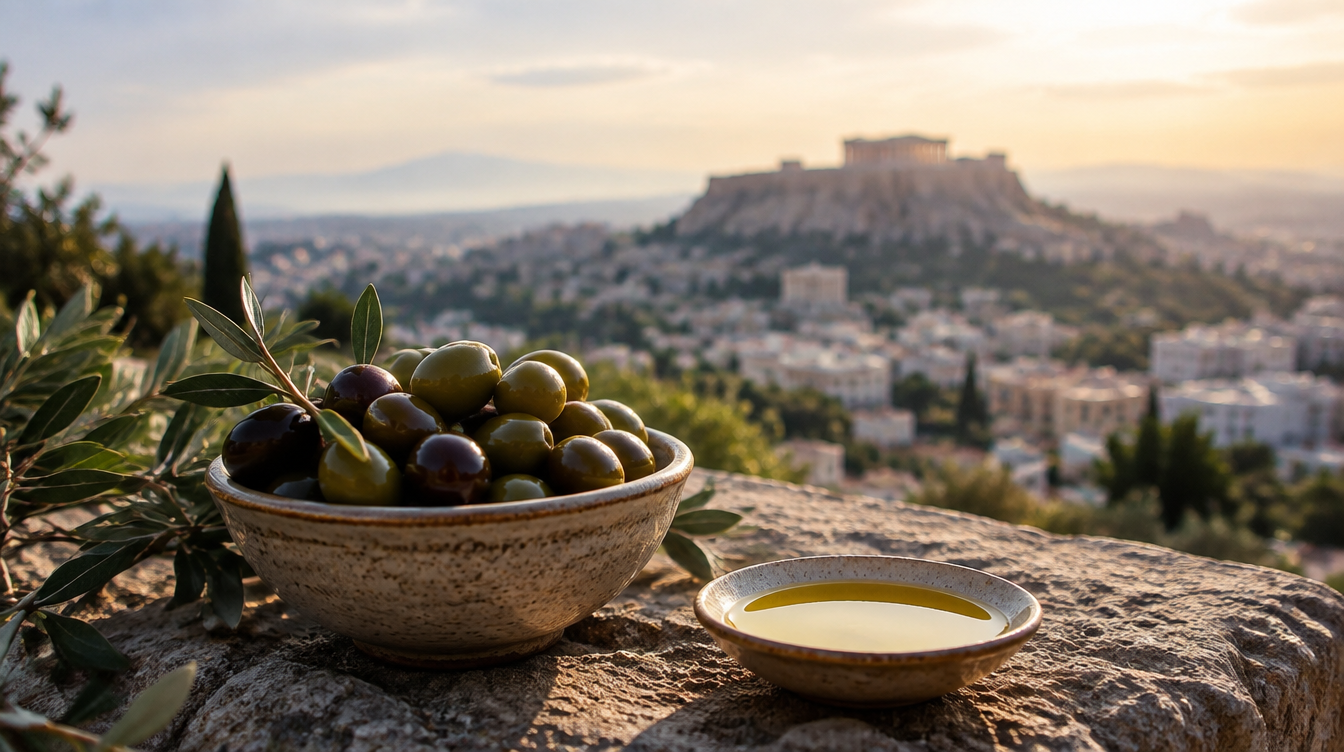
Athena vs Poseidon is not just the title of a myth. It is, in a very real sense, the founding story of one of the most influential cities in human history. Long before Athens had a democracy, a navy, or a Parthenon, its citizens told a story about the day two of the most powerful gods on Olympus stood on a rocky hill and competed for the right to be its patron. The loser did not simply walk away. According to some versions of the myth, his fury at losing reshaped how the winning side would be allowed to participate in civic life for centuries afterward, turning what could have been a light origin tale into one of the more politically loaded myths to survive from the ancient world.
This is the story of that contest, what each god offered, why the choice mattered so much to the people who told it, and how the echoes of Athena vs Poseidon still shape the way visitors understand the Acropolis today, thousands of years after the last citizen who genuinely believed it happened as described.

A City Without a Name
Before it was Athens, the story goes, the city on this stretch of Attic coastline had no settled patron and, in some versions, no fixed name at all. Its first king, Cecrops, is described in myth as half-man and half-serpent, a native-born ruler tied directly to the soil of Attica rather than descended from some other divine or royal line. It was during his reign that two Olympians, Poseidon and Athena, both decided they wanted to be the city’s protector.
Rather than fighting outright, a decision that would have suited Poseidon’s temperament far better than Athena’s, the two agreed to settle the matter through a contest of gifts. Whoever offered the city something more valuable would win the right to have it named in their honor and to serve as its eternal patron. Cecrops, or in some tellings the full assembly of citizens, would judge the outcome.
Poseidon’s Gift: Power From the Depths
Poseidon went first. Standing on the rock that would later become the Acropolis, he struck the stone with his trident, and where the blade landed, a spring burst forth. In most versions, this was not fresh water but seawater, salty and undrinkable, a literal demonstration of Poseidon’s dominion over the sea delivered directly into the heart of the city he hoped to rule.
Some later versions of the myth soften this into a horse springing from the rock instead of, or alongside, the saltwater spring, tying Poseidon’s gift to his other major domain as god of horses. Either way, the underlying message was the same: Poseidon offered raw power, naval strength, and the promise of a city with access to the might of the sea, an offer that would have been enormously appealing to a coastal settlement that depended on maritime trade and defense.
Athena’s Gift: Something the City Could Actually Use
Athena’s turn came next, and her approach was almost the opposite of theatrical. She knelt and planted something small into the rocky soil: an olive tree. To modern eyes, it might look like an unimpressive follow-up to a geyser of seawater or the sudden appearance of a horse. To the people voting on this contest, it was nothing of the kind.
The olive tree offered food, oil for cooking and lamps, wood for building, and a durable crop that could sustain a household and be traded for generations. Unlike Poseidon’s saltwater spring, which was undrinkable and largely symbolic, Athena’s gift was immediately, practically useful, and it promised prosperity that would compound over time rather than a single dramatic display of force.
Cecrops, weighing the two offerings, judged the olive tree the more valuable gift, and Athena was declared the winner. The city took her name, and that olive tree, according to local tradition, continued growing on the Acropolis for centuries afterward, tended as a sacred relic long after the mythological contest itself had passed into legend.
Different Storytellers, Different Details
Like most Greek myths, the contest between Athena and Poseidon was not preserved in a single, fixed version. The Roman scholar Varro, writing centuries after the myth first circulated in Greece, is the source most often credited with recording the detailed vote-and-flood version involving the citizens and their wives. Earlier Greek sources, including passing references in the historian Herodotus, treat the contest more briefly, focused mainly on the judgment itself rather than any civic fallout that followed it.
This kind of variation was normal in Greek religious storytelling. Different city-states, and even different generations within the same city, adjusted myths to emphasize whatever lesson or explanation mattered most to them at the time. Athens, a city that took enormous pride in its own uniqueness and its self-image as the intellectual center of the Greek world, had every incentive to keep retelling and reshaping the story of Athena vs Poseidon as a founding myth that justified its values, its name, and eventually its political structures.
The Contest’s Place in Athenian Civic Life
The memory of Athena vs Poseidon was not confined to temple architecture. It was woven into the city’s calendar of public religious life through the Panathenaic Festival, the most important civic and religious celebration in ancient Athens, held annually with a much grander version every four years. The festival honored Athena’s birthday and, by extension, her patronage of the city won through the very contest described in this myth.
During the festival, a new robe, woven specifically for a wooden statue of Athena believed to be extremely ancient, was carried in procession from the city gates up to the Acropolis, along a route still referred to today as the Panathenaic Way. Livestock sacrifices, athletic competitions, and musical contests filled out the celebration, all ultimately tracing their symbolic origin back to the single moment Cecrops chose an olive tree over a saltwater spring. In this sense, the myth was not simply a story Athenians told about their past; it was actively performed and renewed every year through public ritual, keeping the outcome of that ancient contest central to how the city understood its own identity.

The Vote That Changed Everything
The most striking version of this myth, recorded by the Roman-era writer Augustine and attributed to earlier Greek sources, adds a detail that turns Athena vs Poseidon from a simple contest into a story about political consequence. In this telling, the decision was not made by Cecrops alone but by a vote among the city’s citizens, and crucially, women were allowed to participate in that vote alongside men.
The women, so the story goes, outnumbered the men and voted overwhelmingly for Athena, securing her victory. Poseidon, furious at the loss and specifically at having been defeated by a vote that included women, flooded the plain of Attica in retaliation. To calm his anger and prevent further disaster, the men of the city are said to have stripped women of several civic privileges as a form of appeasement, including, in this telling, the right to vote and the right to pass their name down to their children.
Whether or not this version reflects a real historical shift in Athenian civic life, later Athenian democracy is well documented as having excluded women from formal political participation entirely, and this myth offered one culturally resonant explanation for that exclusion: not simply custom, but a story rooted in the city’s own founding contest, in which women’s political power was remembered, briefly exercised, and then explicitly walked back.
Why the Choice Mattered So Much
On the surface, Athena vs Poseidon reads as a fairly simple morality tale: practical, sustainable value defeats raw, destructive power. But the myth carried real weight for how Athenians understood their own civic identity. Athens grew into a city defined by intellectual achievement, artistic production, and political innovation, values that aligned neatly with the goddess of wisdom and strategic craft rather than the god of earthquakes and stormy seas.
At the same time, Athens never fully rejected Poseidon. The city built a strong navy and depended heavily on maritime trade and sea power throughout its history, particularly during its fifth-century BCE golden age, when Athenian warships dominated the Aegean and secured the grain shipments the city depended on to feed its growing population. A city that had mythologically snubbed the god of the sea in favor of an olive branch could not, in practice, afford to ignore him entirely.
The compromise version, reflected in temple architecture on the Acropolis itself, honored both gods rather than treating the myth as a clean, one-sided victory. This balancing act mirrors something broader about how Greek religion generally worked: myths rarely functioned as simple morality tales with a permanent, uncomplicated winner. They were living frameworks, revisited and rebalanced as the practical needs of the community shifted over time.
Where You Can Still See the Story Today
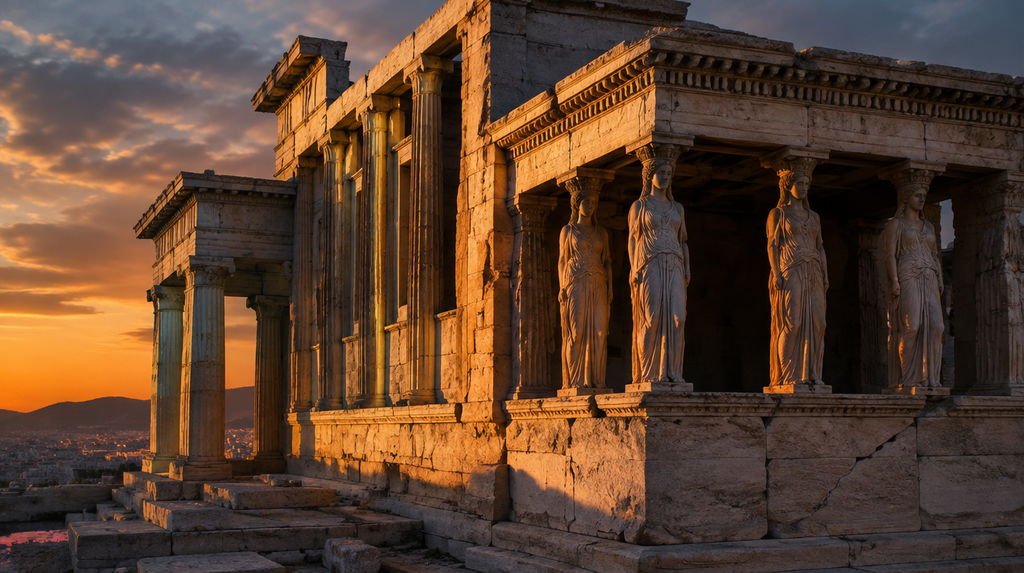
The Erechtheion, an unusual and asymmetrical temple still standing on the Acropolis, was built specifically to honor both Athena and Poseidon together, marking the very spot where their mythical contest was said to have taken place. Ancient visitors could reportedly see the marks believed to be left by Poseidon’s trident strike, alongside the sacred olive tree associated with Athena’s gift, growing in the temple’s western courtyard.
This architectural choice, dedicating the temple to both losing and winning god rather than to Athena alone, suggests that even the city named in her honor understood the value of not fully alienating the sea god whose domain it still depended on for survival and trade. The myth of Athena vs Poseidon, in other words, ended in the stories with a clear winner, but Athenian religious practice treated it as more of an ongoing negotiation than a settled score. Even the Parthenon, the Acropolis’s most famous temple and dedicated solely to Athena, originally featured a sculpted pediment depicting the contest itself, meaning that for centuries, visitors climbing the hill to honor the winning goddess were greeted first by an image of the very dispute that had earned her the city in the first place.
A Myth That Still Shapes How We See Athens
Nearly every visitor who climbs the Acropolis today is, whether they realize it or not, walking through the physical afterlife of Athena vs Poseidon. The city’s name, its historic reliance on olive cultivation and oil production, and even the layout of its most sacred temple all trace back to a myth about which gift mattered more: dazzling, forceful power, or something quieter and more durable planted directly into the ground.
That the story has survived nearly three thousand years, still referenced by tour guides standing on the same rock where the contest supposedly took place, says something about how effectively Greek mythology could turn an abstract civic value into a memorable, human-scale drama. Long after anyone still believed Poseidon literally struck that stone, the story of Athena vs Poseidon kept doing exactly what it was designed to do: explaining, in a single unforgettable scene, why this particular city became what it became.
It is worth remembering, too, that the myth’s darker layer, the account of women’s political participation being rolled back in the aftermath of Poseidon’s flood, gives Athena vs Poseidon a weight that goes beyond charming origin story. Read alongside the historical reality of women’s exclusion from Athenian democracy centuries later, the myth reads less like a footnote and more like a culture explaining, and perhaps quietly justifying, a political decision through the language of divine anger and appeasement. That double function, part civic pride, part uncomfortable political memory, is part of why the story has continued to attract scholarly attention long after its purely religious meaning faded into the background of everyday Athenian life.
For more on the gods at the center of this story, our guide to the 12 Olympian Gods and our closer look at Zeus, King of the Gods cover the wider family both Athena and Poseidon belonged to. For further reading, Wikipedia’s entries on Athena and the Erechtheion provide useful background on the archaeological and literary sources behind this myth.
Illustrations in this article were created using AI in a photorealistic style.
Want to hold a piece of this history in your hands? Visit our official shop for digital albums, CDs, and restored vinyl records celebrating the golden era of rebetiko.