Ask a Greek grandmother what the biggest holiday of the year is, and she won’t say Christmas. She’ll look at you like the answer was obvious all along. Easter is the big one. Bigger than the tree, bigger than the presents, bigger than almost anything else on the calendar, and it isn’t particularly close.
And here’s the thing that trips up most outsiders first: it’s usually not even the same Sunday as everyone else’s Easter. Different date, different mood, different everything, really.
Grab a coffee, because this one’s worth sitting with. Here’s what actually happens during Greek Easter week, why the date keeps wandering off from the Western calendar, and why a bowl of soup made from lamb organs is, somehow, one of the most emotional meals of the year.
Table of Contents
First, Why Is the Date Always Off?
Quick answer: calendars. Long answer, but still simple: Western churches follow the Gregorian calendar. Greek Orthodox churches calculate Easter using the older Julian calendar, plus a rule that Orthodox Easter must always fall after the Jewish Passover.
That combination means Orthodox Easter can land anywhere from one to five weeks after the date most of the world celebrates. Some years, by pure coincidence, they land on the same Sunday. Most years, they don’t, and Greek families abroad end up juggling two entirely separate Easter weekends, one for the neighbors, one for the actual celebration.
For Greeks, this is not a trivia footnote. It shapes travel plans, flight prices, and when half the diaspora books their tickets home. Greek Easter Traditions run on their own clock, and everyone just works around it, planners and calendar apps be damned.
Here’s the quick cheat sheet if you want to sound like you know what’s going on:
| Greek Phrase | What It Means | When You’ll Hear It |
|---|---|---|
| Kalo Pascha | “Happy Easter” (said before the day itself) | Anytime during Holy Week |
| Christos Anesti | “Christ is Risen” | Midnight, Holy Saturday |
| Alithos Anesti | “Truly, He is Risen” | The reply, immediately after |
| Kali Anastasi | “Good Resurrection” (a common Holy Week greeting) | Throughout the week leading up |
The Week Before: Everything Gets Quieter
Holy Week in Greece doesn’t creep up quietly. The whole country visibly shifts gears, and you can feel it before anyone says a word.
Lent itself lasts 40 days, and many older Greeks fast strictly, no meat, no dairy, sometimes no olive oil, right up until the final feast. But it’s Holy Week itself, the seven days before Easter Sunday, where the real transformation happens, and where even people who skipped most of Lent suddenly start paying close attention.
- Holy Monday to Wednesday: Houses get a deep spring clean. Church bells ring in a slower, more solemn rhythm. Bakeries start prepping for the tsoureki rush, and the smell of orange zest and mahlab starts drifting through whole neighborhoods.
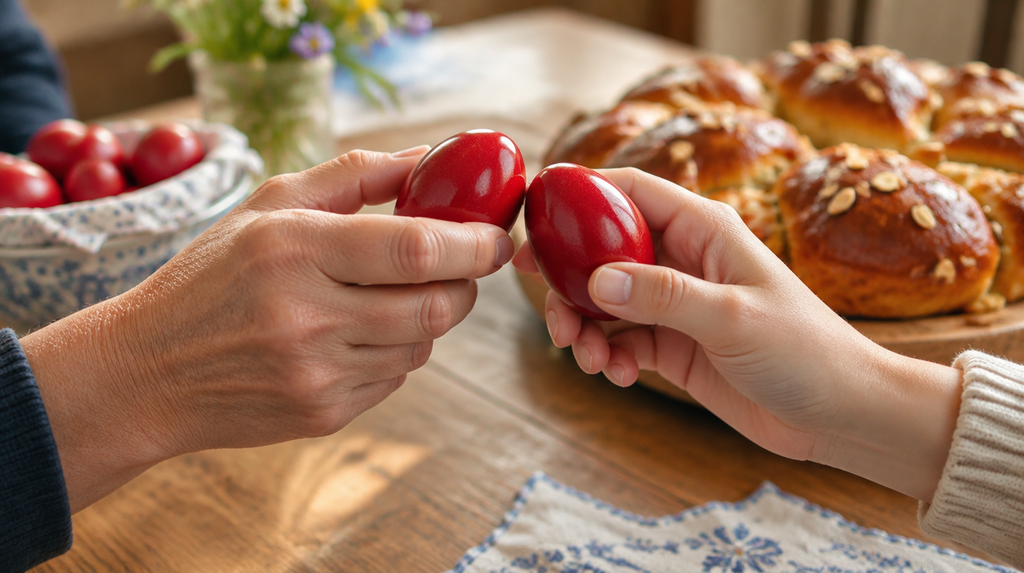
- Holy Thursday: Red eggs get dyed, always red, symbolizing the blood of Christ and the promise of new life. Grandmothers guard their dyeing technique like state secrets, and nobody dares ask for the exact ratio.
- Good Friday: The heaviest day. Flags fly at half-mast. Church bells toll low and mournful. No music plays on the radio, and even the busiest streets go quieter than usual.
Good Friday Evening: The Whole Town Walks Together
If you only witness one Greek Easter tradition in person, make it this one.
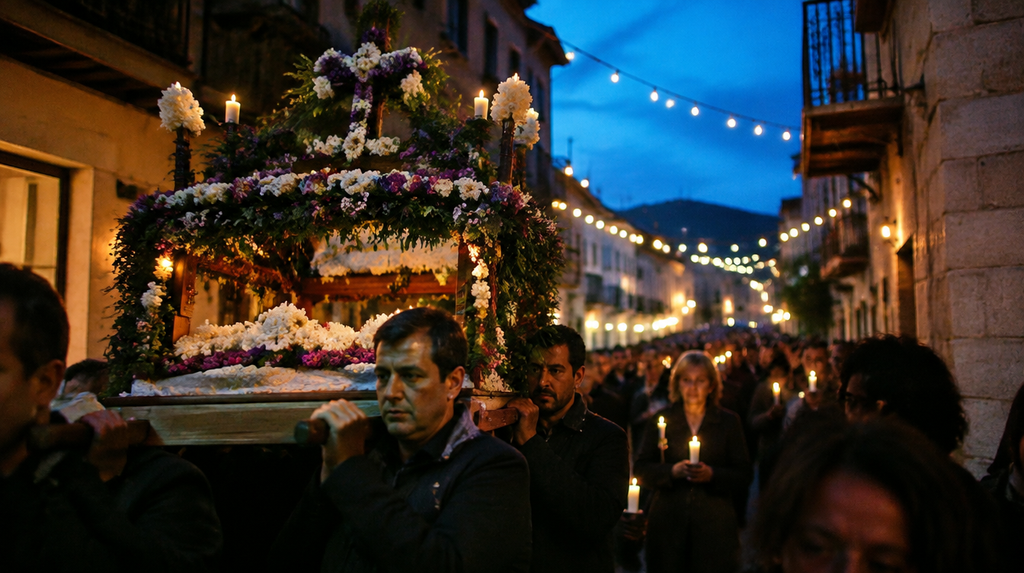
On Good Friday evening, churches carry out the Epitaphios, a flower-covered bier representing Christ’s tomb, in a slow procession through the streets. Entire towns turn out. Shops close. Traffic stops, and nobody seems to mind waiting.
People follow the procession on foot, candles in hand, walking behind the flowers in near silence except for the chanting. In smaller villages, it can feel like the whole population is out on the same street at the same time, which, honestly, it usually is, down to the shopkeepers who locked up early just to join.
Midnight Saturday: The Moment Everything Flips
This is the turn. The whole week builds toward one specific minute.
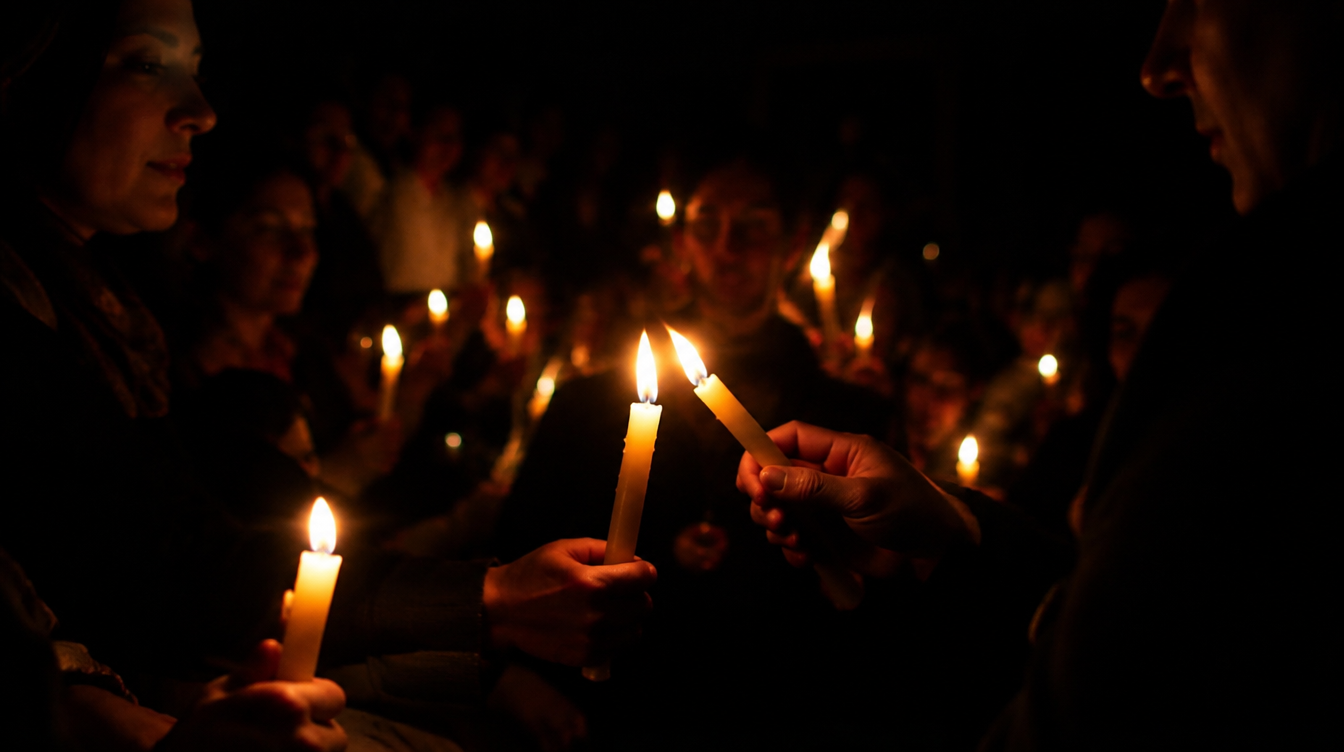
Just before midnight on Holy Saturday, churches go completely dark. Everyone stands together, holding unlit candles, waiting, that particular kind of waiting where nobody talks and everyone can feel the room holding its breath together.
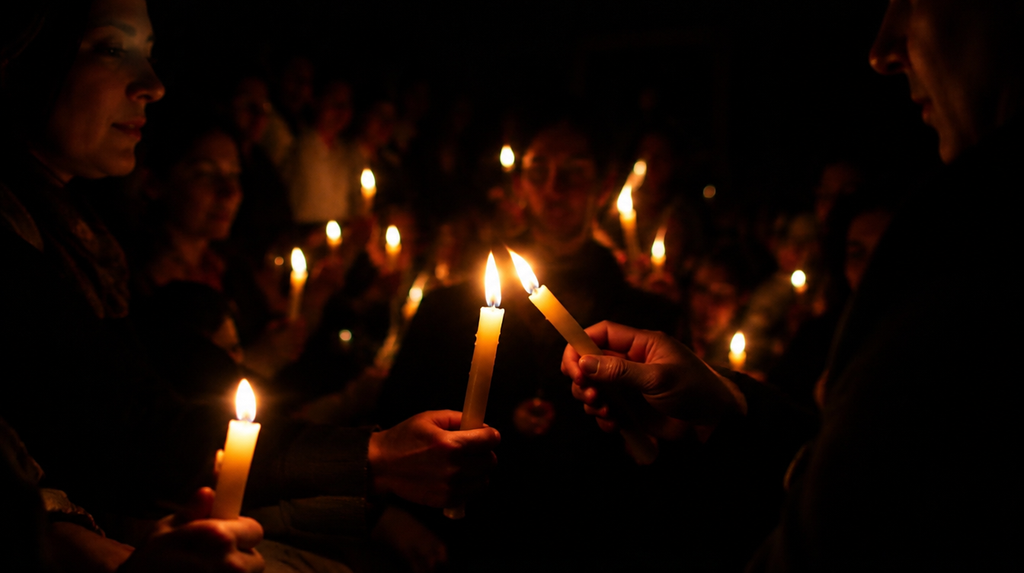
Then, right at midnight, the priest lights a single candle from a flame said to be carried, symbolically, all the way from Jerusalem. That one flame passes to the person next to him. Then the next. Then the next, spreading outward in ripples until the whole building is glowing.
Within minutes, an entire dark church is glowing, candle by candle, while the priest announces:
“Christos Anesti” — Christ is Risen.
The crowd answers back: “Alithos Anesti” — Truly, He is Risen.
Fireworks go off. Church bells go wild. People carry their still-lit candles home carefully, cupping the flame with one hand against the night breeze, trying to keep it alive the whole walk back, since tradition says bringing that exact flame home brings luck for the year.
Then Everyone Eats. A Lot.
After 40 days of fasting, the fasting ends fast. Like, immediately-after-midnight-mass fast, no waiting until morning.
Families head home to a table already set with the first non-Lenten meal in over a month: magiritsa, a soup made from lamb offal, rice, dill, and egg-lemon sauce. It sounds like a hard sell. It’s actually rich, comforting, and deeply tied to using every part of the animal, nothing wasted, a value that runs through a lot of traditional Greek cooking and, honestly, a lot of traditional Greek thrift too.
Alongside the soup:
- Freshly baked tsoureki, a sweet, braided bread flavored with orange zest and a spice called mahlab, the smell of which practically announces Easter on its own before anyone says a word
- The red-dyed eggs from Holy Thursday, ready for a game everyone takes far too seriously
- Wine, always wine, poured freely after weeks of restraint
The Egg-Cracking Game Nobody Admits to Caring About
Here’s a Greek Easter tradition that looks silly and is, somehow, dead serious to everyone involved.
Two people each hold a red-dyed egg. One taps their egg against the other’s, point to point. Whoever’s egg cracks, loses. The winner moves on to challenge someone else, egg still intact, chin held slightly higher.
Supposedly it’s about the resurrection, life breaking through. In practice, it’s a full-contact family sport, and there is always, always one uncle who insists he has a “lucky egg,” picked from the bunch with the seriousness of a man selecting a lottery ticket.
Easter Sunday: The Lamb Comes Out
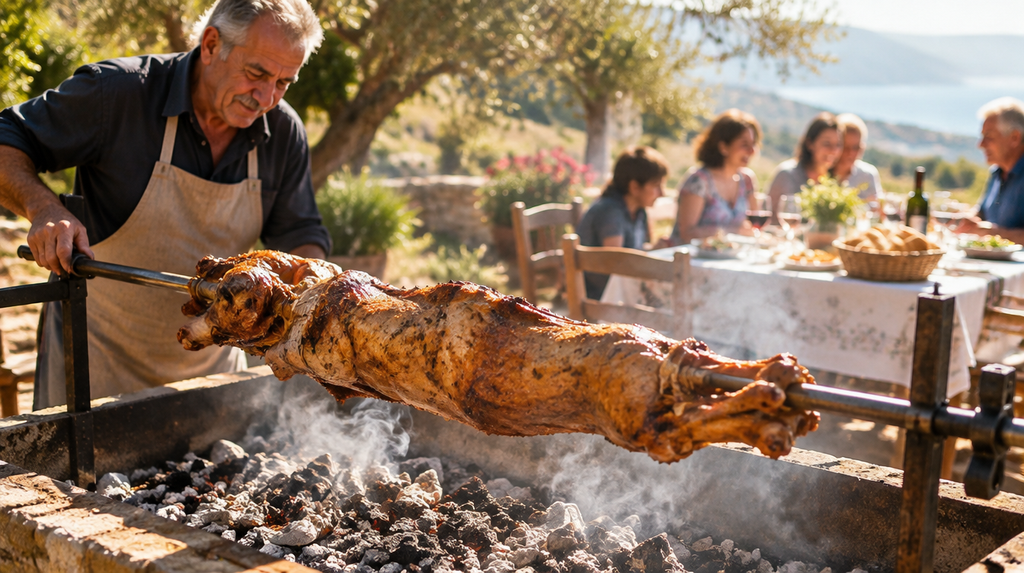
If Holy Saturday night is about faith, Easter Sunday is about food, family, and fire, literally, and by early afternoon the whole neighborhood smells like charcoal and roasting lamb.
Across Greece, whole lambs go on the spit starting early morning, slow-roasting for hours over charcoal while extended families gather in yards, on balconies, wherever there’s room for a grill and a folding table. It is, without much exaggeration, an all-day production involving at least three generations and at least one loud argument about the fire being too hot or not hot enough.
- Kokoretsi, seasoned lamb offal wrapped and grilled, often served as the appetizer while the main lamb keeps roasting slowly on the spit
- Roasted potatoes, salads, and whatever the family’s specific side-dish tradition happens to be, the one nobody’s allowed to change without a fight
- Music, dancing, and usually at least one impromptu singalong by early evening
It’s loud. It’s long. Lunch can stretch into dinner without anyone quite noticing the transition. That’s kind of the point.
Not Every Island Does It the Same Way
Here’s where it gets fun. Greek Easter Traditions aren’t one uniform script followed identically everywhere. Different islands have gone their own delightfully chaotic direction.
- Corfu: On Holy Saturday morning, locals throw clay pots full of water out of their windows, smashing them onto the street below. Nobody agrees on the exact origin, but the sound of the whole old town shattering pottery at once is unforgettable, somewhere between chaos and celebration.
- Chios: In the village of Vrontados, two rival church congregations launch thousands of homemade rockets at each other’s bell towers on Holy Saturday night. It’s technically a friendly rivalry. It’s also, visually, a small war, and the smoke lingers over the village for hours afterward.
- Kalymnos: Dynamite. Actual dynamite, set off in controlled amounts throughout Holy Week, a tradition rooted in the island’s sponge-diving history and still going strong today.
None of that made it into the “official” version most guidebooks describe, which is exactly why it’s worth knowing. Greek Easter Traditions look wildly different depending on which patch of coastline you’re standing on, and honestly, that’s part of the charm, there’s no single “correct” way to do it, just a shared spirit everyone somehow agrees on.
Why It All Feels So Different
Compare this to a quiet Easter brunch somewhere else, and the contrast is obvious. Greek Easter isn’t a single meal. It’s a week-long emotional arc: fasting, mourning, waiting in the dark, then an explosion of light, noise, food, and family that doesn’t really stop until everyone’s too full and too tired to keep going, usually sometime well after midnight for the second night in a row.
That arc is exactly why so many people in the diaspora plan their whole year around getting home for it. It’s not really about the eggs or the lamb. It’s about being in the room when the lights come back on.
The One Thing the Diaspora Never Gets Over Missing
Talk to any Greek living abroad, and Easter comes up fast. Christmas, they’ll survive somewhere else. Easter is the one that stings.
It’s not the food, though they’ll swear it’s the food. It’s that specific minute at midnight, standing shoulder to shoulder with people who’ve known you your whole life, watching one small flame turn into a hundred, then into hundreds more. That’s genuinely hard to replicate in a foreign apartment with a scented candle and a laptop stream of the service.
So every spring, flights out of major hubs to Athens fill up fast, sometimes faster than Christmas. People will burn vacation days, skip other plans, just to be standing in that specific dark church at that specific midnight, holding a candle next to a grandmother who’s been saving them a seat since March.
A Few Things People Get Wrong About It
Since we’re already myth-busting the calendar, might as well clear up a couple more misconceptions while we’re here.
“It’s basically the same as Western Easter, just later.” Not quite. Beyond the date, the whole emotional shape is different. Western Easter tends to center on a single Sunday morning. Greek Easter is a slow, week-long build, more like a marathon than a sprint, with Good Friday functioning almost as its own separate, heavier holiday that some Greeks treat with as much weight as the resurrection itself.
“The egg dye is just food coloring.” Traditionally, it’s onion skins boiled down, or a specific red dye, and plenty of families still insist the old method gives a deeper, more “correct” shade of red than anything from a store-bought kit. Ask three grandmothers for their technique and expect three passionately defended, mutually contradictory answers.
“Everyone fasts the full 40 days strictly.” Realistically, it varies a lot by generation and region. Older, more rural households tend to fast more strictly, sticking to the old rules almost to the letter. Younger, urban Greeks often observe a lighter version, or fast intensely just for Holy Week itself. Nobody’s checking anyone’s plate, but everyone still knows whose grandmother is judging.
For more on how Greek communities keep traditions like this alive across generations, our coverage of Rebetiko festivals keeping tradition alive explores a similar thread of cultural continuity through music. And if the lamb has you thinking about your own Easter table, our guide to Real Greek Moussaka is a solid next stop. For further background on the calendar question, Wikipedia’s entry on the computation of Easter dates walks through the Julian-versus-Gregorian math in more detail.
Illustrations in this article were created using AI in a photorealistic style.
Want to hold a piece of this history in your hands? Visit our official shop for digital albums, CDs, and restored vinyl records celebrating the golden era of rebetiko.