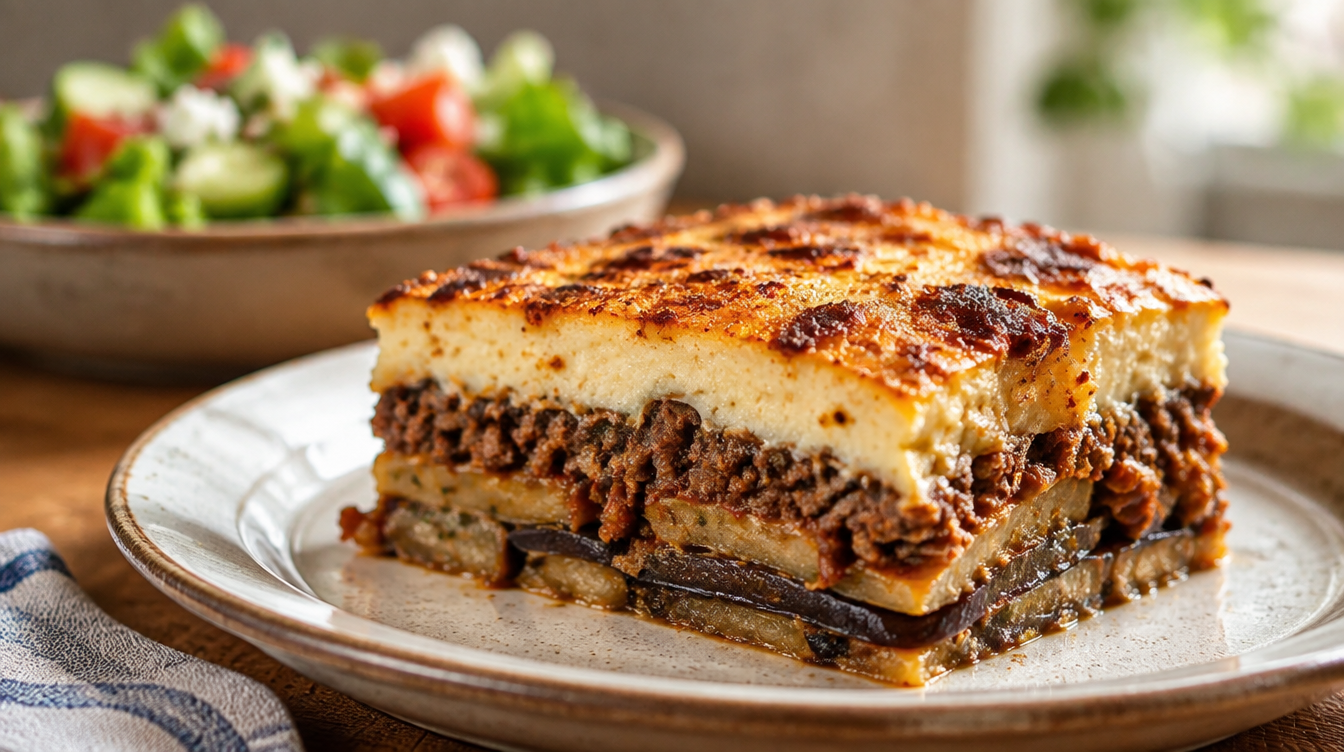
Real Greek Moussaka is a dish that rewards patience more than any single clever trick. It is built in distinct layers, fried eggplant, a rich spiced meat sauce, and a thick, golden béchamel crown on top, and getting each layer right matters more than rushing to the finish line. Done properly, it is one of the most satisfying dishes in Greek home cooking, the kind of thing that fills a kitchen with the smell of cinnamon and browning cheese well before it ever reaches the table. Done carelessly, with soggy eggplant and a thin, broken sauce, it becomes a soupy mess that gives the whole dish a bad reputation it does not deserve.
This guide walks through a genuine Real Greek Moussaka recipe from start to finish, including the specific techniques that separate a proper version from the flattened, one-note casserole many people outside Greece have come to expect, along with the small details that make the difference between a dish that holds together beautifully and one that falls apart on the plate.
A Dish Younger Than You Might Think
Moussaka is often assumed to be an ancient Greek dish handed down unchanged for millennia, but the layered version most people recognize today, eggplant, spiced meat sauce, and béchamel, is surprisingly modern. Eggplant-based casseroles have existed across the Ottoman-influenced Eastern Mediterranean for centuries, but the specific French-inspired béchamel topping was added by the Greek chef Nikolaos Tselementes in the 1920s, who trained in France and brought back techniques from French cuisine to modernize traditional Greek dishes.
This means a Real Greek Moussaka recipe, as most people know it, is only about a century old, a fairly young addition to a food culture that stretches back thousands of years. That relative youth has not stopped it from becoming one of the most internationally recognized Greek dishes, largely because Tselementes’s béchamel addition gave the dish a richness and structure that the earlier, sauce-free versions lacked.
Regional Variations Worth Knowing
While eggplant remains the defining ingredient in most versions of the dish, several regional and seasonal variations exist across Greece. Many households add a layer of thinly sliced, fried potato beneath the eggplant, both to stretch the dish further and to add a heartier, more substantial base that holds up well to the rich meat sauce and béchamel above it. This potato layer is especially common in versions served at larger family gatherings, where feeding a crowd affordably matters as much as tradition.
In summer, some families substitute or add sliced zucchini alongside the eggplant, taking advantage of the vegetable’s peak season and lighter flavor. A vegetarian version, replacing the meat sauce with a thick lentil or mixed vegetable ragù seasoned with the same cinnamon and allspice combination, has also become increasingly common in modern Greek kitchens, offering the same structural layers and warm spicing without the meat. None of these variations move far from the core identity of a Real Greek Moussaka recipe; they simply reflect what a household had on hand, what was in season, or how many people needed feeding that particular Sunday.
The Three Layers, and Why Each One Matters
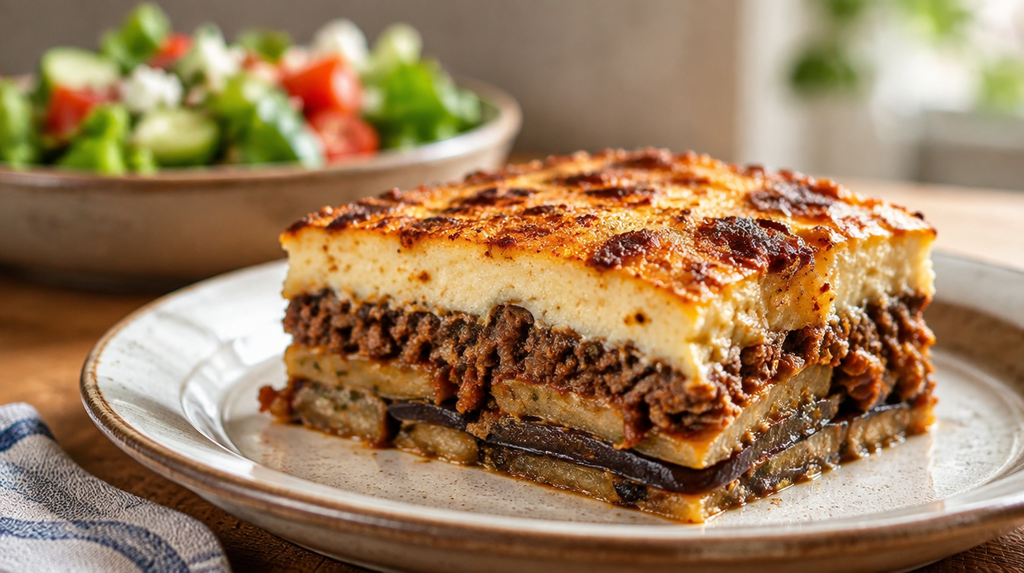
A proper Real Greek Moussaka recipe rests on three distinct layers, each requiring its own separate preparation before anything gets assembled together. The base layer is fried or roasted eggplant, sometimes alternated with a layer of sliced potato underneath, which adds heartiness and helps absorb some of the meat sauce’s moisture. The middle layer is a spiced ground meat sauce, traditionally lamb or a lamb-beef blend, seasoned with cinnamon, allspice, and tomato, giving the dish its distinctive warm, slightly sweet undertone that sets it apart from a typical Italian-style lasagna. The top layer is a thick béchamel sauce, often enriched with egg yolks and a generous amount of grated cheese, baked until deeply golden and just firm enough to hold a clean slice.
Skipping or rushing any one of these three layers throws off the entire dish. Watery eggplant turns the whole casserole soggy. An under-seasoned meat layer leaves the dish tasting flat despite the rich topping. A thin béchamel refuses to set properly, sliding apart the moment you try to serve it rather than holding together in a clean, structured slice that shows off the three layers a good Real Greek Moussaka is supposed to have.
Preparing the Eggplant Correctly
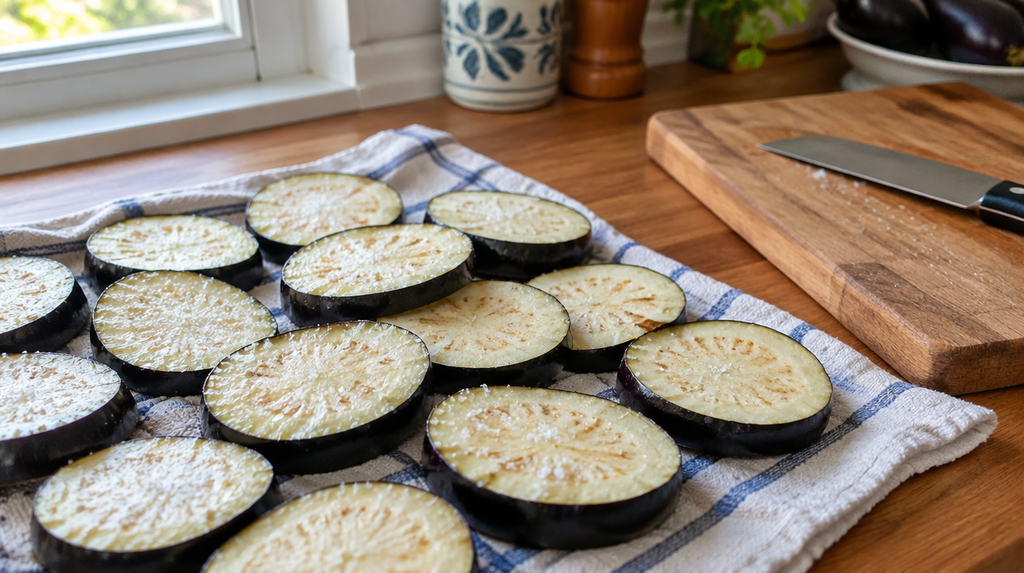
Eggplant naturally contains a significant amount of moisture, and preparing it properly before assembly is one of the most important, and most frequently rushed, steps in the entire process. Slice the eggplant into rounds roughly half an inch thick, salt both sides generously, and let the slices sit in a colander for at least thirty minutes. This draws out excess moisture and bitterness, both of which would otherwise water down the finished dish.
After draining, pat the slices completely dry with a clean towel before cooking. Traditional versions fry the eggplant in olive oil until golden on both sides, which produces the richest flavor but also adds noticeable oil to the finished dish. A lighter alternative, increasingly common in modern Greek kitchens, is to brush the slices with olive oil and roast them on a baking sheet until tender and lightly browned, cutting down significantly on the amount of oil the eggplant absorbs while still achieving a similar texture and enough color to hold its own beneath the other layers.
Building the Spiced Meat Sauce
The meat sauce is where much of moussaka’s distinctive character comes from, and the spicing here matters more than most home cooks expect, since it is the one layer that carries almost all of the dish’s warmth and depth. Start by sautéing finely chopped onion and garlic in olive oil until softened, then add ground lamb, or a lamb-beef blend if lamb alone tastes too strong for your preference, breaking it apart as it browns.
Once the meat has browned, stir in tomato paste, crushed tomatoes, a bay leaf, and the two spices that give the dish its signature warmth: ground cinnamon and ground allspice, added in small amounts, roughly half a teaspoon of each for a full batch, since too heavy a hand with either spice can quickly overwhelm the sauce. A splash of red wine deepens the sauce further, and the whole mixture should simmer uncovered for at least twenty to thirty minutes, allowing the liquid to reduce until the sauce is thick enough that a spoon dragged across the pan leaves a clear trail rather than immediately filling back in with liquid.
A common mistake is under-reducing this sauce and moving straight to assembly while it is still loose and watery. A thin meat layer will release liquid into the eggplant and béchamel during baking, undermining the structure of the entire dish, so patience at this stage pays off considerably later, especially once the finished dish needs to hold a clean slice on the plate.
The Béchamel That Holds Everything Together
Béchamel, a classic French white sauce, is what gives a Real Greek Moussaka recipe its distinctive golden top and its ability to hold together neatly in clean, structured slices. Start by melting butter in a saucepan, whisking in an equal amount of flour, and cooking the mixture for a minute or two to eliminate any raw flour taste. Gradually whisk in warm milk, a little at a time, until the sauce thickens into a smooth, pourable consistency with no lumps.
Once thickened, remove the béchamel from heat and stir in a generous amount of grated cheese, traditionally a hard, salty Greek cheese like kefalotyri, along with a pinch of nutmeg, which pairs surprisingly well with the sauce’s richness and warmth. Finally, temper in two or three beaten egg yolks, stirring quickly to prevent them from scrambling in the hot sauce. This egg enrichment is what allows the béchamel to set firmly enough during baking to hold a clean slice rather than staying loose and saucy on the plate.
Assembling and Baking
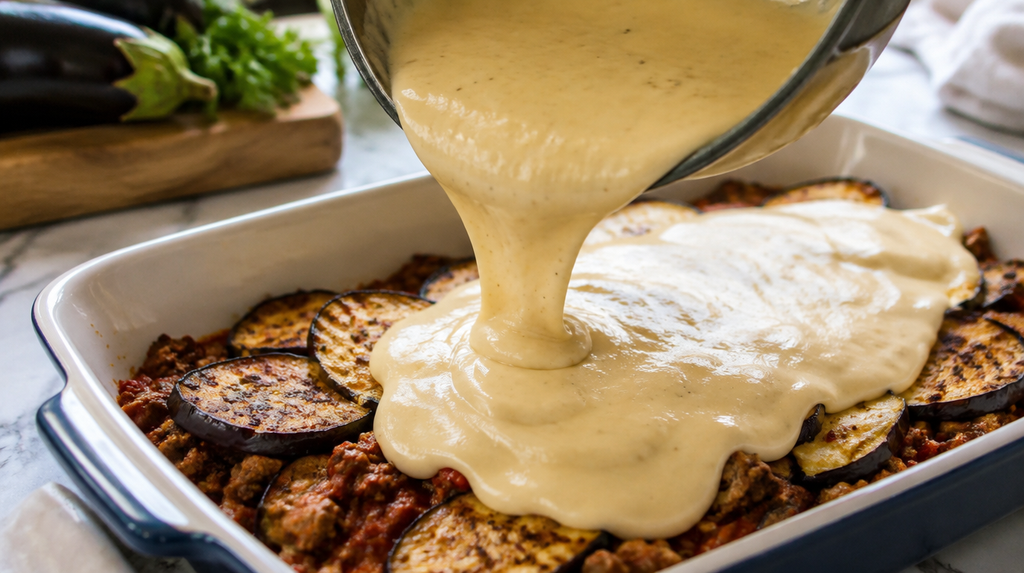
To assemble, layer half the roasted or fried eggplant across the bottom of a large, sturdy baking dish, spread the meat sauce evenly on top, then add the remaining eggplant in a second layer. Pour the béchamel over the top, spreading it evenly with a spatula until it fully covers the layers beneath. A light sprinkle of extra grated cheese on top helps the surface brown more deeply during baking.
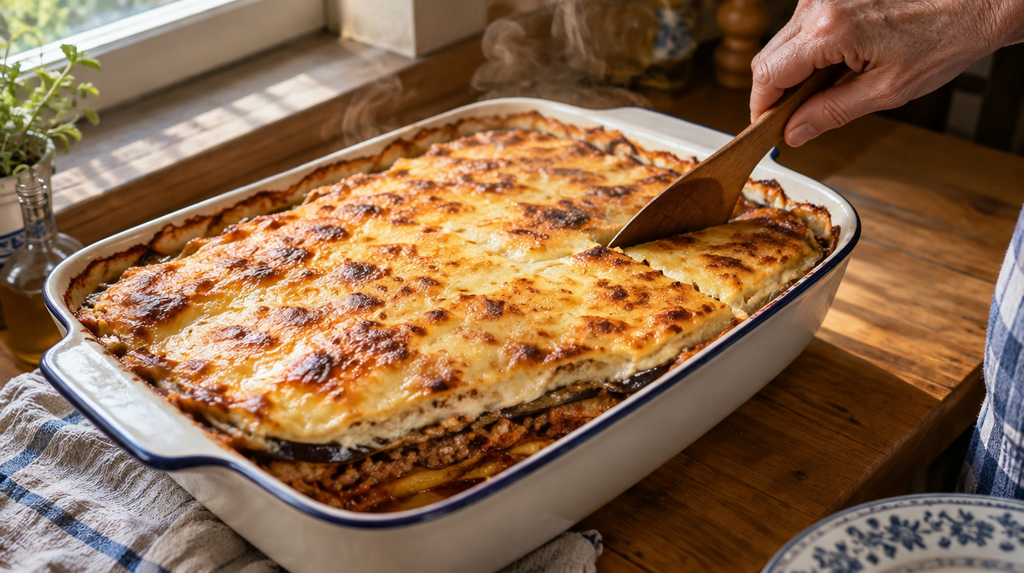
Bake at 375°F (190°C) for approximately forty-five minutes to an hour, until the top is deeply golden and the sauce is bubbling gently at the edges of the dish. The single most important, and most frequently ignored, step comes after baking: let the moussaka rest for at least twenty to thirty minutes before cutting into it, resisting the very understandable temptation to dig in while it is still steaming hot. Slicing too soon, while the layers are still hot and loosely set, causes the dish to collapse into an unattractive, sliding mess rather than holding the clean, distinct layers a properly rested Real Greek Moussaka should display.
Common Mistakes to Avoid
Beyond skipping the eggplant-draining step or under-reducing the meat sauce, a few other habits consistently undermine home versions of this dish. Using pre-ground cinnamon or allspice that has sat in the cabinet for years, rather than reasonably fresh spices, can leave the meat sauce tasting muted rather than warmly aromatic, since both spices lose their potency far faster than most cooks realize. Substituting a thin, store-bought white sauce for a properly made béchamel almost always results in a topping that never sets firmly enough to hold together.
Overbaking is another common issue, drying out the béchamel until it separates or cracks rather than staying smooth and creamy. Checking the dish in the final ten minutes, rather than walking away entirely, helps catch the moment the top turns deeply golden without pushing past it into dryness. Using a baking dish that is too shallow can also cause problems, since the layers need enough vertical space to stay distinct rather than being pressed together so tightly that the sauce squeezes out during baking.
Serving Real Greek Moussaka
Moussaka is typically served as a hearty main course rather than a side dish, often accompanied by nothing more than a simple green salad and crusty bread to round out the meal. In Greek households, it frequently appears at Sunday family lunches or larger gatherings, since the dish scales up easily and tends to taste even better the next day once the flavors have had additional time to settle together, making it as much a practical crowd-feeding dish as a comfort food.
For more Greek recipes built around similarly patient, layered techniques, our guides to the authentic Greek salad and the tzatziki recipe cover two dishes that pair naturally alongside a proper Real Greek Moussaka at the same table.
Making It Ahead and Storing Leftovers
Moussaka is unusually well suited to being made a day in advance, and many Greek cooks actually prefer it this way, since the resting time allows the layers to fully set and the flavors to deepen overnight in the refrigerator. To reheat, cover the dish loosely with foil and warm it in a moderate oven until heated through, which preserves the texture of the béchamel far better than a microwave, which tends to make the top layer rubbery rather than smooth.
For longer storage, moussaka freezes reasonably well, either as a fully baked dish or assembled but unbaked. If freezing before baking, wrap the assembled dish tightly and thaw it fully in the refrigerator before baking as directed, adding a few extra minutes to the cooking time if the dish is still slightly cold in the center. Baked leftovers keep well in the refrigerator for three to four days, and individual portions reheat particularly well in a toaster oven or standard oven, making a properly made batch of Real Greek Moussaka one of the more practical make-ahead dishes in Greek home cooking despite its reputation for being labor-intensive on the first day.
For further reading on the dish’s history, Wikipedia’s entry on moussaka traces its development across the wider Eastern Mediterranean region.
Illustrations in this article were created using AI in a photorealistic style.
Want to hold a piece of this history in your hands? Visit our official shop for digital albums, CDs, and restored vinyl records celebrating the golden era of rebetiko.