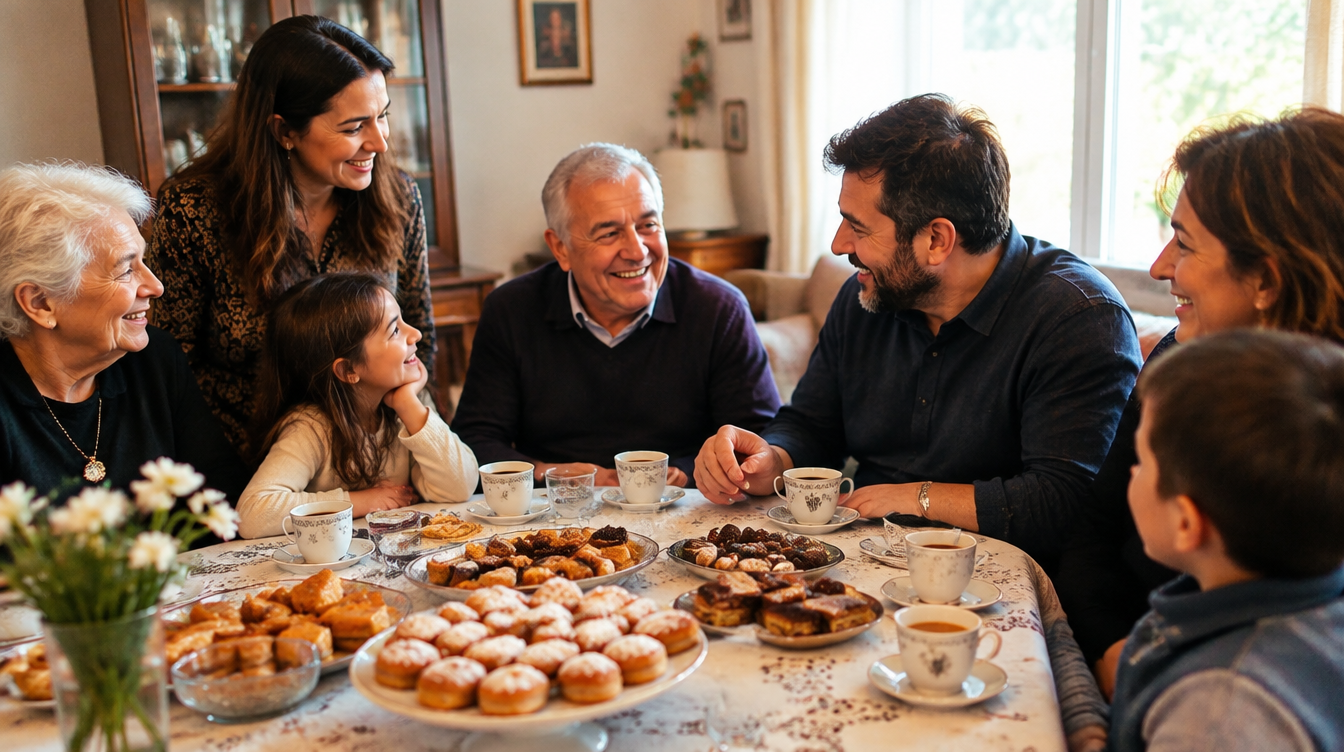
Ask a Greek person when their birthday is, and you might get a slightly vague answer, a shrug, maybe a quick mental calculation before they actually land on the date. Ask about their name day, and watch them light up instantly, ready to tell you exactly when it falls and probably what they’re planning to serve. In Greece, the Greek Name Day tradition often outranks the actual birthday, and for anyone outside the culture, that swap takes a bit of explaining before it fully clicks.
Here’s what a name day actually is, why the door stays unlocked all day long for it, and why showing up uninvited is not just allowed, it’s kind of the whole point of the entire tradition, unlike almost anywhere else in the world.Table of Contents
What Exactly Is a Name Day?
The Greek Name Day tradition ties directly into the Orthodox Christian calendar, which assigns a specific feast day to nearly every recognized saint throughout the year. If you’re named after a saint, and a huge number of traditional Greek names are, your name day falls on that saint’s designated day, celebrated every single year like a second, recurring birthday that everyone in your circle already knows to mark.
This isn’t a small or niche custom. It’s baked so deeply into daily life that many Greek calendars print the saint of the day right alongside the date itself, the same way Western calendars might note a public holiday, and it’s common for people to glance at a wall calendar just to check whose name day is coming up that week.
Where This Tradition Actually Comes From
The custom traces back to the early Christian church, where believers were often named after saints specifically to invoke that saint’s protection and blessing throughout their entire life, a spiritual connection meant to last well beyond childhood. Over centuries, celebrating the feast day of one’s namesake saint became at least as significant, if not more so, than marking the anniversary of one’s own birth, which many older communities considered a far more private, less consequential date.
This connects to another deeply rooted Greek custom worth understanding: naming patterns within families. Traditionally, the first son is named after the paternal grandfather, and the first daughter after the paternal grandmother, with the maternal grandparents’ names often reserved for the second child born into the family. The practical result is that name days tend to repeat heavily within extended families, meaning a single family might genuinely have three or four members all sharing the exact same name day, turning one celebration into a combined family event covering multiple relatives at once, sometimes spanning three generations under one roof.
The Big Ones Worth Knowing
Some name days are so widely shared that entire cities practically shut down a little bit in celebration, with bakeries selling out and streets noticeably livelier than usual. A quick reference for the most common ones, worth bookmarking if you know a lot of Greek friends:
| Name | Name Day | Saint/Feast |
|---|---|---|
| Giorgos / Georgia | April 23 | Saint George |
| Ioannis / Yiannis / Ioanna | January 7 | Saint John the Baptist |
| Konstantinos / Eleni | May 21 | Saints Constantine and Helen |
| Dimitrios / Dimitra | October 26 | Saint Demetrios |
| Maria / Marios | August 15 | Dormition of the Virgin Mary |
| Nikolaos / Nikoletta | December 6 | Saint Nicholas |
Because Georgios, Ioannis, and Konstantinos rank among the most common Greek names of all time, their name days function almost like unofficial national holidays. Entire villages and neighborhoods can feel like one continuous open house on those particular dates, with streets busier than usual and bakeries selling out of sweets by early afternoon.
Saint George’s Day, April 23, deserves special mention here beyond just its popularity. Beyond being one of the most widely shared name days in the entire country, it’s traditionally associated with the first day shepherds could move their flocks up to summer pastures, tying the celebration to agricultural life in rural Greece as much as to purely religious observance. In villages with strong pastoral traditions, the day still carries that dual meaning today, part name day, part seasonal marker signaling the turn toward warmer months.
The Open House Rule: Why Nobody Needs an Invitation
Here’s the part that genuinely surprises most outsiders. On someone’s name day, tradition says their home is open to visitors all day long, no RSVP, no formal invitation, no advance warning required at all, sometimes starting as early as mid-morning and running well past dinner.
Friends, neighbors, coworkers, distant cousins you haven’t seen since last Easter, anyone connected to the celebrant even loosely can simply show up, offer congratulations, and expect to be welcomed in for coffee, a sweet, maybe a full meal if they arrive around lunchtime. There’s no real social penalty for arriving without calling ahead, and in smaller communities, the opposite is often true: calling ahead can almost feel unnecessary or even a little formal, since everyone in the neighborhood already knows exactly what day it is.This means the celebrant, not the guests, does most of the hosting work. Whoever’s name day it is typically spends the entire morning preparing food and drinks specifically because they know people will drop by throughout the day, sometimes a handful of visitors, sometimes what feels like half the neighborhood cycling through between breakfast and dinner.
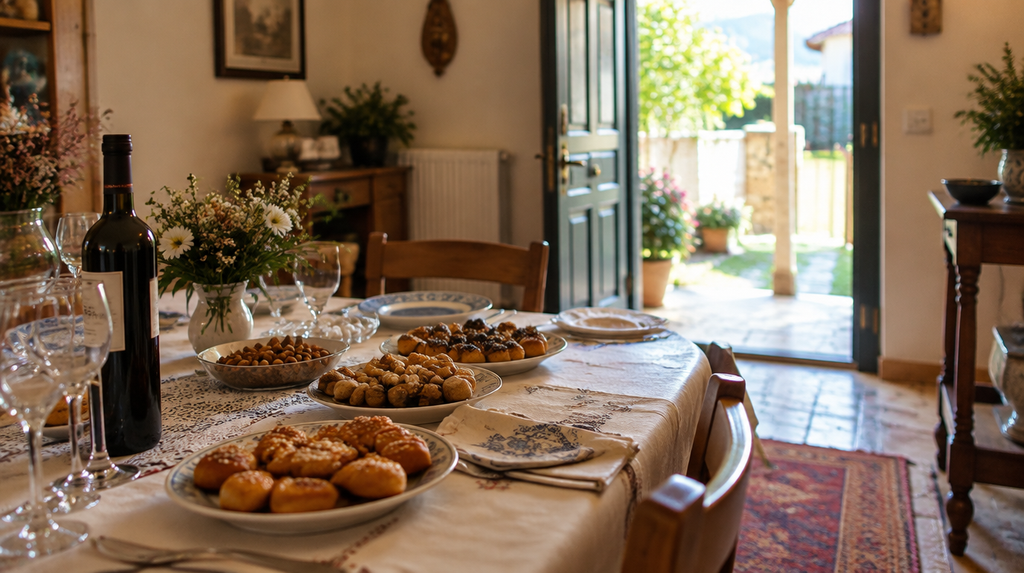
A typical spread laid out for the whole day might include several of the following, kept ready and refreshed as the hours pass and new guests keep arriving:
- Homemade sweets like koulourakia or a simple cake, something that can sit out comfortably without spoiling quickly
- Greek coffee or tea, made fresh in small batches throughout the day rather than brewed once in one large bulk pot
- A savory spread of cheeses, olives, and cold cuts, for guests who arrive closer to lunch or dinner time
- Ouzo or a similar traditional spirit, poured for the evening crowd once the day winds toward its later hours
Nobody expects a full sit-down meal from every single guest interaction throughout the day. Most visits actually last somewhere between fifteen minutes and an hour, just enough time for a coffee, a quick catch-up, and the customary congratulations before the next round of guests arrives at the door.

How to Actually Wish Someone Happy Name Day
The standard phrase is simple enough to learn in about ten seconds: “Chronia Polla” (Χρόνια Πολλά), which translates roughly to “many years.” It works for name days, birthdays, and honestly most celebrations in Greek culture, making it one of the most useful, versatile phrases a visitor could possibly learn before a trip.
A slightly more specific option exists too: “Na ta ekatostiseis,” which loosely means “may you reach a hundred,” a warm, slightly over-the-top wish for a long life that gets tossed around especially by older relatives, usually accompanied by a firm pat on the shoulder or a warm kiss on both cheeks depending on how close the relationship actually is.
If you want to sound genuinely thoughtful rather than just politely correct, adding “kai tou chronou” afterward, meaning “and next year too,” extends the wish forward into the future, a small phrase that lands surprisingly well with hosts who appreciate the extra effort and attention to detail.
Gifts Work Backwards From What You’d Expect
In a lot of cultures, the birthday person receives gifts and everyone else’s job is just to bring something nice. On a Greek name day, it can genuinely go either direction, and sometimes both happen at once within the same visit.
- Guests often bring a small gift, flowers, sweets, or a bottle of something nice, when they visit, though it’s far from strictly required by anyone
- The celebrant, in turn, frequently sends guests home with a treat too, often a slice of cake or a small pastry wrapped up carefully to go for later that evening
- Larger, more formal gifts are less standard than in a birthday celebration; the visit itself, the time spent together, is treated as the actual gift being exchanged between everyone present that day
- Children’s name days sometimes lean closer to Western-style gift-giving, especially in families with younger kids who’ve grown up with birthday parties as a comparison point and expect something similar
That reciprocal, low-pressure gifting is part of why the whole tradition feels less like an obligation and more like a genuinely warm, communal occasion built around presence rather than presents, in the truest sense of that distinction.
When Your Name Doesn’t Have an Obvious Day
Not every name maps neatly onto a single, universally recognized saint’s day, and that particular flexibility trips up plenty of people, Greek and non-Greek alike, especially when trying to figure out their own celebration date for the first time.
Some names have multiple possible feast days depending on which specific saint or tradition a family follows, meaning two people with the exact same name might genuinely celebrate on entirely different dates depending on regional or family custom passed down through generations. Others, particularly newer or non-religious names that became popular in the last few decades, don’t have an assigned day at all. In those cases, families sometimes celebrate on All Saints’ Day instead, a kind of catch-all date that covers anyone without a specific match on the calendar, falling reliably on the Sunday after Pentecost each and every year.
Foreign names present their own puzzle entirely in a country where the tradition runs this deep. A Greek family with a relative named after a non-Greek, non-Orthodox figure sometimes simply picks the nearest equivalent saint’s name as a workaround, or skips the tradition for that particular family member altogether, treating their birthday as the primary celebration instead and letting the name day custom quietly slide for that one person.Why It Still Beats Birthdays for a Lot of Greeks
Part of the appeal comes down to sheer predictability and shared meaning. Everyone named Georgios celebrates on the same day, together, all at once, as part of something bigger than a single individual’s personal milestone, a kind of built-in community celebration nobody had to organize from scratch. There’s a communal quality to it that a private, individually-scheduled birthday simply doesn’t carry in the same way, since a birthday belongs entirely to one person while a name day is shared with everyone else who happens to carry the same name.
Birthdays have gained ground in recent decades, especially among younger, more urban Greeks influenced by Western media and celebration styles. But name days haven’t gone anywhere. In plenty of households, both get celebrated, birthdays quieter and more private, name days louder, more social, and considerably harder to predict how many people might actually show up.
Has Modern City Life Changed Any of the Rules?
Strict “show up whenever” open-door tradition still holds strongest in smaller towns and villages, where neighbors genuinely know each other well and dropping by unannounced feels completely natural rather than intrusive. In larger cities like Athens or Thessaloniki, the custom has softened somewhat out of practical necessity, shaped by the sheer scale and pace of urban life.
Apartment living, longer work hours, and simply knowing far more people than a small village ever would has pushed many urban Greeks toward a lighter version of the tradition: a quick phone call or text earlier in the day to check if the celebrant is actually home and genuinely receiving guests, rather than the full unannounced open-house approach their grandparents grew up with. The spirit of the tradition, celebrating together rather than through a formal scheduled party, still holds firmly in place. The execution has just adjusted to fit apartment buildings, elevators, and busier calendars that leave less room for spontaneous drop-ins.
For more on how the Orthodox calendar shapes Greek life throughout the entire year, our piece on Greek Easter traditions covers another major celebration tied directly to the same religious rhythm. For further reading, Wikipedia’s entry on name days covers how the wider tradition varies across different countries that observe it.
Illustrations in this article were created using AI in a photorealistic style.
Want to hold a piece of this history in your hands? Visit our official shop for digital albums, CDs, and restored vinyl records celebrating the golden era of rebetiko.