Walk into almost any tourist-facing restaurant outside Greece and you will find a “Greek salad” built on a bed of lettuce, drowned in a sweet vinaigrette, and topped with crumbled feta scattered like confetti. It looks fine. It is also almost nothing like the dish Greeks actually eat, which does not go by the name “Greek salad” at home at all. It is called horiatiki, and the differences between the export version and the real thing go far deeper than garnish, touching everything from which vegetables belong in the bowl to how the feta is cut and when the olive oil gets poured.
This piece works through the authentic version of horiatiki in a question-and-answer format, tackling the specific choices, ingredients, and habits that separate a genuine Greek village salad from the imitation most people abroad have grown up eating.
What Makes a Salad “Greek” in the First Place?
The name “Greek salad” is almost entirely a foreign invention. In Greece, this dish is called horiatiki salata, which translates roughly to “village salad,” a name that points to its real origin: a simple, seasonal combination of whatever ripe vegetables a rural household had on hand, dressed with local olive oil and topped with local cheese. It was never conceived as a lettuce-based side dish. It was, and still is, a substantial standalone plate, often eaten as a light meal in the heat of summer rather than a starter before something bigger.
Understanding horiatiki as a village dish rather than a restaurant invention explains almost every “rule” that follows. The ingredients are not arbitrary; they reflect what actually grows well in Greek soil during the hottest months, and the preparation reflects generations of home cooks, not chefs trying to plate something photogenic.
Where Did the Name “Greek Salad” Actually Come From?
The term “Greek salad” is largely a marketing label created outside Greece, most likely popularized through Greek diaspora restaurants and later international menus that needed a simple, recognizable name for foreign customers. Inside Greece, almost nobody orders “Greek salad” from a menu; they order horiatiki, and the word carries none of the exotic, foreign-food framing that “Greek salad” picked up once it traveled abroad.
This naming gap partly explains why the exported version drifted so far from the original. Once a dish becomes a generic, internationally recognized category rather than a specific regional recipe tied to a place and a season, it becomes far easier for restaurants to modify it to fit local supply chains and local palates, adding lettuce as cheap bulk filler, crumbling the feta because pre-crumbled cheese is easier to portion and store, and sweetening the dressing to match customer expectations shaped by other bottled salad dressings already familiar to them.
None of these changes were made with any reference to the original dish; they were made for convenience and cost, and then simply passed down through menu after menu until they became the expected version.
What Are the Most Common Mistakes People Make Abroad?
A few habits show up again and again in restaurants and home kitchens outside Greece, and each one moves the dish further from its roots. The most obvious is bulking the salad out with lettuce or mixed greens, which changes both the texture and the overall proportion of the dish, turning a vegetable-and-cheese-forward plate into something closer to a garden salad with a few Mediterranean toppings scattered on top.
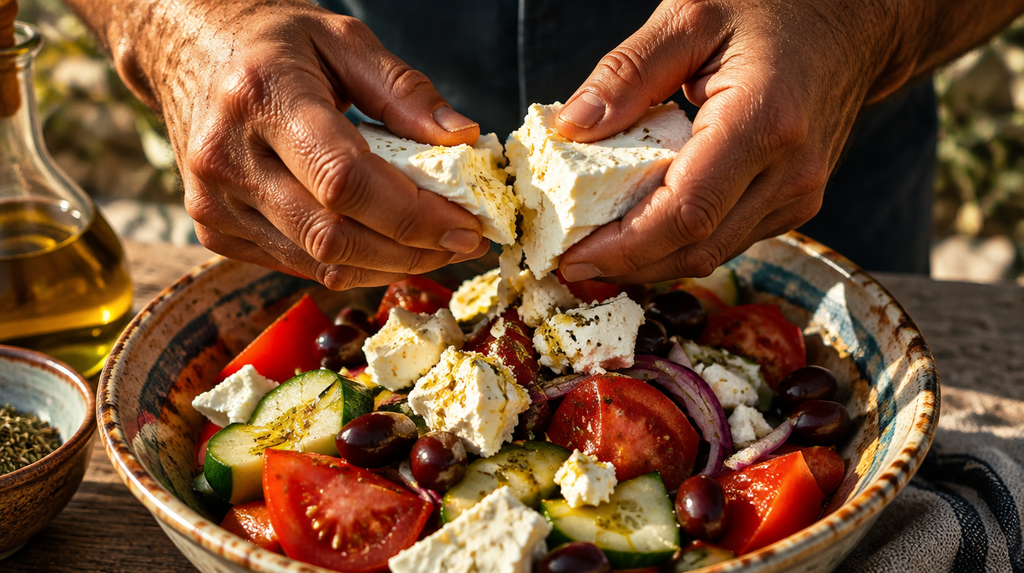
The second common mistake is treating feta as an ingredient to be sprinkled rather than a centerpiece to be served whole. Pre-crumbled feta, especially the shelf-stable kind sold in small tubs, is usually made with less care and dries out far faster than a fresh block, losing much of the creamy interior texture that makes a proper slab so satisfying to break apart at the table.
A third mistake is over-dressing the salad with a sweetened, heavily emulsified vinaigrette, which masks the natural sweetness of a ripe tomato instead of letting it come through. Because supermarket tomatoes outside Greece are frequently picked underripe and bred for shelf life rather than flavor, some restaurants compensate by leaning harder on the dressing, which only compounds the difference between the original dish and its export. The single biggest factor in getting horiatiki right, more than any technique, is starting with tomatoes that are genuinely ripe, ideally in season, since no amount of good olive oil can fully make up for a bland tomato at the center of the bowl.
A fourth, smaller mistake worth mentioning is refrigerating the finished salad before serving, which mutes the aroma of the raw vegetables and stiffens the olive oil, robbing the dish of the loose, glistening texture it is meant to have straight from the counter.
Does Real Greek Salad Have Lettuce in It?
No, and this is usually the first thing that surprises people. Authentic horiatiki contains no lettuce, no leafy greens of any kind, and typically no lettuce-adjacent bulk filler at all. The base is built entirely from ripe tomatoes cut into thick wedges, cucumber cut into similarly hearty chunks, thinly sliced red onion, and green bell pepper cut into rings or strips.
The absence of lettuce is not a stylistic choice. It comes down to what grows in Greece’s hot, dry summer climate. Lettuce wilts and bolts quickly in high heat, while tomatoes and cucumbers thrive, so the salad that developed regionally used the vegetables that were actually abundant and at peak ripeness at the same time of year, rather than a leafy base that would have been out of season or difficult to grow well.
Why Is the Feta Always a Slab, Never Crumbled?
In an authentic horiatiki, the feta arrives as a single, thick, unbroken slab set directly on top of the vegetables, usually drizzled with a little extra olive oil and a pinch of dried oregano before serving. It is meant to be broken apart at the table with a fork, by the person eating it, not pre-crumbled in the kitchen.
This matters for more than presentation. Feta is a protected designation of origin product in the European Union, meaning only cheese made in specific regions of Greece, from sheep’s milk or a sheep-and-goat milk blend using traditional methods, can legally be labeled feta within the EU. Serving it as an intact slab lets its texture, a firm, slightly crumbly interior with a tangy, briny finish, actually register on the plate instead of disappearing into a scattering of small crumbles that dry out and lose their character within minutes of being cut.
What Kind of Olive Oil Actually Belongs in Horiatiki?
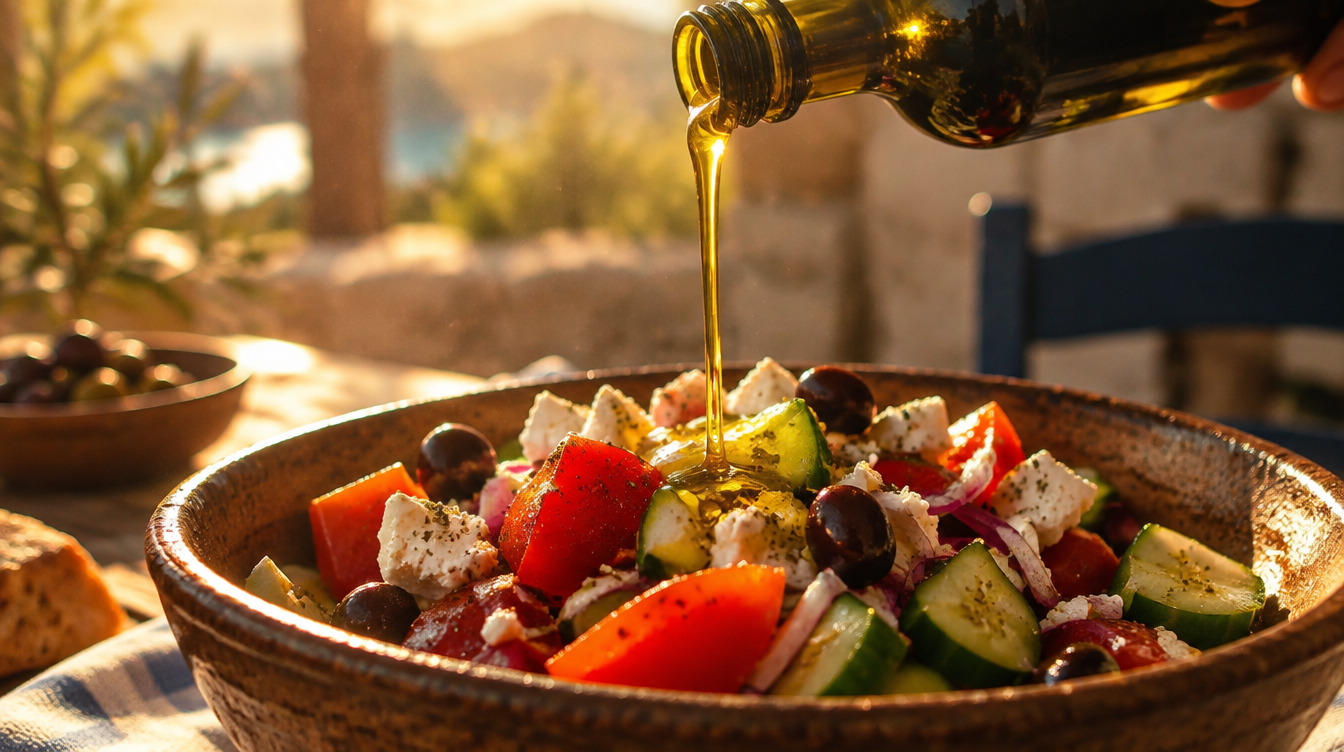
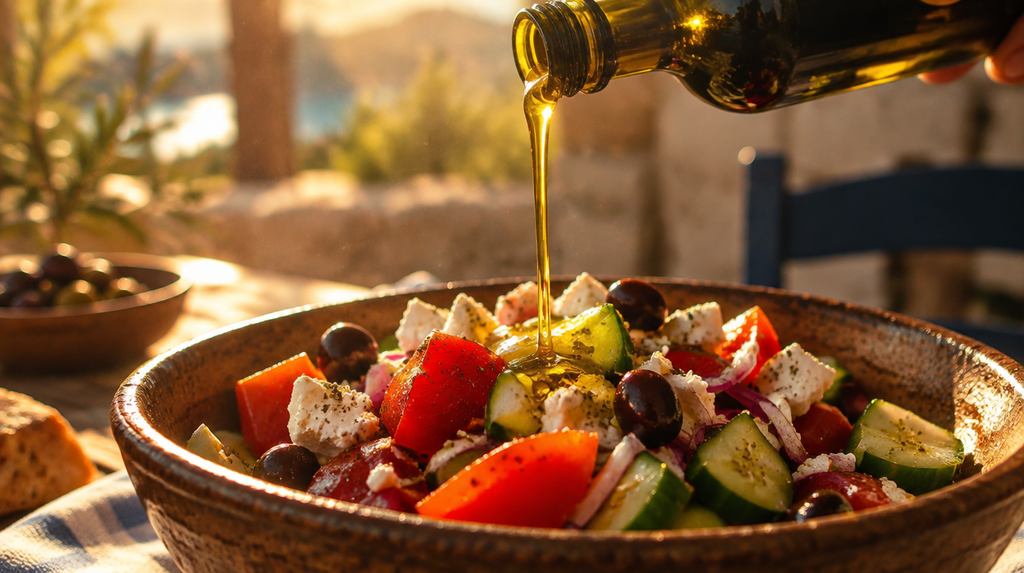
Extra virgin olive oil is not a garnish in this dish; it is one of the main components, poured generously rather than drizzled sparingly. Greece is one of the world’s largest per-capita consumers of olive oil, and in a dish this simple, the quality of the oil is directly tasteable in every bite.
Regional oils are often preferred by the household making the salad, whether from Crete, the Peloponnese, or one of the many islands with a strong olive-growing tradition. The oil is typically added at the table rather than tossed through the vegetables in advance, allowing each diner to pool as much as they like at the bottom of the bowl and mop it up with bread once the vegetables are gone, a step many home cooks consider the best part of the meal.
Do Greeks Really Skip the Vinegar?
Not entirely, but the ratio looks nothing like the sweet, heavily acidic dressings common in supermarket bottled versions abroad. Traditional horiatiki uses a light touch of red wine vinegar, or sometimes none at all, relying primarily on the natural acidity of ripe tomatoes and the richness of the olive oil to carry the flavor. Salt and dried oregano, rubbed between the fingers to release its oils just before serving, round out the seasoning.
There is also no sugar, no mustard, and no pre-made vinaigrette shaken up in a jar. The “dressing,” to the extent the word even applies, is really just three or four separate ingredients added directly into the bowl and left for the diner to mix as they eat, rather than emulsified into a uniform sauce beforehand.
What’s the Right Way to Cut the Vegetables?
Size and shape matter more than most people expect. Tomatoes are cut into thick wedges or large chunks, never diced small, so that each bite still tastes distinctly of tomato rather than disappearing into a mixed texture. Cucumbers are peeled in alternating strips, leaving some skin on for color and texture, then cut into thick half-moons or chunks that match the scale of the tomato pieces. Red onion is sliced thin enough to soften slightly in the salt and oil but still retain a sharp bite, and green pepper is left in rings or long strips rather than diced.
Kalamata olives, unpitted, are scattered throughout, both for flavor and because biting around a pit is simply part of the experience in Greece, unlike the pitted, often overly briny olives that appear in many international versions.
The Authentic Horiatiki Recipe, Step by Step
To bring everything above together, here is how a genuine village-style horiatiki actually comes together:
- Cut four ripe, firm tomatoes into thick wedges and place them in a wide, shallow bowl.
- Peel one cucumber in alternating strips, then cut it into thick half-moons and add it to the bowl.
- Thinly slice half a red onion and scatter it over the vegetables.
- Cut one green bell pepper into rings or strips and add it in.
- Scatter a generous handful of unpitted Kalamata olives over the top.
- Season with coarse salt, and a light splash of red wine vinegar if desired.
- Place one thick, unbroken slab of feta directly on top of the vegetables.
- Drizzle generously with extra virgin olive oil, over both the vegetables and the feta.
- Sprinkle dried oregano over the feta, crushing it slightly between your fingers as you go.
- Serve immediately with crusty bread on the side, and let each diner break the feta apart and mix the salad themselves at the table.
There is no lettuce to add, no croutons, and critically, no refrigeration beforehand. The vegetables should be at room temperature, since chilling dulls the flavor of a ripe summer tomato far more than most people realize.
How Should It Be Served and Eaten?
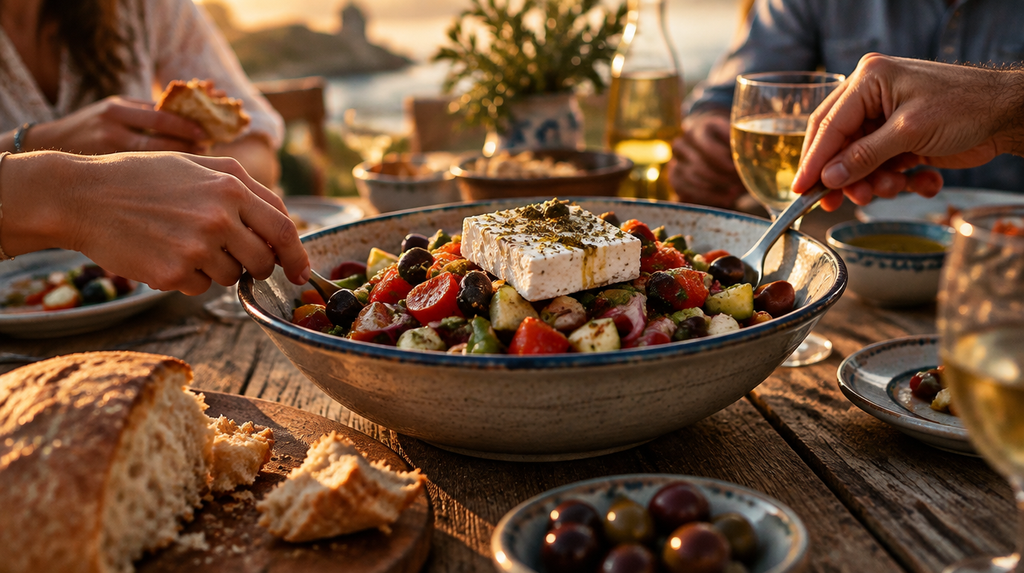
Horiatiki is almost never served as a solitary starter course the way it often is abroad. In a typical Greek meal, it arrives at the table alongside several other shared dishes, grilled meat or fish, fried potatoes, perhaps a plate of dolmades, and everyone eats from the same bowl with their own fork rather than being served an individual portion. Bread is used constantly throughout the meal to soak up the combination of tomato juice and olive oil left behind, a practice locals sometimes call “sponging,” and leaving that liquid unfinished at the bottom of the bowl is considered something close to a small culinary tragedy.
This communal, unhurried style of eating is itself part of what makes the dish authentic. Horiatiki was never designed to be a quick individual side order; it developed as part of a shared table where the pace of the meal mattered as much as any single ingredient.
That slower pace also explains why the dish is rarely eaten alone as a full meal replacement the way a dinner salad might be treated elsewhere. It functions as one voice in a larger conversation of dishes on the table, meant to be tasted alongside grilled protein, starchy sides, and bread, rather than competing with them for attention. A diner might return to the horiatiki bowl three or four times over the course of a meal, taking a small portion each time, rather than clearing an individual plate of it in one sitting at the start.
For more on the food culture surrounding dishes like this one, our article on what Greeks really ate and drank in 1930s tavernas explores how simple, seasonal dishes like horiatiki fit into a much longer tradition of communal eating in Greece. For further reading, Wikipedia’s entries on Greek salad and feta cheese provide useful background on the dish’s origins and protected status.
Illustrations in this article were created using AI in a photorealistic style.
Want to hold a piece of this history in your hands? Visit our official shop for digital albums, CDs, and restored vinyl records celebrating the golden era of rebetiko.