
A century ago, rebetiko was music that respectable Athenian society wanted nothing to do with — confiscated by police, dismissed by radio stations, sung mostly by people society preferred to ignore. Today, it fills concert halls, university syllabi, and streaming playlists across the world. Understanding rebetiko today means understanding a genre that didn’t just survive its rocky beginnings — it fundamentally reshaped what Greek music means to Greeks themselves.
Table of Contents
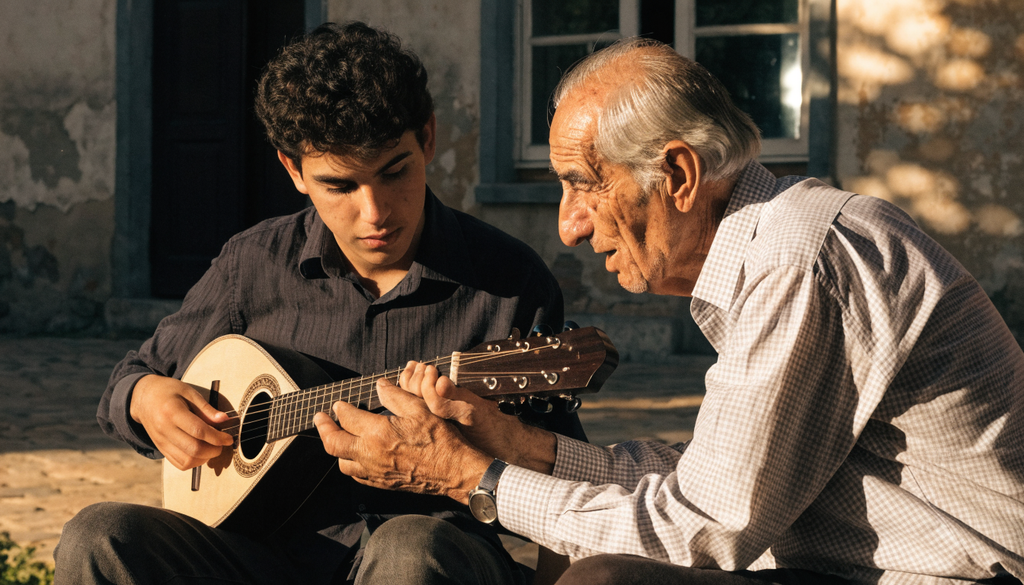
Rebetiko Today: Same Soul, New Sound
To appreciate how far rebetiko has traveled, it helps to place its past and present side by side. The core emotional honesty of the genre hasn’t changed — but almost everything around it has.
Then: The Tavernas of the 1930s
We’ve told this part of the story before — how Markos Vamvakaris helped put an underground sound on record for the first time, and how the crowded, improvised neighborhoods of the Piraeus Golden Age gave that sound its raw emotional material. In those early decades, rebetiko lived almost entirely in informal spaces: tekedes, small tavernas, and back rooms, played by musicians who had little formal training and even less social standing.
It was music made out of necessity, not ambition — a way to process hardship, not to build a career.
Now: Rebetiko Today’s New Stages
Rebetiko today occupies a completely different world, while somehow keeping its emotional core intact:
- Dedicated festivals across Greece and the diaspora celebrate the genre specifically, drawing crowds who once wouldn’t have set foot in a rebetiko taverna
- University programs and conservatories now teach rebetiko as a serious musical tradition, with dedicated scholarship on its history and technique
- Streaming platforms have introduced the genre to younger listeners worldwide, many discovering it completely outside its original cultural context
- Contemporary Greek musicians regularly draw on rebetiko phrasing, rhythms, and instrumentation, blending it into modern folk, indie, and even electronic music
| Aspect | Then (1930s) | Now |
|---|---|---|
| Venue | Tekedes, hidden hash dens, informal tavernas | Concert halls, dedicated festivals, streaming platforms |
| Social status | Associated with poverty, censored by authorities | Celebrated as protected cultural heritage |
| Audience | Dockworkers, refugees, social outsiders | Broad domestic and international audiences |
| Distribution | Word of mouth, early scratchy recordings | Global streaming, digital archives, festivals |
| Training | Entirely self-taught, passed informally | Formally taught in music schools and conservatories |
What Hasn’t Changed
Despite this transformation, the emotional foundation of rebetiko today remains remarkably intact. The zeibekiko rhythm still carries the same introspective, almost solitary weight it always did. The lyrical themes — longing, hardship, small stolen joys — still resonate because the human experiences behind them haven’t gone anywhere.
This is perhaps the most important thing about rebetiko today: it didn’t survive by becoming something else. It survived by staying honest, even as the world around it changed completely.

Why Rebetiko Today Still Matters
- It proves that authentic cultural expression can survive suppression, neglect, and decades of social stigma without losing its power
- It offers younger generations, in Greece and across the diaspora, a genuine emotional connection to their heritage — not a sanitized version of it
- It continues to influence contemporary Greek musicians, ensuring the genre keeps evolving rather than becoming a museum piece
Rebetiko today isn’t a revival in the sense of something brought back from the dead. It never actually died — it simply waited, patiently, for the rest of the world to catch up to what the tavernas of Piraeus always understood.

Illustrations in this article were created using AI in a photorealistic style.
Want to hold a piece of this history in your hands? Visit our official shop for digital albums, CDs, and restored vinyl records celebrating the golden era of rebetiko.