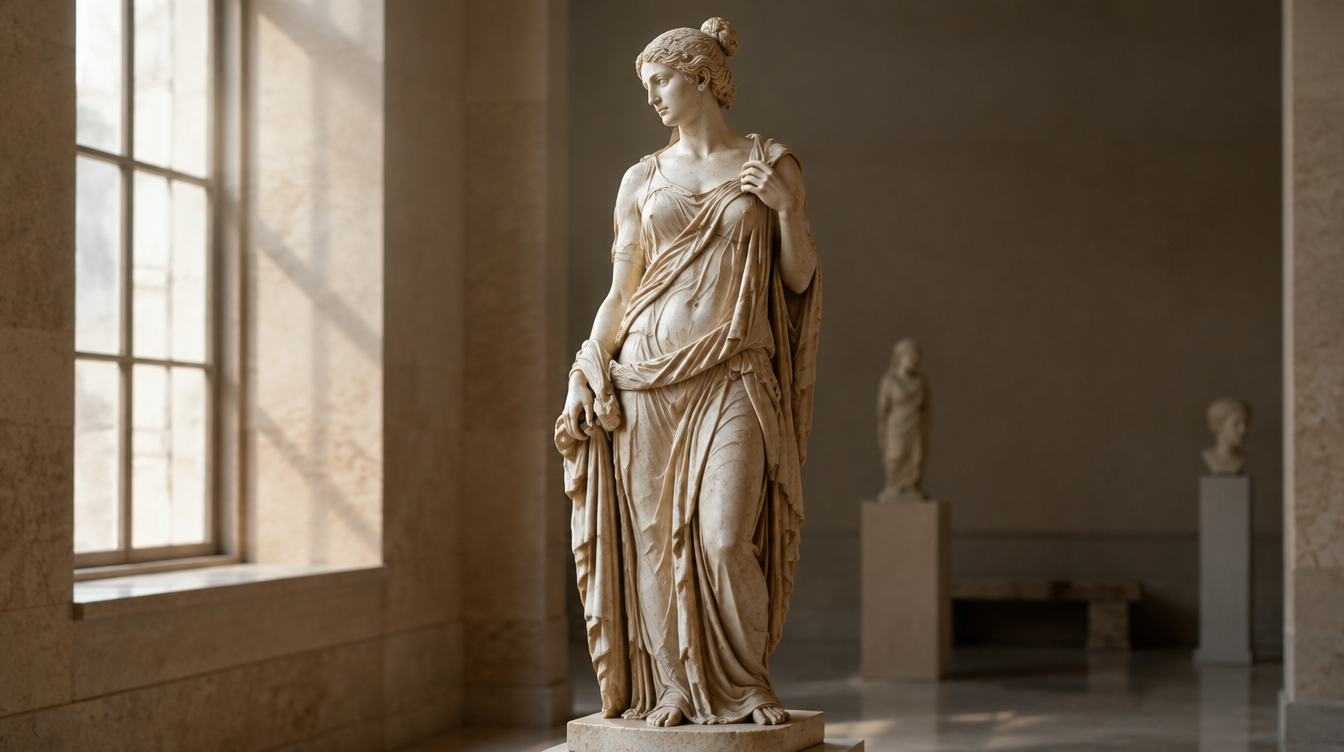
Ancient Greek philosophy can sound intimidating. Big names, long words, strange arguments about forms and atoms. But at its heart, it is simply a set of questions that any curious person has asked at some point: What is the world made of? How should I live? What is a good life? Can I trust what I see?
The Greeks were the first people in the West to ask those questions out loud, in public, and to argue about the answers. They did it in market squares, in gardens and on shady walkways, and their habit of questioning everything shaped the way we think today.
This beginner’s guide walks through Ancient Greek philosophy in plain language, organized around six big questions and the thinkers who tried to answer them.
Table of Contents
Quick Facts
Where it began: the Greek cities of Ionia, then Athens
When: roughly the 6th century BC to the late ancient world
Famous names: Socrates, Plato, Aristotle, Epicurus, Zeno and Diogenes
Main idea: use reason, not just tradition, to understand life
Word origin:philosophia, “love of wisdom”
How Ancient Greek Philosophy Began
Before philosophy, the Greeks explained the world with myths. Storms were sent by Zeus, the sea was ruled by Poseidon, and the seasons followed the story of Persephone. Around the 6th century BC, a few thinkers on the coast of Asia Minor began asking different questions: What if there is a natural explanation? What is everything made of?
The first of these thinkers was Thales of Miletus. He suggested that everything comes from water. We know today that this was not right, but the important thing is the method. Thales tried to explain nature by looking at nature itself, not at the gods.
This change did not mean the Greeks abandoned their religion. Many philosophers still honored the gods. But they started to add a new tool to the toolbox, and that tool was reason. If you want to see the mythic world that philosophy was responding to, start with our guide to the 12 Olympian gods.
Question 1: What Is the World Made Of?
The earliest philosophers, called the Presocratics, offered competing answers.
Thinker
His Answer
Thales
Water is the basic substance
Heraclitus
Everything changes, like a river you cannot step into twice
Pythagoras
The world is built from numbers and harmony
Democritus
Everything is made of tiny, indivisible atoms
📖 Quick Glossary:philosophía means “love of wisdom”; logos means reason or word; areté means excellence or virtue; eudaimonía means a flourishing life, the Greek idea of happiness.
Question 2: How Should We Question Ourselves?
Enter Socrates. Born in Athens around 470 BC, he did not write a single book. Instead, he walked through the city and talked to everyone: craftsmen, politicians, poets and young men. He asked simple questions like “What is justice?” or “What is courage?” and then asked more questions about the answers.
This became known as the Socratic method. It is a style of conversation where a questioner gently exposes the gaps in an argument until both people see it more clearly. It is still used in classrooms and law schools today.
Here is how a short Socratic exchange might sound if it were set in the Athenian marketplace.
A: I am sure I know what courage is. It is not running away in battle.
Socrates: What if a general pulls his army back to win a better fight? Is he a coward?
A: No… perhaps courage is something else.
Socrates: Then let us look for it together.
Socrates believed the wisest person is the one who knows how little they know. According to tradition, the oracle at Delphi once called him the wisest man in Athens. He thought this must be a mistake and set out to prove it, and his search became his life’s work. You can read more about the place in Wikipedia’s article on Delphi.
At the end of his life, Socrates was put on trial in 399 BC, accused of not honoring the city’s gods and of corrupting the young. He was sentenced to death, and he accepted the verdict calmly, drinking the cup of hemlock. His death made him the first great martyr of philosophy.
Question 3: What Is Real?
Socrates’ most famous student, Plato, took the questions further. Plato was convinced that the world we see is only a shadow of a deeper, unchanging reality, which he called the world of Forms.
To explain this, he told a famous story, the Allegory of the Cave. Imagine prisoners chained in a cave since birth, facing a wall. Behind them is a fire, and between the fire and the prisoners people carry objects. The prisoners see only shadows on the wall and believe they are real. One day, a prisoner is freed and forced to climb out. At first the sunlight blinds him, but eventually he sees the real world. When he returns to tell the others, they laugh at him.
🧭 Local Tip: If you visit Athens, begin at the ancient Agora, where Socrates talked with citizens, then continue to the park that preserves the site of Plato’s Academy. Both fit comfortably into one day of walking and short rides.
Question 4: What Is a Good Life?
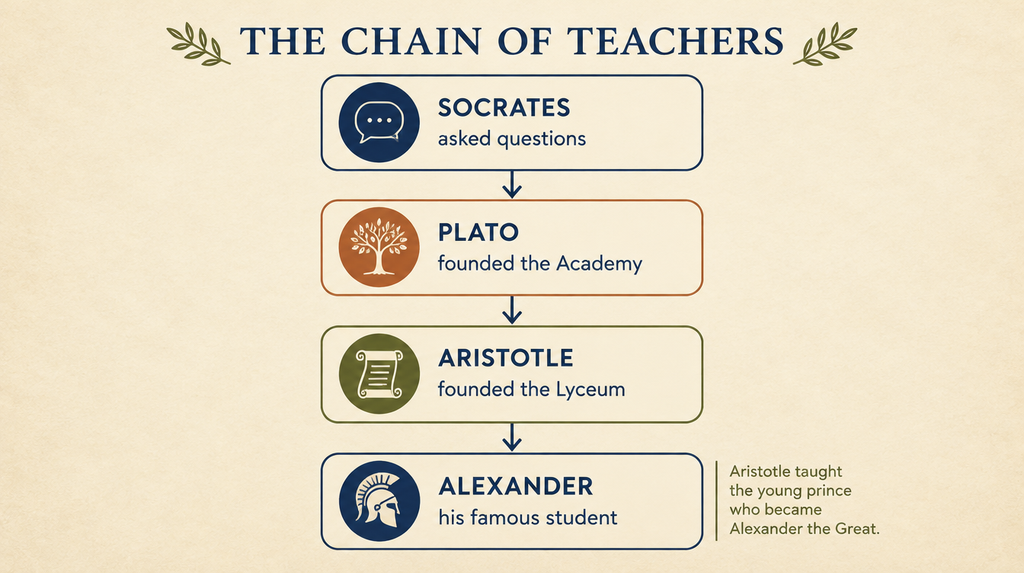
Aristotle, who studied under Plato for about twenty years, answered this one in a down-to-earth way. For him, the goal of life is eudaimonia, often translated as “flourishing” or “happiness.” But it is not a feeling. It is a way of living well, using your talents and practicing virtues like courage, generosity and moderation.
His famous idea of “the mean” says that virtue lies between two extremes. Courage, for example, is the midpoint between recklessness and cowardice. Generosity is the midpoint between wastefulness and stinginess.
Aristotle founded his own school, the Lyceum, where teachers and students often discussed ideas while strolling. The followers of his school were called peripatetics, “the walkers.” He also tutored a young prince who later became Alexander the Great.
Question 5: How Can We Be Happy?
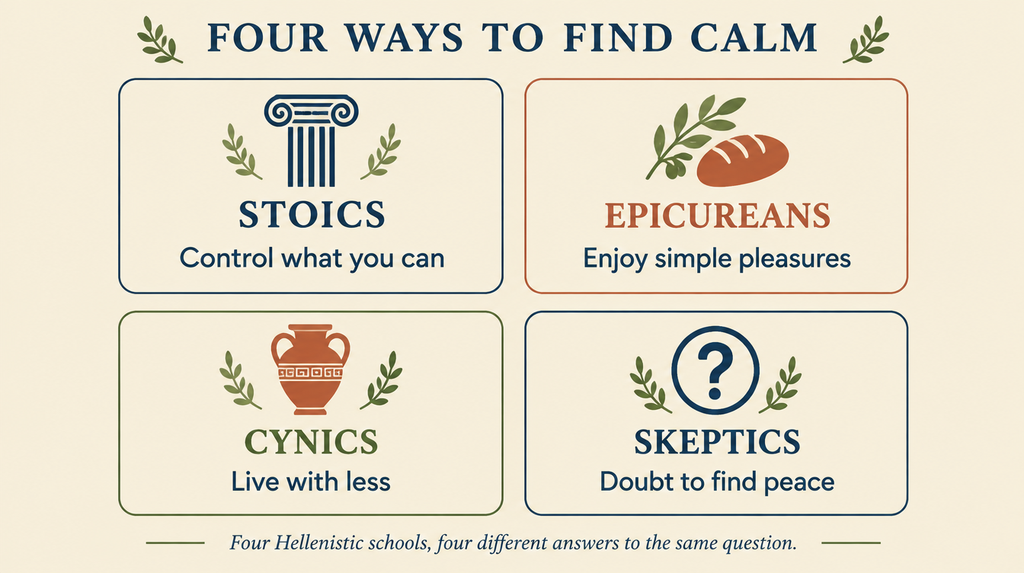
After Alexander, the Greek world became larger, noisier and less certain. People looked for philosophies that could help them live calmly. Four schools became famous.
School
Founder
Core Idea
Stoicism
Zeno of Citium
Accept what you cannot control, and focus on virtue
Epicureanism
Epicurus
Seek simple pleasures, friendship and freedom from fear
Cynicism
Diogenes
Live simply, ignore social show and be honest
Skepticism
Pyrrho
Doubt everything to find peace of mind
The Stoics got their name from the Stoa Poikile, the “painted porch” in the Athenian Agora where Zeno taught. The Epicureans met in a garden outside the city. Contrary to the popular stereotype, Epicurus did not teach luxury. He taught that the best pleasures are simple ones: bread, water, friends and conversation. That ideal fits nicely with the Greek table, as described in our guide to the Mediterranean diet, the Greek way of eating.
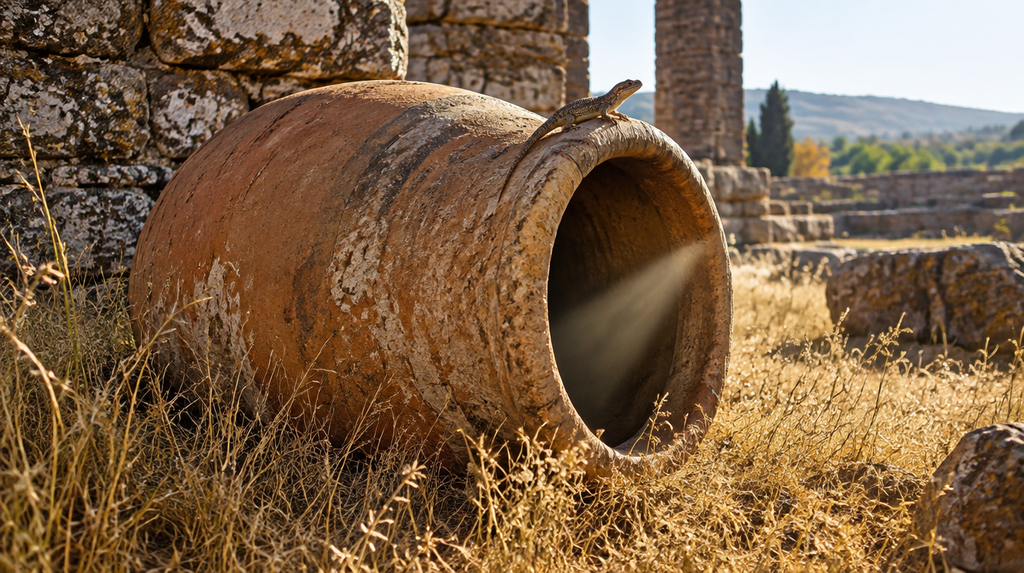
The Cynics went furthest in rejecting comfort. The most famous, Diogenes, is said to have lived in a large clay jar in the city. A well-known story tells that when Alexander the Great visited him and offered to grant any wish, Diogenes simply asked the king to step aside because he was blocking the sun.
Question 6: Can We Trust Our Senses?
The Skeptics asked a question that still unsettles people. If our senses sometimes deceive us, how can we be sure of anything? They did not insist that nothing is true. Instead, they recommended suspending judgment and not rushing to conclusions. The result, they said, was peace of mind.
You do not have to agree with them to see the value. Many of us rush to opinions online without checking the facts. A little skepticism, in the Greek sense, is a healthy habit.
Five Greek Habits You Can Try This Week
Philosophy was not only about theory. The Greeks saw it as a way of life. Here are five habits from Ancient Greek philosophy that anyone can try.
Ask one more question. Before you accept a claim, ask what evidence supports it. That is Socrates.
Walk and talk. Take a friend for a long walk and discuss something that matters. That is Aristotle’s Lyceum.
Sort what you control. Write two lists: things you can change and things you cannot. Focus on the first. That is Stoicism.
Enjoy something simple. Share a meal with friends and call it enough. That is Epicurus.
Know yourself. Spend ten quiet minutes asking what you really value. The phrase “know thyself” was carved at the temple of Apollo at Delphi, and it is a perfect motto for the whole subject. For the god behind that temple, see our story of Daphne and Apollo.
🗣️ Say It Like a Local: The Greek word philosophía (fee-lo-so-FEE-ah) is the very word we use in English. Say it aloud with a smile and you are speaking Ancient Greek, almost unchanged.
Philosophy and the Greek Table
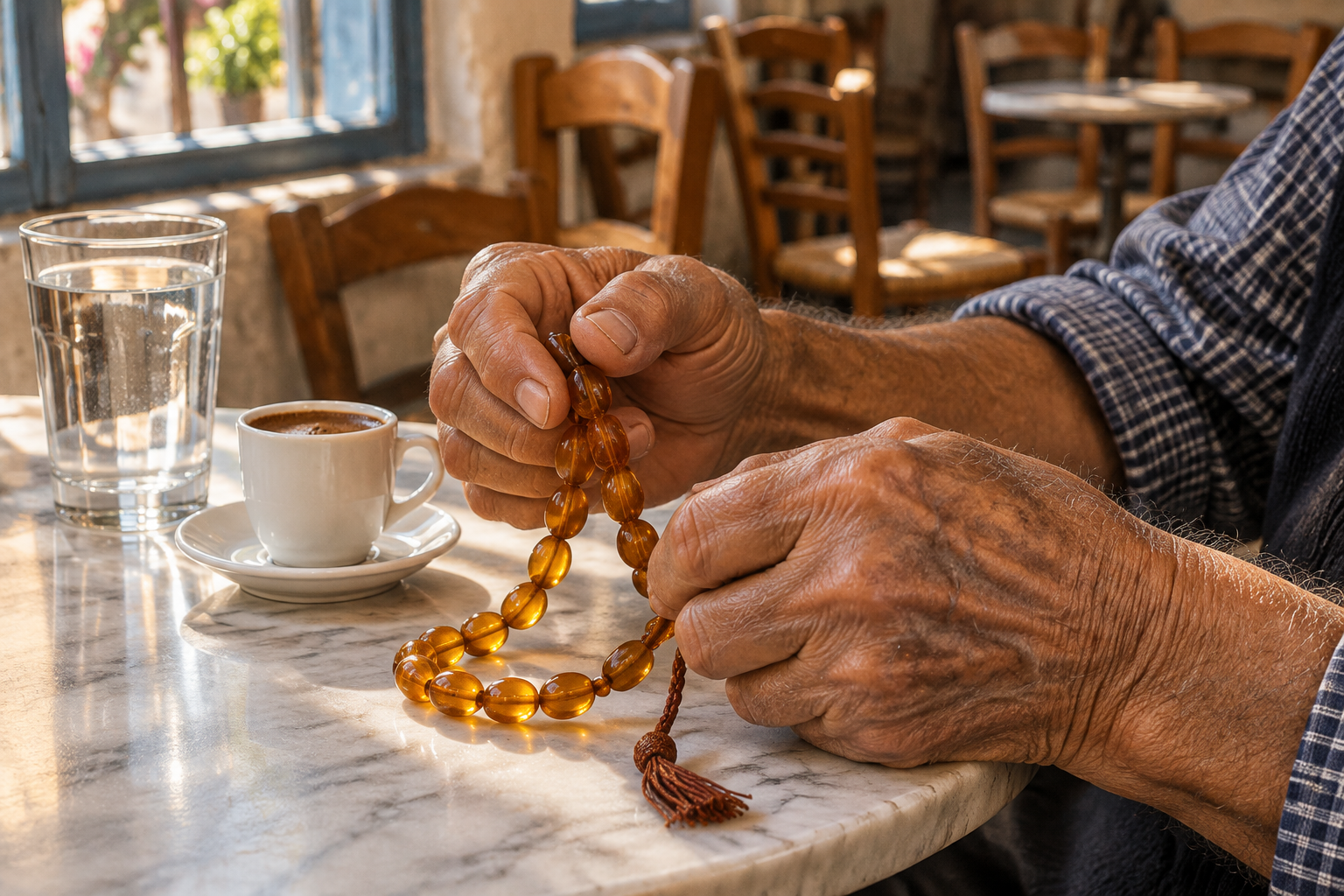
The old habit of long conversation never left Greece. The ancient symposium, a gathering of friends with wine and talk, evolved into the modern kafeneio, where men and women still debate politics and life over small cups of coffee. If you want to understand the ritual, our guide to what Greek coffee is and how it is made explains why the table matters.
The idea of welcoming a stranger into a conversation also has a long history. It connects with the tradition we explore in filoxenia, the Greek art of making strangers feel at home.
Where to Feel Ancient Greek Philosophy in Athens
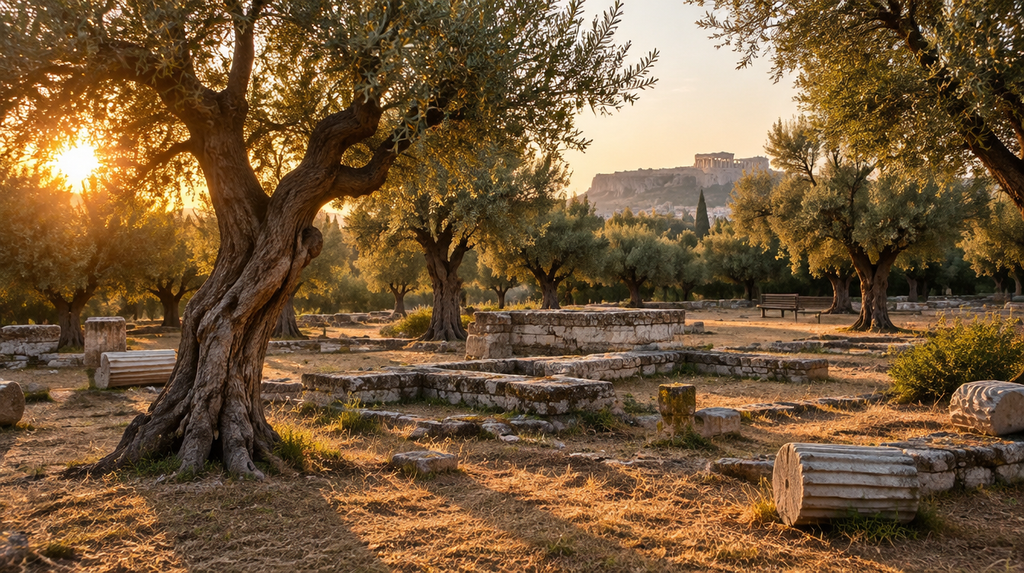
You can still walk where the philosophers walked. Start at the ancient Agora, where Socrates talked and the Stoics taught. Continue to the site of the Academy in a quiet park and then to the grounds of the Lyceum, where the foundations of Aristotle’s school have been uncovered. Our first-timer’s guide to Athens can help you plan the route, and the story of Athena vs. Poseidon and the contest that named a city shows why Athena, goddess of wisdom, was the perfect patron for a city of thinkers.
Rapid-Fire Questions About Ancient Greek Philosophy
Who is the best philosopher to read first? Many people start with Plato’s shorter dialogues, which are easy to follow and full of drama.
Did women study philosophy? Yes, though their number was small. Some, such as Hypatia in the later Roman period, became famous teachers.
Was Socrates really condemned for his ideas? The charges were religious, but historians think politics and resentment played a role.
What is the difference between Stoicism and Epicureanism? Stoics focus on duty and virtue, and Epicureans on pleasure and peace. Both aim at calm.
Do I need to read Greek? Not at all. Excellent translations exist for every major thinker.
Why It Still Matters
Ancient Greek philosophy lasts because the questions never expire. We still ask what is real, how to live and how to be happy. The Greeks did not give final answers, but they gave us something just as useful: a way of asking.
So the next time you catch yourself wondering what a good life looks like, you are doing exactly what Socrates did on a warm day in the Athenian marketplace. Keep asking.
Illustrations in this article were created using AI in a photorealistic style.
Want to hold a piece of this history in your hands? Visit our official shop for digital albums, CDs, and restored vinyl records celebrating the golden era of rebetiko.