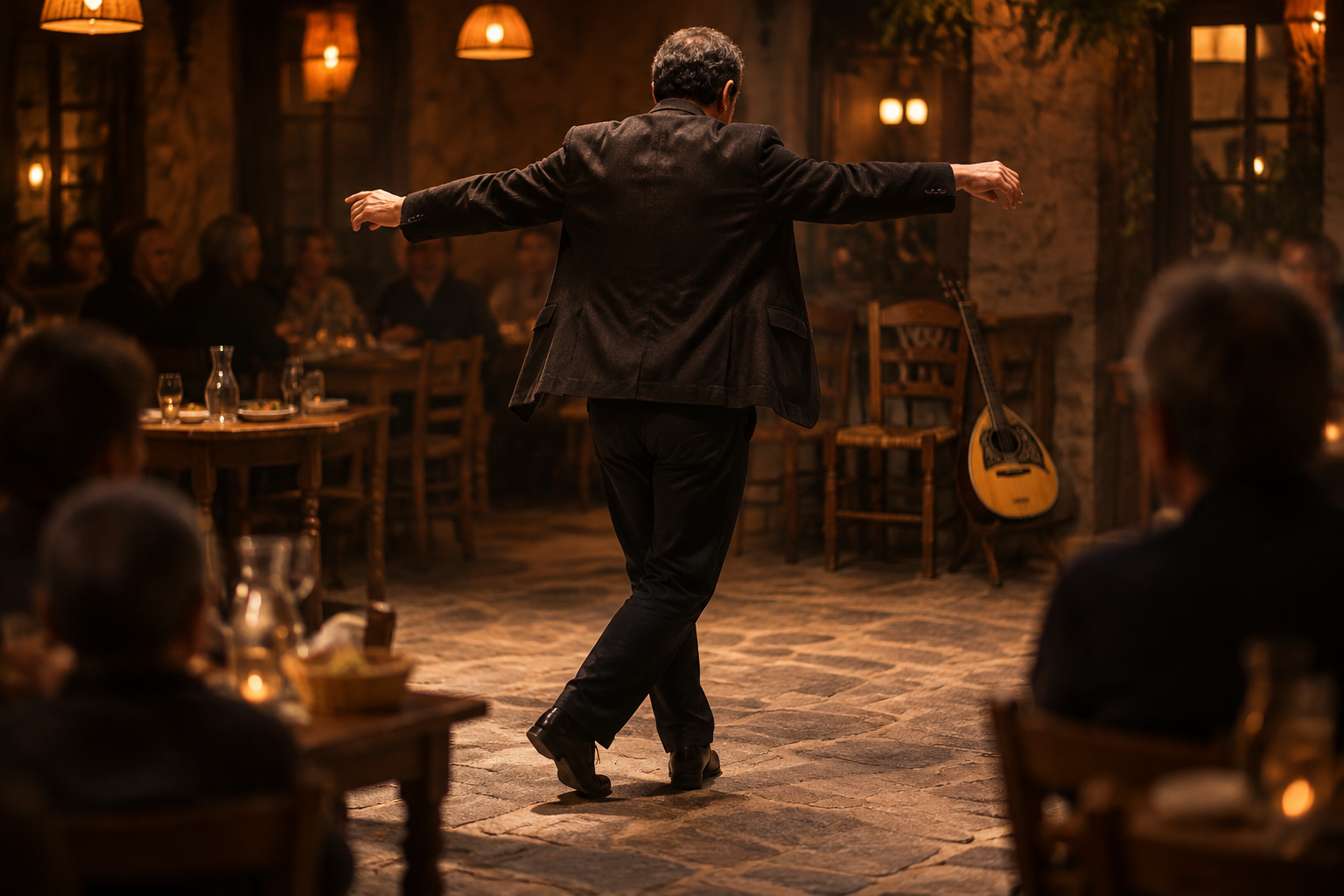
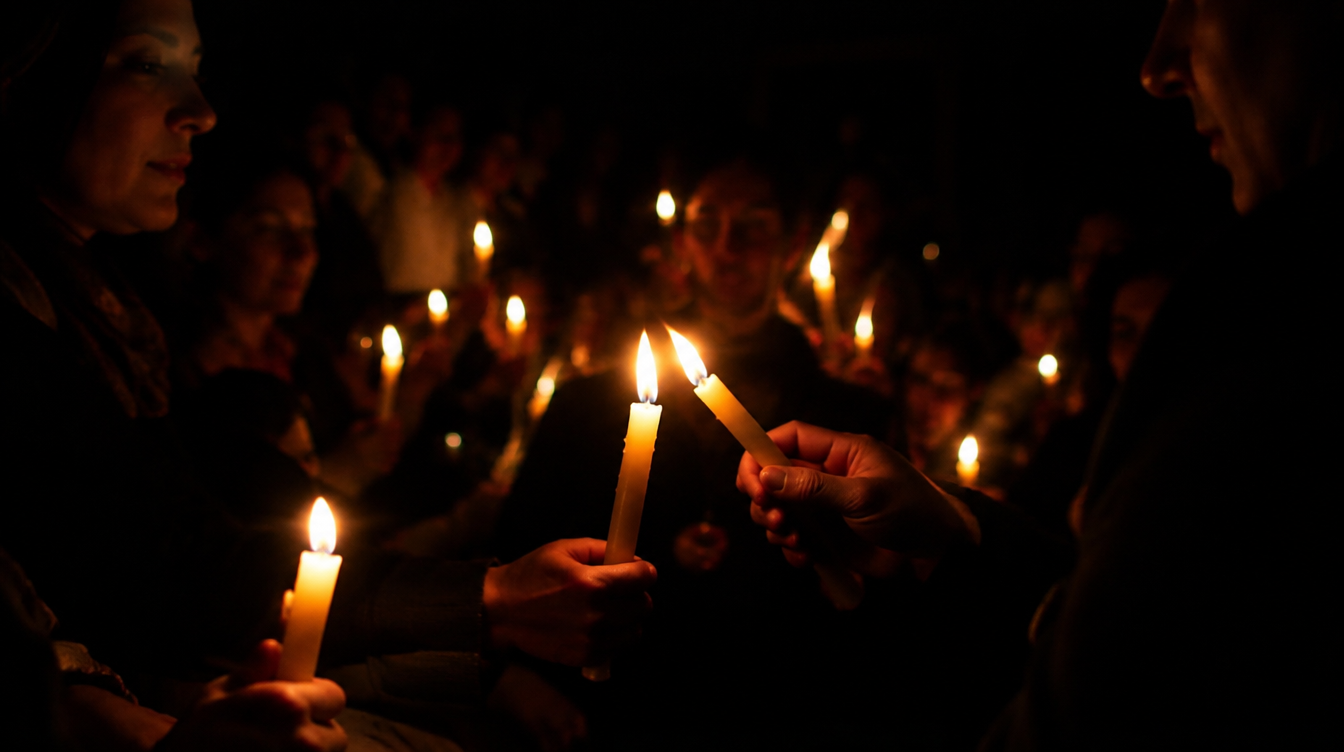
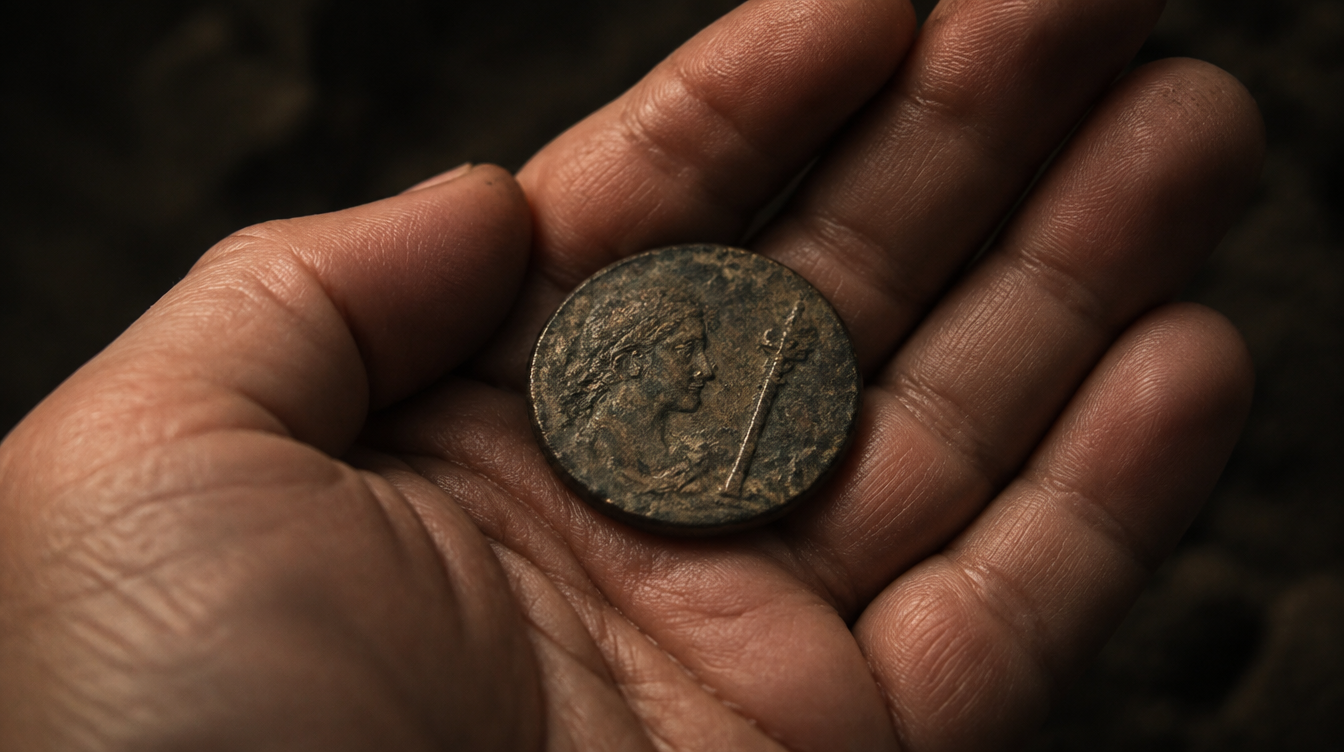
It is past midnight in a taverna somewhere in Greece. The plates have been cleared and the wine is half gone. Then the band slides into a slow, heavy song, and a man at the back table pushes his chair away. He stands. He rolls his shoulders. He walks to the middle of the floor, and the whole room goes quiet.
He is about to dance a zeibekiko. Nobody will join him. Nobody will cut across his space. Nobody will shout over the music. For the next few minutes, the floor belongs to one person, and everyone in the room knows it. If you have ever wondered why Greeks treat this dance with a kind of hushed respect, this guide is for you.
When the zeibekiko begins, the whole taverna goes quiet.
What Is the Zeibekiko?
The zeibekiko (Ζεϊμπέκικο) is a Greek folk dance, and it is nothing like the circle dances you see at weddings. It is a solo dance, traditionally performed by one man at a time. It has no set steps. It has certain figures and a circular movement, but the rest is improvised. Everything the dancer does comes from what he feels in that moment, and the whole dance happens in a very small space, often described as less than a square metre.
The music is built on a slow, heavy beat counted in nine. You will see it written as 9/4 in some places and 9/8 in others, because musicians and writers do not always agree on how to notate it. What matters is the feeling: weighty, a little swaying, and just uneven enough to keep you leaning in.
The dancer’s outstretched arms have earned it a nickname, the “eagle dance.” And the mood matters as much as the movement. The zeibekiko is danced to express sorrow, longing, pride and the weight of a hard life. Greeks often describe it as a personal ritual more than a performance, and the dancer usually chooses a song that matches his state of mind.
📖 Quick Glossary:Zeibekiko (Ζεϊμπέκικο) is the solo dance. Zeibeks were the irregular fighters it is named after. A mangas (μάγκας) is a tough, proud street character of the rebetiko world. Rebetiko is the urban music of the taverns, where the dance found its home.
From the Zeybeks to the Taverna: A Short Timeline
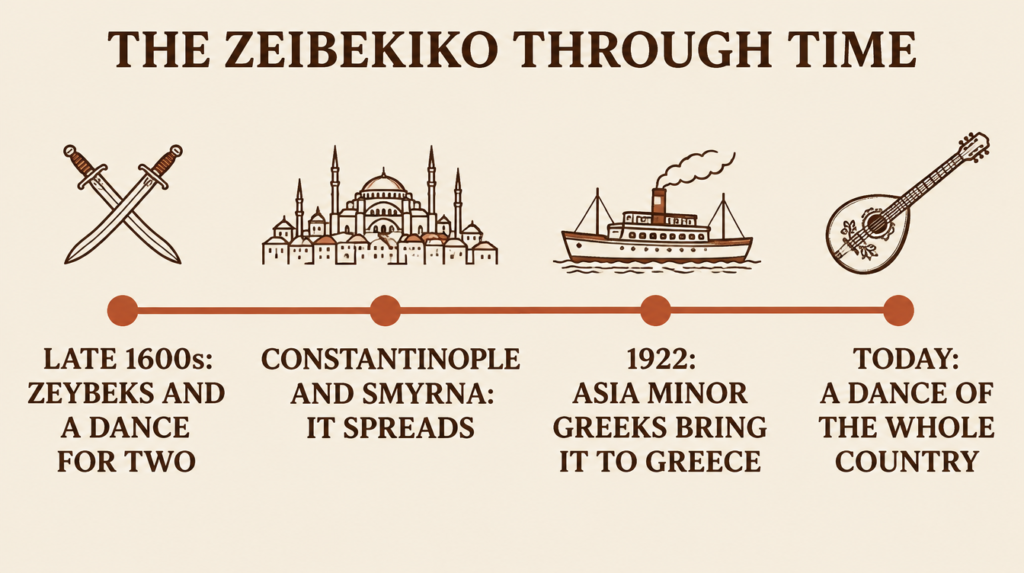
The name comes from the Zeybeks, irregular militias in the Aegean region of the Ottoman Empire, active from the late 17th to the early 20th century. The dance was first popularized in cities such as Constantinople and Smyrna, and it began as a dance for two armed men facing each other. Over time that duel turned inward and became an improvised solo.
The Zeybeks were active around Prousa (today’s Bursa) and Erythrai. Popular accounts describe them as mountain rebels who protected villagers from tax collectors and greedy feudal lords, which helps explain the dance’s proud, defiant air. The traveler Evliya Çelebi is reportedly among those who saw a version of it danced at local feasts in Magnesia and Aydın.
You may have noticed that Turkey has a related dance, the zeybek, and that the two are described as similar. How the two family trees connect is a topic where historians and dancers do not fully agree, so we will not take sides here. This article is about the Greek zeibekiko and how it lives in Greece today.
What we can say is how it arrived. After the 1922 population exchange, when Greeks from Asia Minor came to Greece in huge numbers, the dance spread across the mainland. If you want the full story of that moment, our piece on the Asia Minor refugees of 1922 covers it. The zeibekiko traveled with them, settled in the port taverns and became part of the birth of rebetiko in Piraeus. In those same taverns you would also have heard the click of a komboloi, the worry beads that kept many a restless hand busy while the band tuned up.
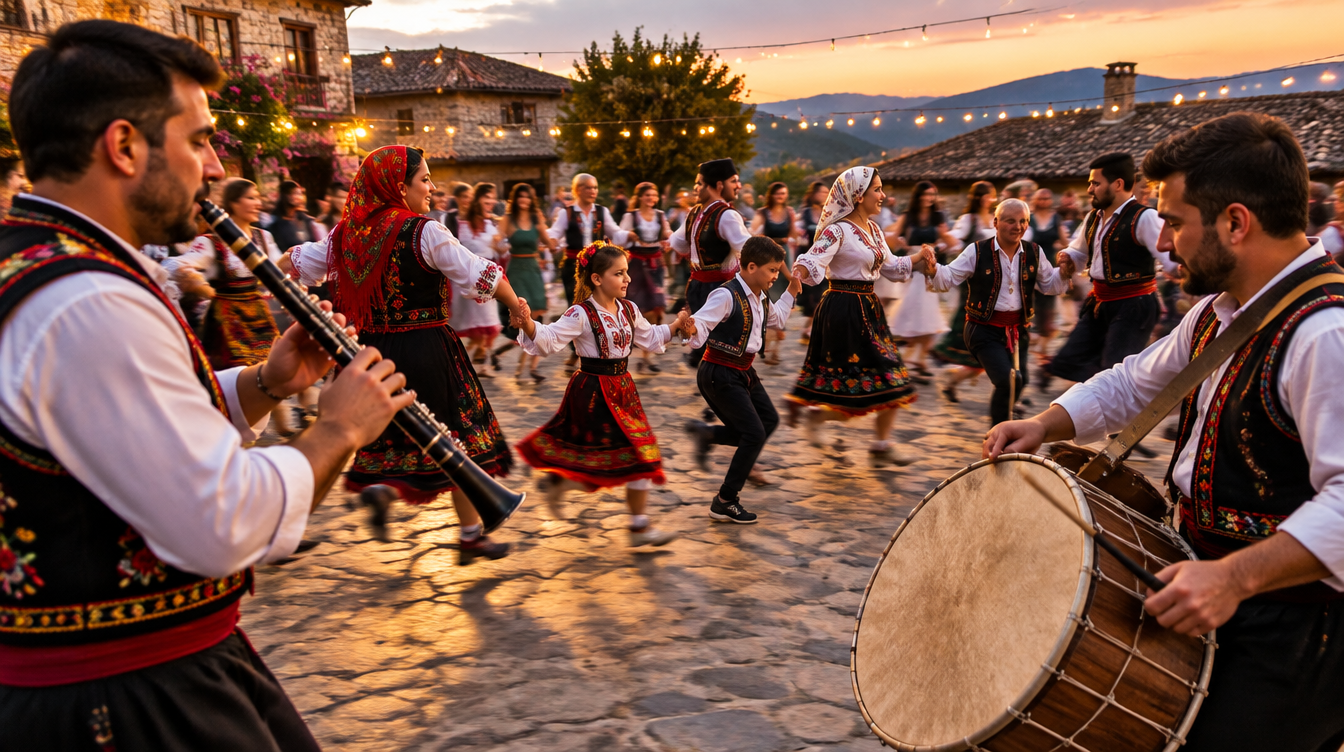
From a dance for two armed men to the solo you see in tavernas today.
Five Minutes on the Floor: A Zeibekiko, Beat by Beat
Here is how a typical zeibekiko unfolds, from the first note to the last. Every dancer does it differently, so think of this as a map, not a recipe.
The song chooses the moment
Someone asks the band for a particular song, or the band starts one and someone hears his own story in it. In the zeibekiko, the dancer often picks the music to match what he is carrying that night. A slow, heavy tune is the signal. People shift in their chairs. Conversations stop mid-sentence.
The stand
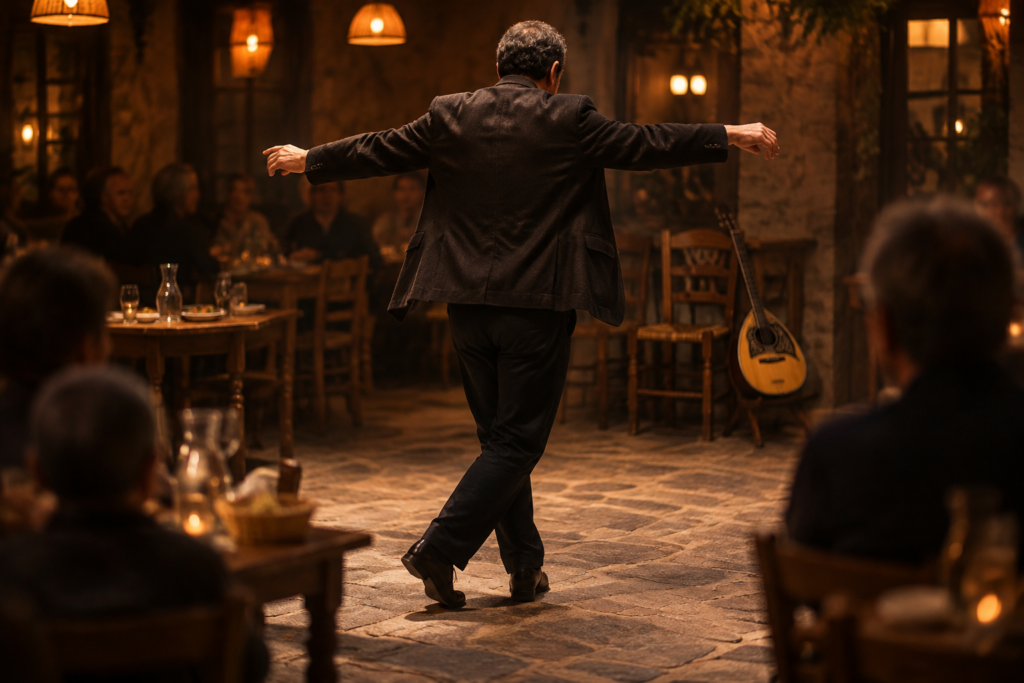
He walks out and pauses before he moves. This pause is a big part of the dance. Then the arms open, shoulder-high, like wings, and the body begins to turn slowly in place.
Most of the dance happens in a very small circle.
The turn
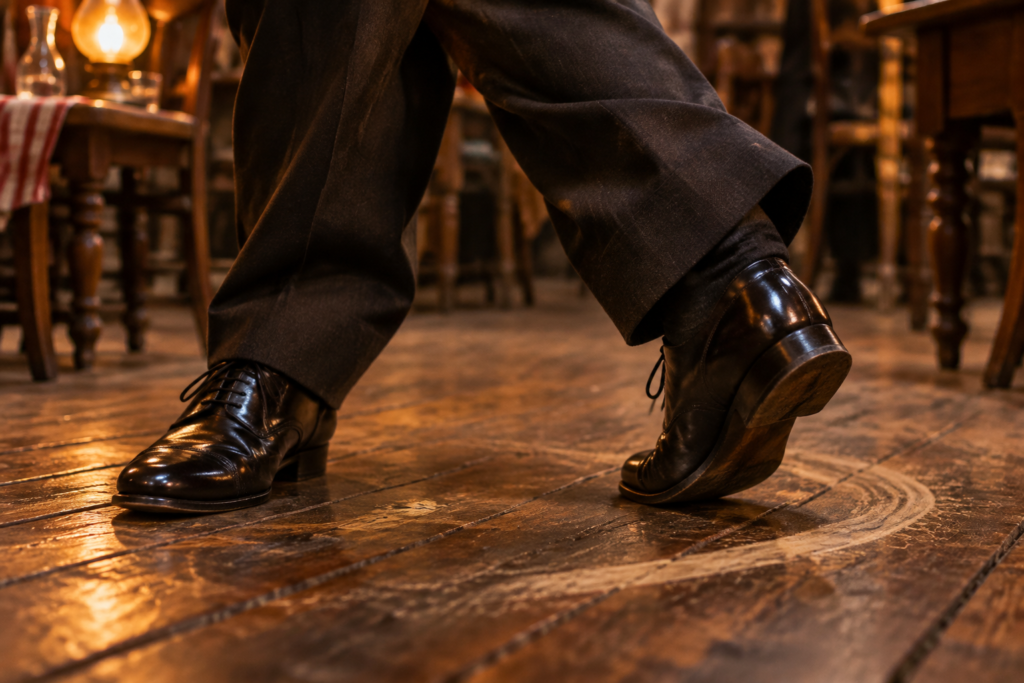
The movement is circular and unhurried. There are known figures, but no fixed order. He may turn, pause, lower himself, rise again and stare off into the distance. The dancer is telling a story with his body, and nobody is expected to understand every line.
The tricks
Here and there, the dancer adds a flourish. Some stand on a chair. Some lift a whole table. Others are said to pick a glass of wine off the floor with their mouth, which takes real balance and a steady neck. A slap of the palm on the thigh is a common gesture, often a sign of surprise or strong emotion, as if the dancer were reacting to hard news only he can hear. These moments add bravado and humor, and they are why the dance can be both solemn and playful.
Lifting a table is one of the classic feats of the dance.
The last note
When the music ends, so does the dance. There is usually no bow and no speech. The man simply returns to his seat, and the room slowly breathes again.
The Unwritten Rules of the Floor
The zeibekiko is full of rules that nobody has ever written down. Here are the ones that matter most for anyone watching.
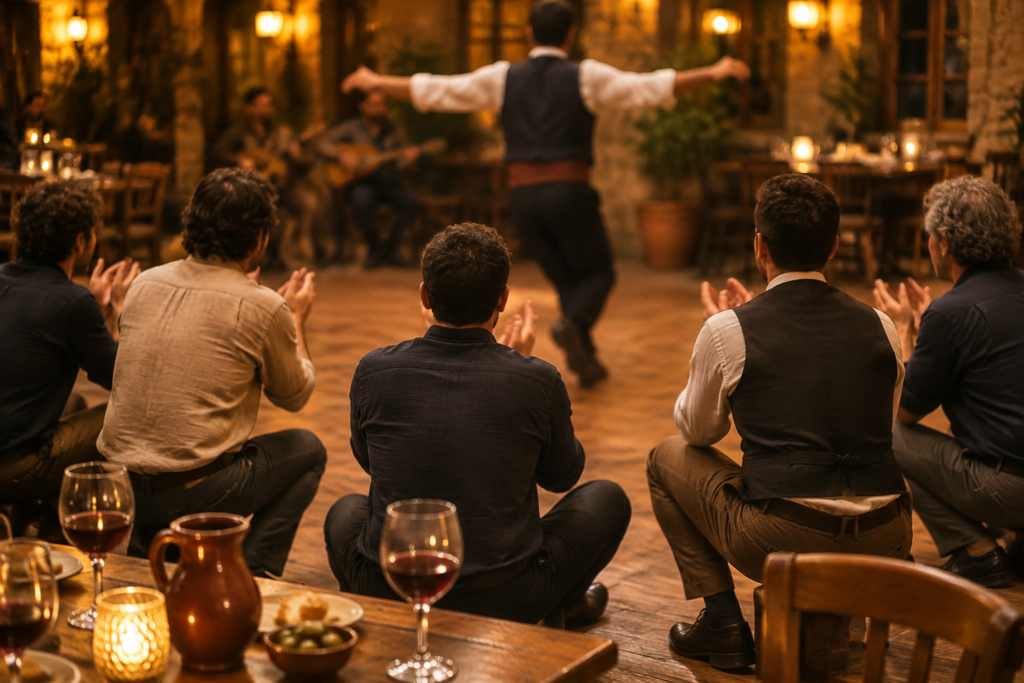
The second rule is more flexible, and it depends on where you are. In some places, friends kneel in a circle around the dancer and clap along to encourage him. In others, he dances in silence while the room watches. Both are described by writers on the dance, and both are real. When in doubt, watch the locals and follow their lead.
Do
Don’t
Stop talking and give the dancer your attention
Walk across the floor while he is dancing
Follow what the locals do around you
Join in uninvited, or dance beside him
Let him finish, even if it feels long
Treat it like a party dance and cheer over it
Applaud politely when the song is over
Film from right in front of him
⚠️ Common Mistake: Treating the zeibekiko like sirtaki or a wedding line dance. It is a personal moment, not a group activity. If a Greek friend gets up to dance, the best thing you can do is stay quiet and watch.
In some tavernas, friends kneel around the dancer and clap him on.
Why It Hits So Hard: A Dance About Loss
Ask a Greek why the zeibekiko moves people, and the answer usually comes back to loss. Writers describe it as an expression of grief, longing, sorrow and unfulfilled dreams, even the loss of a homeland, and they compare it to a moment of prayer. It originated in Asia Minor, a region historically populated by Greeks, and it followed centuries of Ottoman rule and the large population exchange of the early 20th century. That history sits inside the dance, even when the dancer is only thinking about a bad week.
It also explains the “once only” habit. A real dancer, one writer notes, performs once and does not hog the floor in front of the band. He is not there to impress anyone. He picks the song and the lyric that match his state of mind, says what he has to say, and sits down.
The zeibekiko is different from the dances visitors usually meet first. Sirtaki and kalamatianos are social, and the group is the point. In the zeibekiko the individual is the point. Dancers do borrow some figures from the tsamiko and kalamatianos, but they use them to tell a private story. Strangers are expected to keep their distance, and even friends treat it as a personal moment.
The Songs Behind the Dance
The zeibekiko is a rhythm, so countless songs have been written in it. The names you will hear most often come from the golden age of rebetiko and the generations after it. Markos Vamvakaris is credited with helping shape the dance in the taverns, and Vassilis Tsitsanis wrote some of its best-loved songs. Later composers, among them Apostolos Kaldaras, Stavros Xarhakos and Manos Loizos, carried it into new decades.
One piece stands out. “Evdokia” is an instrumental by Manos Loizos, and it is so strong that, according to one Greek music site, lyricists avoided writing words for it. The film Evdokia, directed by Alexis Damianos, is also said to have helped make the dance popular. If you only listen to one zeibekiko today, make it this one, and notice how little the melody needs a singer.
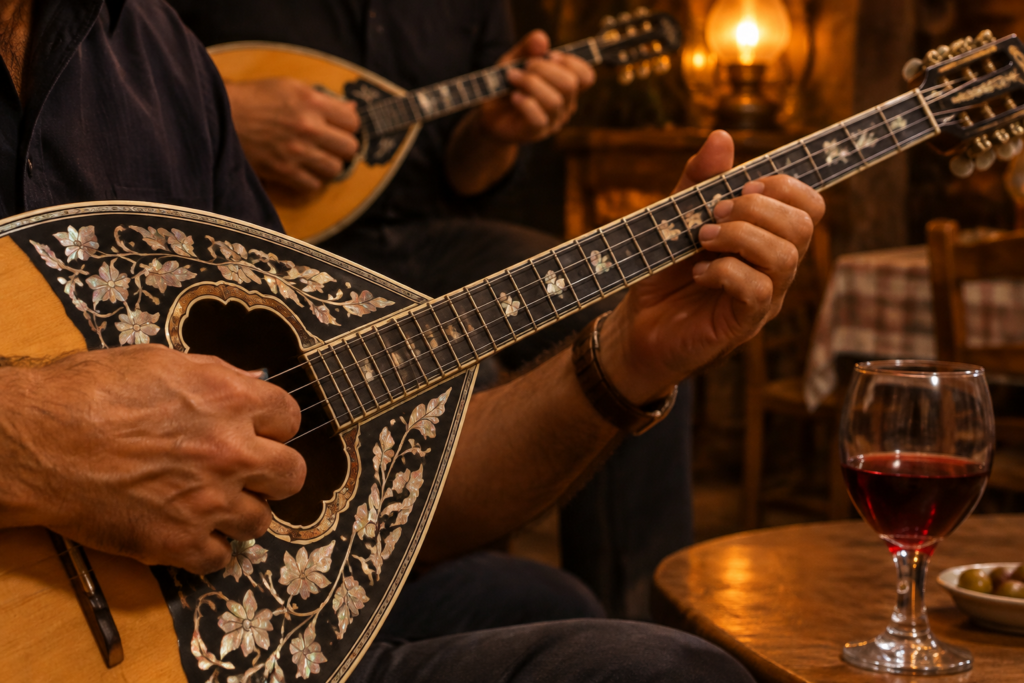
The dance was originally considered a rebetiko dance. Since the 1980s it has been seen as Panhellenic, a dance of the whole country, not just of the port taverns. And its instrument, the bouzouki, is as much a part of the moment as the dancer himself.
The bouzouki carries the slow, heavy pulse of the zeibekiko.
🧭 Local Tip: If you want to hear how the dance sounds, start with a live evening in an Athens taverna. Our guide to live rebetiko in Athens lists where to go, and our rebetiko slang glossary will help you follow the lyrics.
Is It Still a Men’s Dance?
Traditionally, yes. The zeibekiko was danced only by men, and it was often tied to the proud, hard-edged world of the mangas. Writers on the dance link it to stoic acceptance of hardship, and say it was never meant as a display for the young or the wealthy.
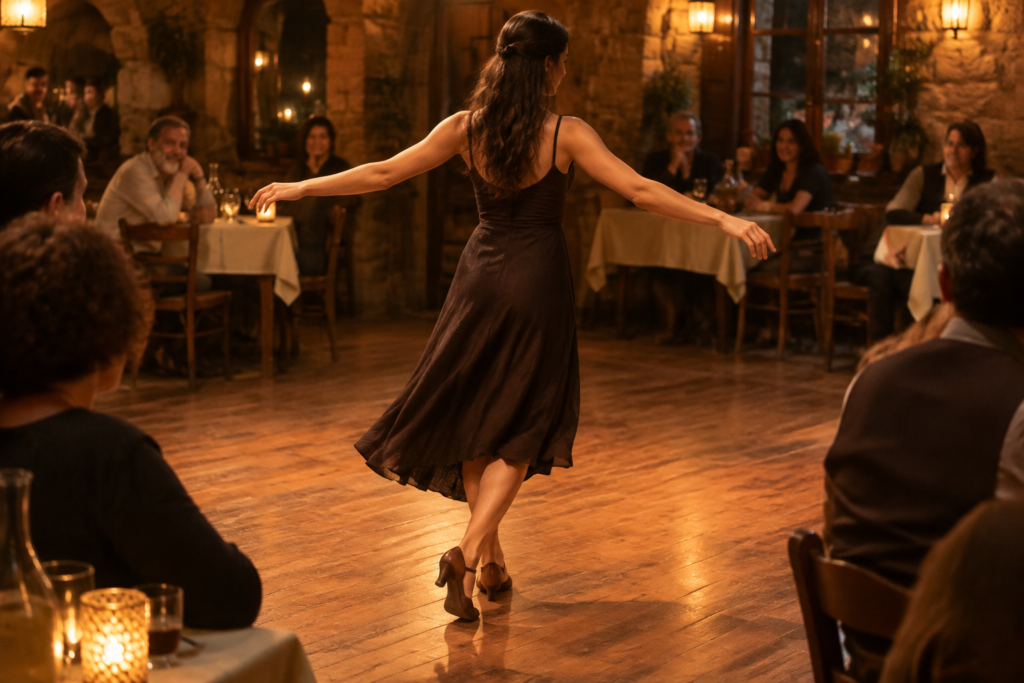
Times have changed. Women now commonly dance the zeibekiko too, and they bring their own interpretations to it. That is not a break with tradition so much as a sign that the dance has kept breathing. A dance that expresses loss and longing was never going to belong to one gender forever.
There is one more modern wrinkle. Some Greeks complain that the dance has become a public show, with politicians and celebrities performing it for cameras. They argue that this strays from its inward, personal nature. It is a fair point, and a good reason to treat the zeibekiko with the same quiet respect you would give any ritual.
Today women dance the zeibekiko too, each with her own interpretation.
How to Watch Your First Zeibekiko
You do not need to speak Greek or know the songs to appreciate a zeibekiko. A few simple habits will make the evening better for you and for everyone around you.
Arrive with the evening. The zeibekiko tends to come late, once the room is warm and the wine has done its work.
Listen for the change. A slow, heavy song after a lively one is often the cue.
Put the phone down. If you must film, do it from your seat and keep the camera low.
Hold your applause. Wait until the last note has faded, then clap warmly.
Say a quiet thanks to your host. If a friend danced, a nod afterwards is plenty.
Above all, remember that you are a guest at someone’s private moment. That is the very spirit of filoxenia, the Greek habit of hospitality: you are welcomed in, and you repay it with respect.
If you are lucky, you will see something that no tourist show can copy: a person alone in a room full of people, saying something he does not have words for. That is the zeibekiko. No rehearsal, no audience request and no applause needed.
Illustrations in this article were created using AI in a photorealistic style.
Want to hear the story? Listen to our digital album The Tears of the Aegean, available in our official shop.