Introduction
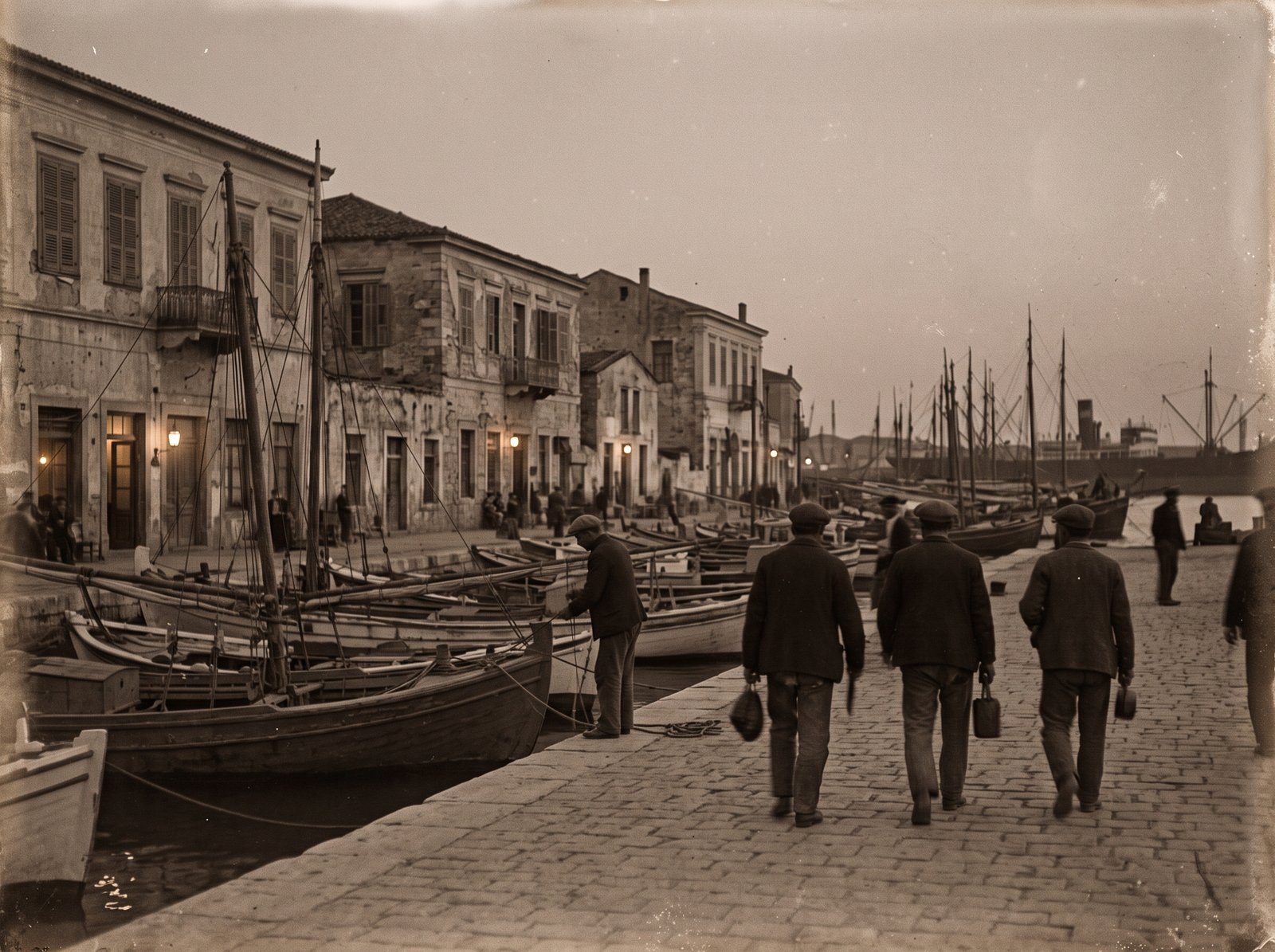
There is a particular kind of silence that falls over old Piraeus at dusk. The port grows quiet, the gulls settle, and if you close your eyes, you can almost hear it. A bouzouki, tuning itself in a back room. A glass set down on a wooden table. A voice, rough with cigarette smoke, beginning to sing.
This is where our story lives. Not in palaces or concert halls, but in the low-ceilinged tavernas near the harbor, where in the 1930s a new kind of music was taking its first breath. It was called Rebetiko, and it carried the weight of displacement, poverty, and stubborn joy.
To understand Greece in the twentieth century, you must first understand this music. And to understand this music, you must first understand Piraeus.
A City Built from Loss
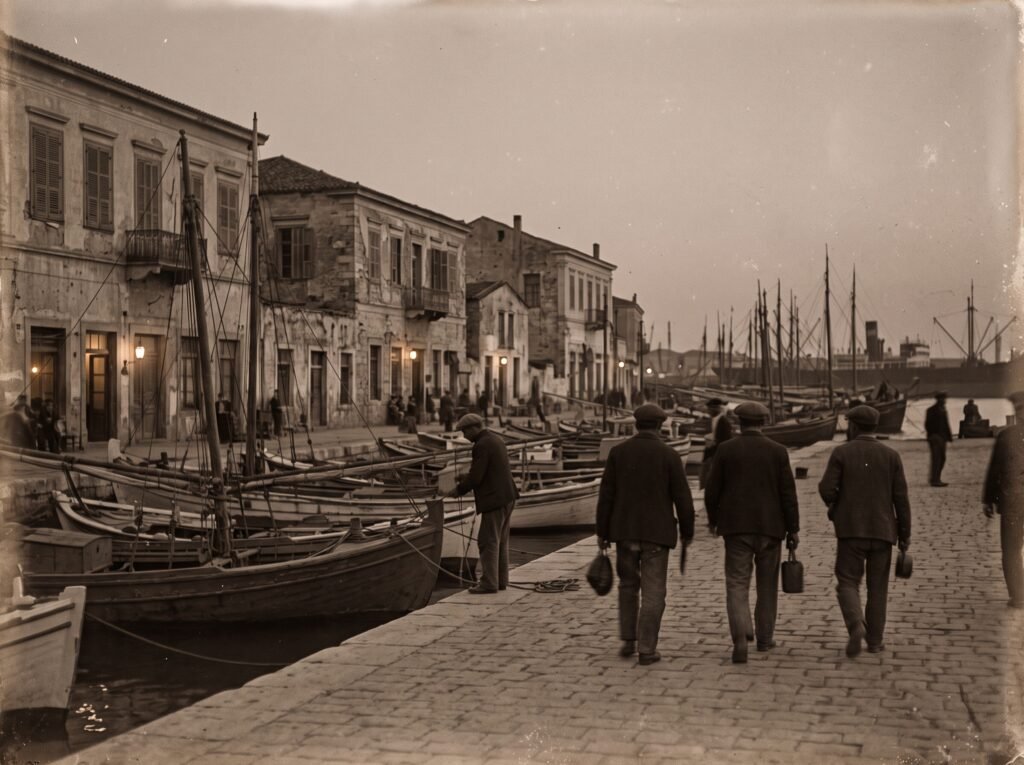
Piraeus in the 1930s was not the postcard version of Greece. It was a city of newcomers, crowded and restless, still absorbing the shock of a recent catastrophe.
In 1922, after the Asia Minor Catastrophe, well over a million Greek refugees arrived from Smyrna and the Anatolian coast. Many of them landed first in Piraeus, carrying almost nothing but memory.
They brought something else too, something that could not be confiscated at the border.
- Musical traditions from Smyrna’s cafés and courtyards
- Instruments like the outi and the santouri, rarely heard before in mainland Greece
- A particular way of bending a melody, full of longing, known as amanes
These refugees settled into overcrowded neighborhoods near the port. Life was hard. Work was scarce. And in that hardship, a musical language began to form.
The Meeting of Two Worlds
Rebetiko did not arrive fully formed. It grew from a collision between two very different musical worlds, both struggling to be heard in the same narrow streets.
On one side stood the Smyrna style, elegant and ornamented, played on santouri and violin. On the other stood a rougher, homegrown sound from the Greek underworld, the hashish dens, and the prison courtyards.
This second strand is often called Piraeus style. It was sparser, more percussive, built around the bouzouki and the baglamas. It did not try to charm. It tried to tell the truth.
By the early 1930s, these two currents were beginning to merge in the tavernas of Piraeus, creating something neither refugee nor native, but entirely new.
The Tavernas as Sacred Ground
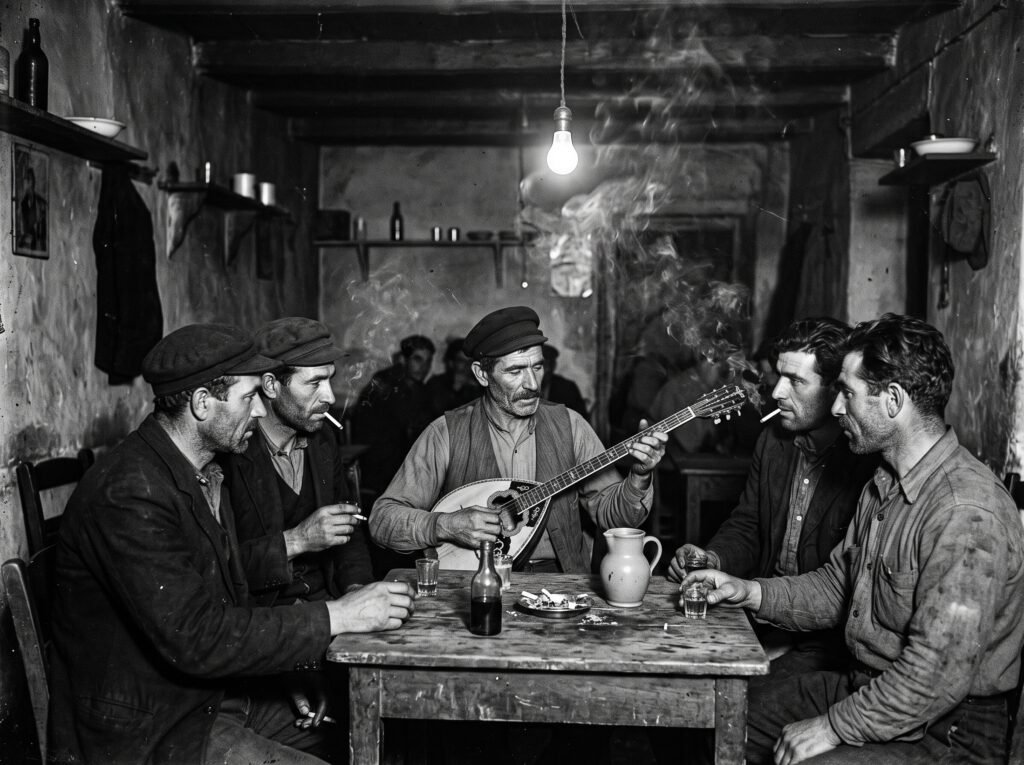
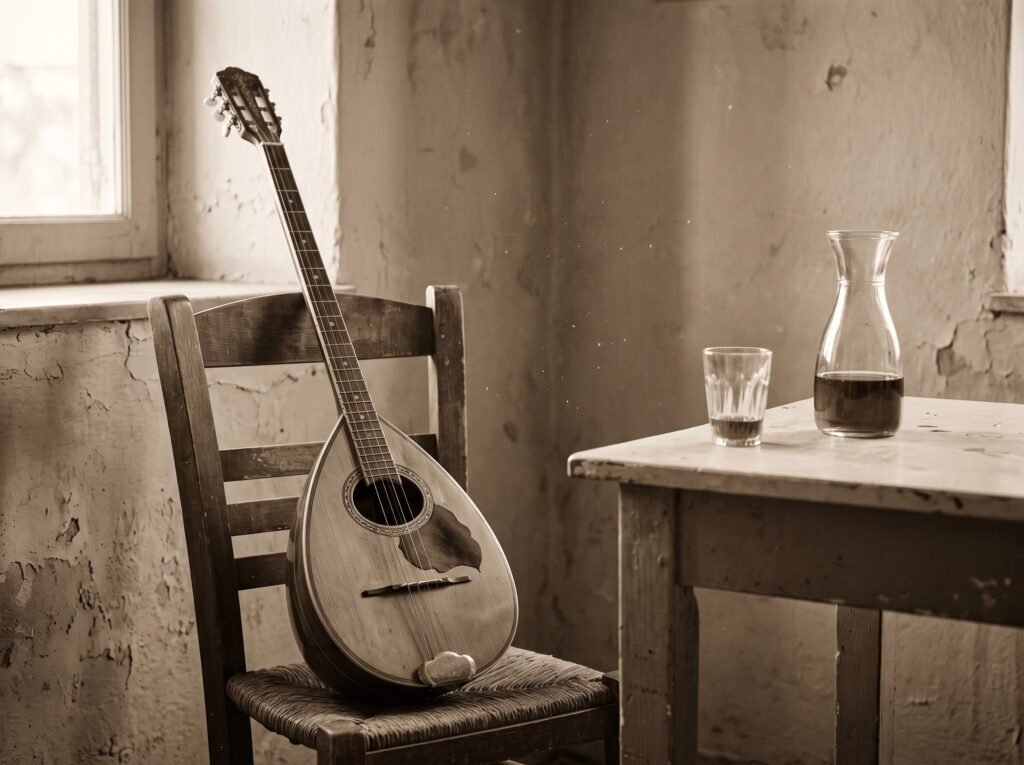
It is easy to romanticize the taverna, but let’s be honest about what it actually was. A cramped room. Cheap wine. Men who worked with their hands all day and needed somewhere to put down the weight of it at night.
These were not concert venues. They were survival spaces.
And yet, inside them, something close to ritual took place. A musician would begin a slow taximi, an improvised solo with no fixed rhythm, and the room would fall still. Then the rhythm would enter, and with it, the dance.
The Zeibekiko: A Dance of One
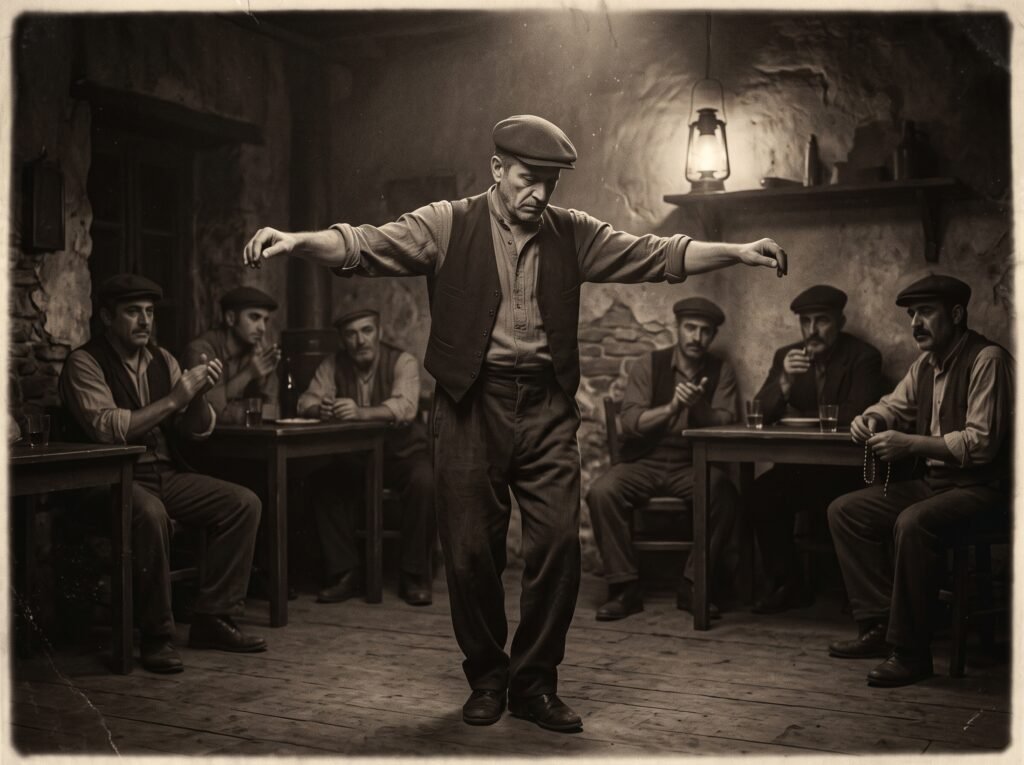
No single image captures old Rebetiko culture better than the zeibekiko. This was not a couple’s dance. It was solitary, almost meditative.
A man would rise from his table, alone, and move slowly in a circle, arms outstretched like a bird balancing in wind. No fixed steps. No performance for an audience. Just a private conversation between the dancer and his own troubles.
Friends would sometimes kneel around him, clapping softly, protecting the moment rather than interrupting it. It was respect, not applause.
Music Born from the Margins
The early Rebetiko world was tangled up with poverty, and often with the hashish dens known as tekes. This history makes some people uncomfortable, but honesty matters more than comfort here.
Many of the first great Rebetiko songs were written by men living on society’s edges: sailors, laborers, small-time smugglers, refugees with no papers and no safety net. Their lyrics spoke plainly about things polite society preferred to ignore.
- Poverty and hunger
- Prison and police harassment
- Love affairs gone wrong
- The particular ache of exile
This was music without pretension. It did not ask permission to exist.
The Instruments That Carried the Story
Every era has its own voice, and Rebetiko’s voice came from a small, specific family of instruments. Each one shaped the sound in its own way.
- The bouzouki — the long-necked lute that became Rebetiko’s defining instrument, sharp and metallic, capable of both fury and tenderness
- The baglamas — a miniature bouzouki, small enough to hide from police raids, its tiny frame producing a bright, urgent tone
- The outi — a fretless lute inherited from the Smyrna tradition, warm and rounded, built for slow improvisation
- The santouri — a hammered dulcimer, shimmering and delicate, a direct echo of the refugee musicians from Asia Minor
By the mid-1930s, the bouzouki had begun to dominate, pushing the ensemble toward the leaner, harder Piraeus sound that would define the genre’s golden years.
A Sound the Authorities Tried to Silence
It is worth remembering that this music was not always welcomed. Greek authorities in the 1930s viewed Rebetiko with suspicion, associating it with the underworld and the hashish dens.
Certain songs were banned from radio. Certain rhythms were considered too foreign, too raw, too honest about how ordinary people actually lived.
And yet the music survived, moving quietly from taverna to taverna, carried by musicians who had nowhere else to be heard, and by listeners who recognized their own lives in every verse.
A Legacy That Still Echoes
What began in those smoky rooms near the Piraeus docks would go on to shape Greek popular music for the rest of the century. The sorrow, the dignity, the stubborn beauty of it all never really left.
When we listen to Rebetiko today, we are not just hearing old recordings. We are hearing the voices of refugees who rebuilt their lives from nothing, and dockworkers who turned exhaustion into art.
That is the real inheritance of this music. Not nostalgia alone, but proof that beauty can grow in the hardest ground.
Bring That Piraeus Night Home
Some stories are best read. This one is best heard.
If these tavernas and their music have stirred something in you, a little longing, a little recognition, we invite you to carry that feeling further. At our official shop, you will find restored recordings that bring this era back to life, exactly as it once sounded through the smoke of an old Piraeus room.
Visit shop.echoesofpiraeus.com to explore our collection of digital albums, remastered CDs, and restored vinyl pressings from the golden age of Rebetiko. Let the bouzouki play once more, this time in your own home.