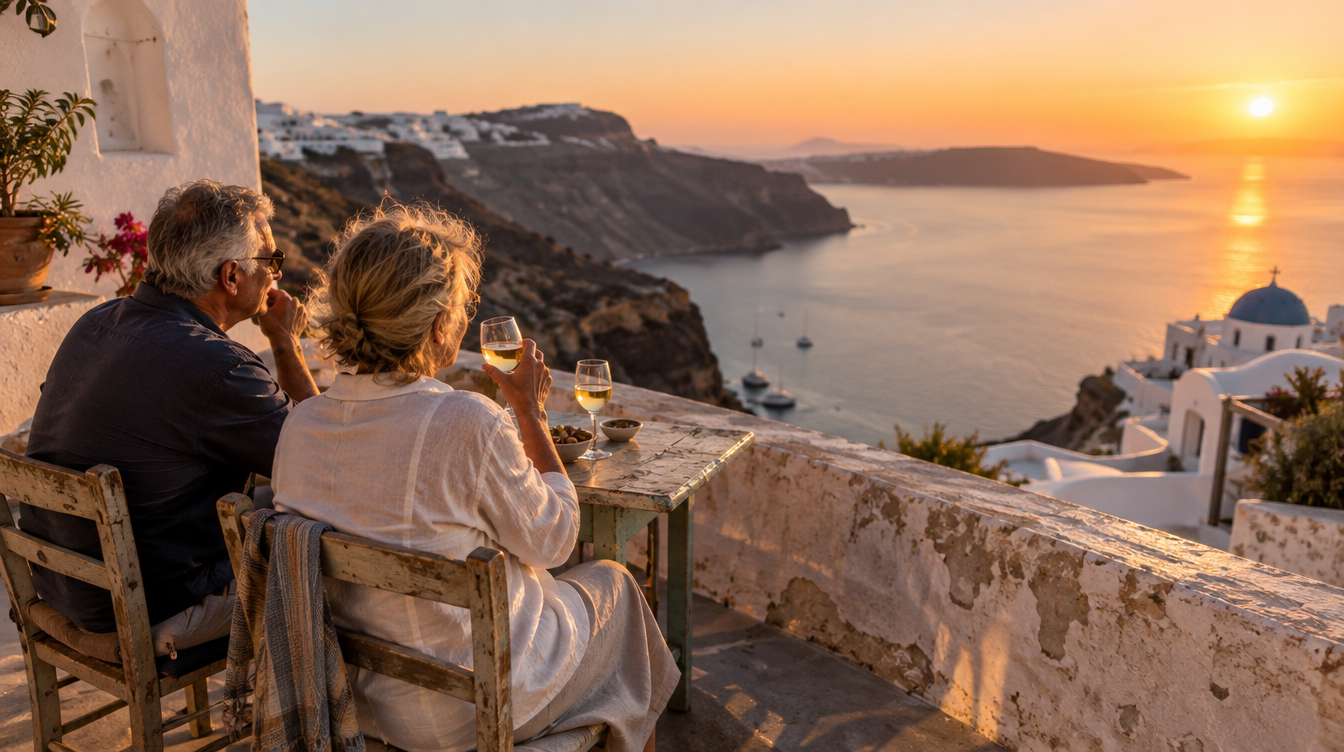
Santorini Beyond the Postcards is a phrase that sounds almost contradictory once you have actually seen the postcards. Blue domes, whitewashed houses stacked along a caldera, a sunset that turns the whole sky into something out of a painting. The images are not exaggerated. They are real, and they are also, at this point, only a small slice of what the island actually offers once you get past the handful of spots that show up in every travel brochure and appear, almost identically framed, in thousands of visitors’ photo albums every single year.
This guide sets the postcard version of Santorini next to what people who actually live there tend to recommend, from where to watch the sunset without three hundred strangers pressed against the same railing, to which villages, beaches, and tavernas locals quietly send their own visiting relatives, rather than the spots featured on the front of every guidebook.
What “Postcard Santorini” Actually Shows You
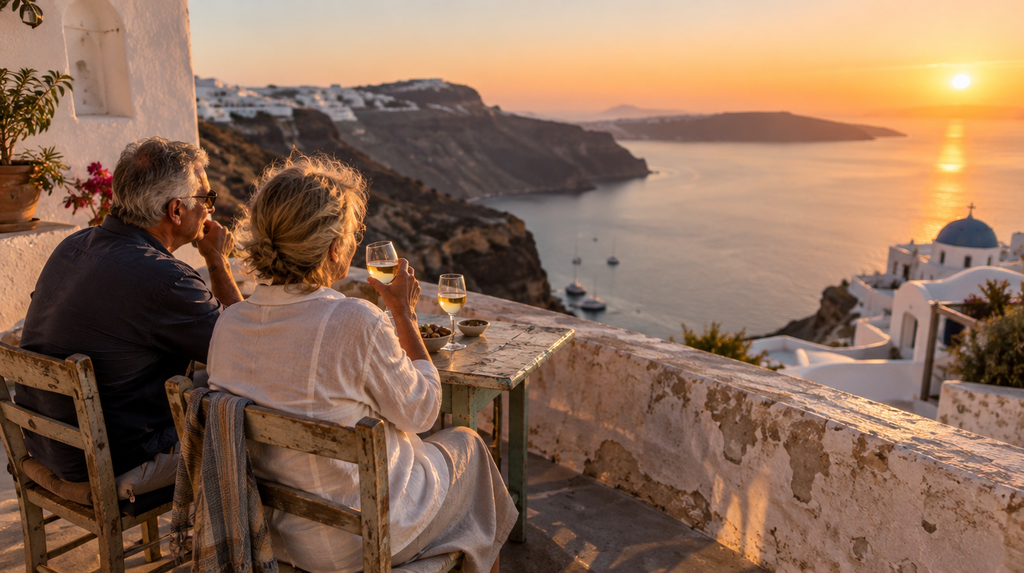
The postcard version of Santorini is concentrated almost entirely in two towns: Oia, famous for its sunset, and Fira, the island’s bustling capital and main cruise-ship arrival point. Both towns are genuinely beautiful, and neither recommendation here is to skip them entirely. The issue is proportion. A huge share of visitors spend nearly their entire trip moving between these two towns, which means they experience roughly ten percent of what the island has to offer while standing in some of its most crowded, heavily photographed corners.
Locals are not dismissive of Oia and Fira exactly, but they are keenly aware that the island’s daily rhythm, its food, its quieter villages, and its actual character live somewhere else entirely, tucked into the parts of the island that rarely make it onto a postcard rack. Santorini Beyond the Postcards, in the way residents talk about it, usually means driving fifteen or twenty minutes away from the caldera-edge towns and discovering that the island slows down considerably once the cruise-ship crowds thin out.
The Sunset Debate: Oia vs. What Locals Actually Watch
Oia’s sunset is, without question, spectacular, and it is also one of the most crowded fifteen minutes on the entire island during peak season, with visitors sometimes arriving two or three hours early just to claim a spot along the castle ruins. Locals rarely bother.
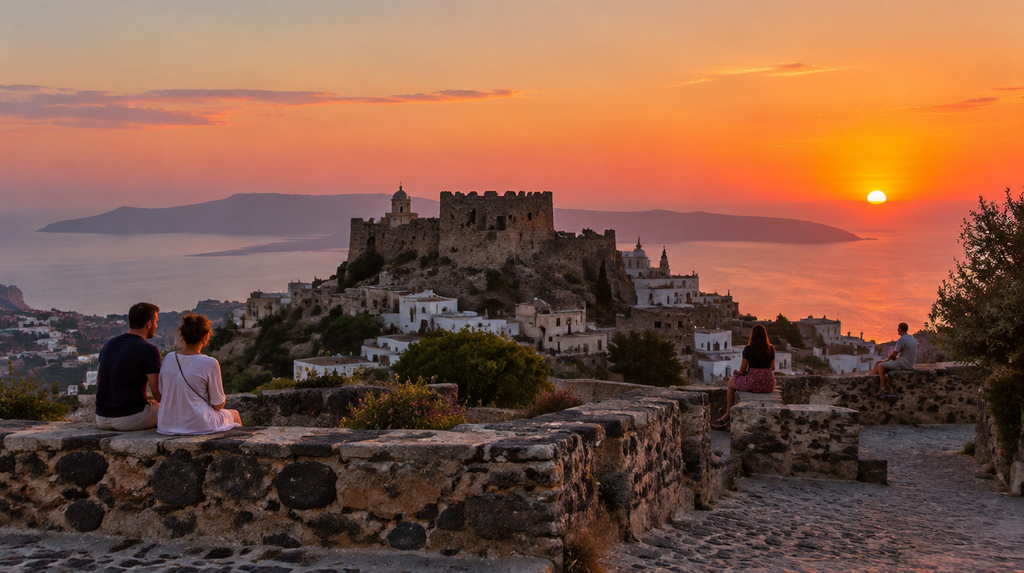
Many residents watch the sunset instead from the village of Pyrgos, Santorini’s former capital, where a Venetian-era castle sits at the highest point on the island and offers a nearly 360-degree view of the caldera, the sea, and the surrounding villages, with a fraction of the crowd. Others simply watch from their own terraces or a quiet local taverna in Imerovigli, a village that sits directly along the caldera rim between Fira and Oia but attracts far fewer day-trippers, its narrow lanes staying noticeably calmer even as Oia fills to capacity just a short drive away. The light hitting the volcanic cliffs is the same dramatic show either way; the difference is whether you are watching it with three hundred strangers or with a glass of local wine and enough space to actually enjoy it.
Beyond Fira: The Villages Locals Actually Live In
Fira functions primarily as the island’s commercial hub, filled with shops, restaurants, and the cable car connecting to the old port. It is convenient, but it is not where most Santorini families actually live their day-to-day lives. Villages like Megalochori, Vothonas, and Pyrgos retain a much quieter, more residential character, with narrow stone lanes, small neighborhood churches, and far fewer souvenir shops per square meter.
Megalochori in particular has become a favorite recommendation among locals for visitors who want the same architectural charm as Oia, the same whitewashed walls and blue accents, without the wall-to-wall crowds. It also sits close to several of the island’s oldest wineries, making it a natural stop for anyone interested in Santorini’s wine culture rather than just its skyline, and its small central square, ringed by cafes rather than souvenir stalls, offers exactly the kind of unhurried afternoon many visitors assume no longer exists on the island.
Skip the Tourist Taverna: Where Locals Actually Eat
Restaurants directly on the caldera rim in Oia and Fira tend to charge a premium for the view rather than necessarily for the food, and locals are generally candid about this. Many residents instead recommend heading slightly inland, to villages like Pyrgos, Megalochori, or Emporio, where family-run tavernas serve genuinely good, home-style Santorinian food at a fraction of the caldera-view prices.
Santorini’s volcanic soil produces several distinctive local ingredients worth seeking out specifically: small, intensely sweet cherry tomatoes, white eggplant, and capers picked wild from the island’s hillsides. Dishes built around these ingredients, tomato fritters called domatokeftedes, fava made from the island’s native yellow split peas rather than fava beans, and grilled octopus paired with the local wine, tend to appear far more often on menus away from the main tourist strip than on the caldera-view restaurant menus geared toward quick turnover and photogenic plates.
One Thing Locals Suggest Skipping Entirely
If there is one recommendation that comes up consistently among Santorini residents, it is to skip the donkey rides once used to carry visitors up the steep switchback path from the old port to Fira. Animal welfare organizations have raised repeated concerns over the physical strain placed on the donkeys, particularly during peak summer heat, and many locals now actively steer visitors toward the cable car instead, which covers the same route in a couple of minutes without the ethical concerns attached to the older tradition. It is a small detail in the broader picture of a visit, but it is one that comes up often enough in conversations with residents that it belongs on any honest list of local recommendations.
The Beach Locals Actually Go To
Santorini’s most photographed beach, Red Beach, is undeniably striking, with dramatic red volcanic cliffs rising above the shoreline. It is also frequently packed shoulder to shoulder during peak summer months, and the narrow cliffside path leading down to it has become crowded enough that access has been restricted at times for safety reasons.
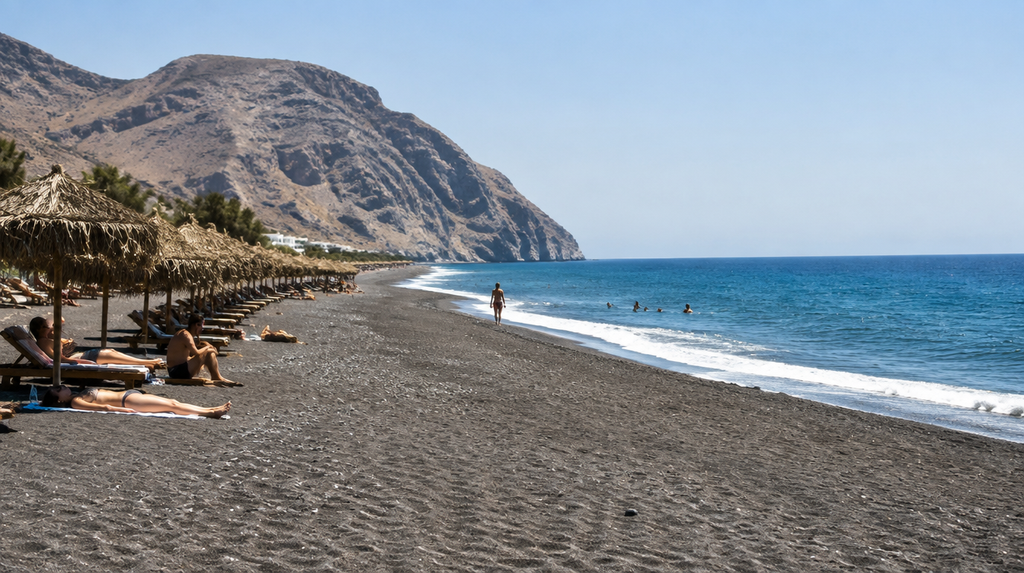
Locals more often head to Vlychada Beach, known for its otherworldly, wind-carved white cliffs and a genuinely quieter atmosphere, or to the long black sand stretches of Perissa and Perivolos on the island’s southeastern coast, which offer more space, calmer water, and a more relaxed beach-club scene without the crowds concentrated around Red Beach’s narrow access point and its limited stretch of sand.
Wine Country: More Than a Tasting Room
Santorini’s volcanic soil and unique basket-shaped vine-training method, developed to protect grapes from strong island winds, produce wines unlike almost anywhere else in the world, particularly the crisp, mineral-driven white Assyrtiko. Most visitors experience this through one or two well-known wineries near Fira and Oia, but locals often point toward smaller, family-run vineyards in Pyrgos, Megalochori, and Vothonas, where tastings are more personal and the vineyards themselves are older, some with vines reportedly over a century old, having survived by being grown low to the ground in coiled, basket-like shapes rather than trellised upward.
Visiting one of these smaller producers, rather than the largest and most heavily marketed winery, is one of the most consistent recommendations locals give visitors who want to understand Santorini’s wine tradition rather than simply sample a flight of glasses with a view. Several of these smaller wineries also grow other native varieties beyond Assyrtiko, including the red Mandilaria grape and the aromatic white Athiri, both of which rarely appear outside Greece and offer a genuinely different tasting experience from the wines most visitors sample at the larger, bus-tour-friendly estates.
The basket-vine method itself, called kouloura locally, is worth seeing in person even for visitors who are not particularly interested in wine. Each vine is coiled into a low, nest-like circle close to the ground, with the grapes growing protected inside the coil, shielded from the island’s near-constant winds and the intense summer sun. Many of these vines are never irrigated at all, surviving instead on the moisture carried in from the sea by nighttime humidity, a growing method unique enough that agricultural researchers from other wine regions occasionally visit the island specifically to study it.
Getting Around Like a Local
Rental cars and ATVs clog the narrow roads around Oia and Fira for much of the summer, and parking near either town during peak hours can eat up a surprising amount of a short visit. Locals frequently rely instead on the island’s public bus network, which connects most villages efficiently and affordably, or on scooters and mopeds for reaching the quieter southern and inland villages where parking is far easier to find.
For visitors specifically interested in Santorini Beyond the Postcards, renting a small vehicle and deliberately routing away from the direct Fira-to-Oia road, through Pyrgos, Megalochori, and the island’s southern villages, tends to reveal a version of the island that feels considerably less rehearsed than the main tourist corridor, with roadside stands selling local produce, small family chapels tucked into hillsides, and stretches of road where the only traffic is the occasional scooter rather than a line of rental cars.
When to Visit If You Want the Real Santorini
Late spring, particularly May and early June, or early autumn in September and early October, are the months locals most often recommend to visitors who want to experience the island without the full weight of peak-summer crowds. The weather remains warm and reliably sunny, the wildflowers or harvest activity add their own seasonal character depending on the month, and both accommodation prices and the crowds thinning at the major viewpoints make the whole island considerably easier to enjoy at a relaxed pace.
Many islanders describe the difference between visiting in August and visiting in late September as almost like visiting two different islands entirely, with the same dramatic scenery but a noticeably calmer, more personal atmosphere once the largest crowds of the year have moved on.
The Ancient History Most Visitors Never See
Santorini’s dramatic crescent shape is itself the result of one of the most powerful volcanic eruptions in recorded human history, which occurred sometime around 1600 BCE and is believed by many scholars to have contributed to the decline of the Minoan civilization on nearby Crete. That eruption buried an entire Bronze Age settlement, now known as Akrotiri, under layers of volcanic ash, preserving it in a manner often compared to Pompeii, minus the human casualties, since archaeological evidence suggests residents had enough warning to evacuate before the final, catastrophic blast.
Despite sitting only a short drive from Fira, Akrotiri receives a fraction of the visitors that flock to the caldera-view restaurants each day, even though it offers something the postcard towns cannot: multi-story buildings, intact staircases, and elaborate wall frescoes preserved almost exactly as they were left roughly 3,600 years ago. Locals frequently mention Akrotiri as one of the most overlooked stops on the island, precisely because it requires stepping away from the caldera views for an hour or two in favor of something that rewards curiosity rather than a camera lens.
This same eruption is also tied to a long-running theory connecting Santorini to the ancient legend of Atlantis, a lost, advanced civilization consumed by the sea, a theory popularized by later Greek philosophers and still debated among historians today. Whether or not the connection holds up to scrutiny, it adds another layer to an island that most visitors experience purely as a scenic backdrop rather than as a genuine, deep archaeological site worth an unhurried morning of its own.
Santorini is most commonly reached by ferry from the port of Piraeus, the same historic harbor at the heart of our Piraeus Golden Age coverage, making the crossing itself part of a much longer Greek maritime tradition long before the island became a global travel icon. Watching the island’s caldera come into view from the deck of a ferry, the same way generations of visitors have arrived for well over a century, remains one of the more understated ways to experience Santorini Beyond the Postcards before ever setting foot on land.
For further background on the island’s geography and history, Wikipedia’s entries on Santorini and Oia offer detailed overviews.
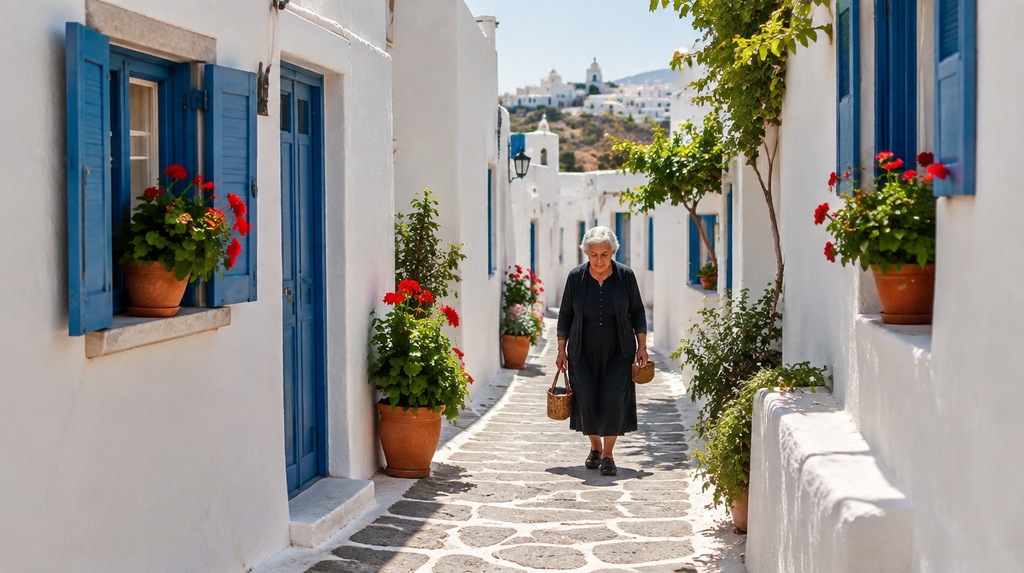
Illustrations in this article were created using AI in a photorealistic style.
Want to hold a piece of this history in your hands? Visit our official shop for digital albums, CDs, and restored vinyl records celebrating the golden era of rebetiko.