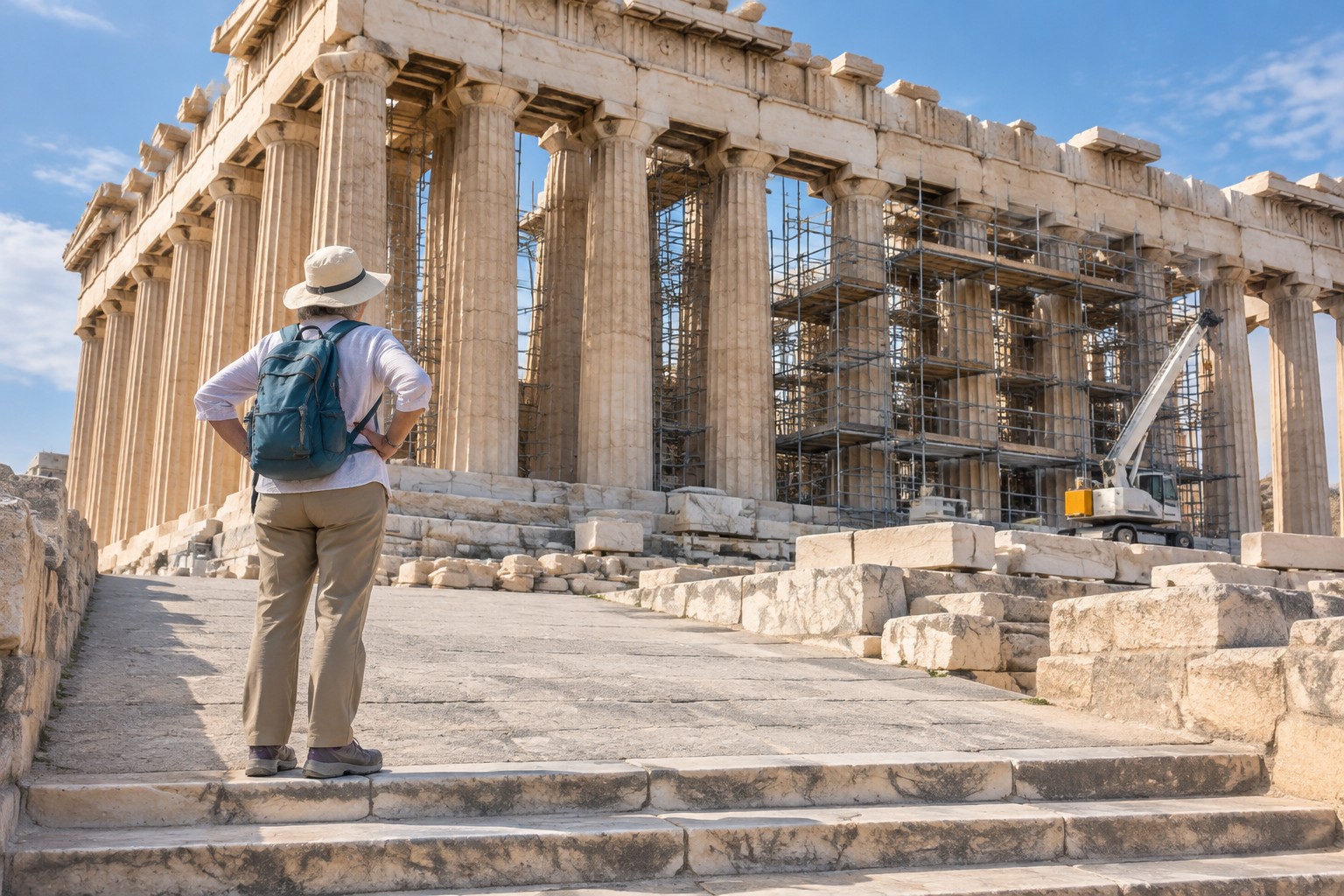
You climb the last stretch of the ramp, a little out of breath, and there it is: the Parthenon Athens has been promising you since the moment your plane touched down. Then your eyes catch something less poetic. Scaffolding. Steel poles and a crane hug the north side, exactly where you wanted your postcard.
Relax. That scaffolding is not a sign that something is wrong. It is a sign that the building is being looked after, as it has been for decades, and the north colonnade is still wrapped in it through 2026. It is also a good clue to the real story. The Parthenon is not a frozen ruin that sat quietly for 2,500 years. It is a building that has been a temple, a church, a mosque and a gunpowder store, and then a very long repair job.
So let’s skip the “big white temple on a hill” summary you can find anywhere. Instead, here is the Parthenon Athens as a biography in five lives, plus a practical section on how to visit it in 2026 without wilting in the sun.
The scaffolding is part of the view, and part of the story.
Why the Parthenon Athens Looks Straight (and Isn’t)
Here is the first surprise, and it is the one that makes people stop talking on a tour. The Parthenon looks perfectly straight and symmetrical. It is neither. Its curves start at the foundation and run through the steps, the colonnade and the roof.
The builders did this on purpose. They angled the blocks of the steps so the platform rises slightly toward the middle. They tilted the columns a touch inward. They made the corner columns a little thicker than the rest. And every column swells gently around its middle, a trick called entasis.
Why bother? The Roman writer Vitruvius, centuries later, explained that these refinements fight an optical illusion: a long straight line, seen from a distance, tends to look as if it sags. The Greeks corrected for the sag, so the building looks perfectly level to your eye. The art historian Jeffrey Hurwit goes a step further and suggests a perfectly straight, perfectly level building would simply look less alive. He describes the Parthenon as almost a sculpture.
There is a bonus. In 2015, engineers concluded that the modular, slightly tilted columns were designed with excellent seismic performance. History.com reports that during an earthquake in 426 B.C. the columns shifted by only a fraction of an inch. The most elegant building in Athens is also a very clever shock absorber.
📖 Quick Glossary:Entasis is the slight swelling of a column. A metope is a carved square panel in the frieze above the columns. The cella is the inner room where the statue of the goddess stood.
The Parthenon’s hidden curves, exaggerated so you can see them.
Life One: A Temple Built in Nine Years
The Parthenon was begun in 447 B.C. under Pericles, after the Persians had sacked the Acropolis. The architects were Ictinus and Callicrates, and the sculptor Phidias supervised the decoration. The building was apparently finished by 438 B.C., the year the great statue of Athena was installed, which means the main structure took about nine years. The sculpted decoration took until 432 B.C. For a marble temple of this size, that is a shockingly fast schedule.
It is a big building, but not as huge as photos suggest: roughly 31 meters wide and 70 meters long, with eight columns across the short ends and seventeen along the sides. Every one of them is white marble, cut and fitted with astonishing precision.
The name comes from Athena Parthenos, “Athena the Virgin.” Inside the cella stood her statue, made of gold and ivory by Phidias and holding a figure of Victory in her hand. The rear room served as the city’s treasury, which is a detail people forget: the Parthenon was part shrine, part bank.
Nine years from first stone to finished temple.
The decoration told stories your eyes can still follow, if you know where to look. The 92 carved metopes showed gods against giants, Lapiths against centaurs, Athenians against Amazons and the fall of Troy. The west pediment showed Athena’s contest with Poseidon for the city, a tale we tell in full in Athena vs. Poseidon: The Battle for Athens. Around the inner chamber ran a long frieze, most likely showing the Panathenaic procession, the city’s biggest festival.
The gold-and-ivory Athena Parthenos, as ancient visitors might have seen her.
Few buildings in Athens were built this fast, and none are as famous as the Parthenon Athens. If you want to meet the rest of Athena’s family, our guide to the 12 Olympian gods puts the whole divine household in one place.
Lives Two and Three: A Church, Then a Mosque
A building that survives for two and a half millennia has to earn its keep, and the Parthenon did that by changing jobs.
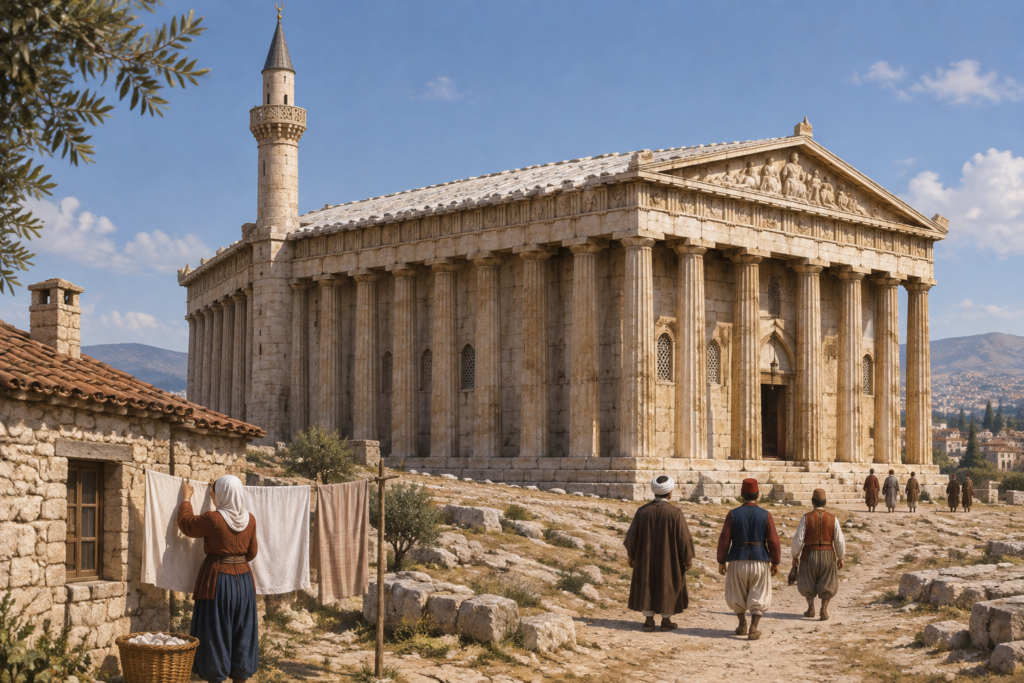
In the Byzantine era it became a Christian church. Some sculptures were removed in the conversion, and Phidias’s great statue was among the things that disappeared. Later, structural changes were made to the interior. The Acropolis was seized by the Ottoman Turks in 1458, and in 1460 the Parthenon became a mosque, with a minaret added at its southwest corner.
Think about what that means. The same marble room heard Greek hymns to Athena, Christian liturgy and then the Muslim call to prayer. Each generation looked at those columns and decided they were worth keeping, even when it no longer believed what the building was built to say.
For centuries the Parthenon was a mosque, minaret and all.
Life Four: The Night the Roof Blew Off
This is the chapter most visitors have half-heard, and the real version is stranger than the legend.
In September 1687, Venice was at war with the Ottomans, and a Venetian army under Francesco Morosini besieged the Acropolis. The defenders were using the Parthenon as a storage magazine for their gunpowder. Whether the Venetians knew that, or just fired at the most obvious target, the result was the same. After an eight-day bombardment, a mortar shell scored a direct hit on the building on September 26, 1687.
The powder exploded. The blast blew apart the long sides and the roof of the temple, and a fire burned for two more days. The building that had survived centuries as a church and a mosque was left skeletal. Historians call it the most damaging event in its history. The explosion also helped push the Turks to surrender.
If you want the ironic cherry on top: afterward, Morosini tried to take the sculptures of the west pediment as trophies. He failed, and in the attempt he damaged the building further. Next time you see the missing center of the temple, remember it is a wound that took a single night to make.
The night of September 26, 1687, in one frame.
🗣️ Say It Like a Local: The Parthenon is o Parthenónas (Ο Παρθενώνας). To ask “Where is the Acropolis?” say Pou ine i Akrópoli? (Πού είναι η Ακρόπολη;).
Life Five: The Long Repair Job
After the explosion, the ruin had a rough couple of centuries. Between 1801 and 1803, Thomas Bruce, Lord Elgin, removed much of the remaining sculpture, and it was sold to the British Museum in 1816. Whether those sculptures should return to Athens is still a debated question, with serious arguments on both sides, and it is not one this article will settle.
What is not debated is the work done on the Parthenon Athens since. A restoration project began in 1975 and has lasted more than 40 years. Conservators lift fallen blocks, match them to their original places and fill gaps with new marble from the ancient quarry, so the repairs are visible but gentle. In 2008 the Acropolis Museum opened at the foot of the hill, and where original sculptures are in London, plaster casts hold their places.
That is why the scaffolding is a good sign. It means people are still doing, in the twenty-first century, what the builders did in the fifth century B.C.: carrying blocks up the hill and setting them carefully in place.
Restoration crews are still setting marble into place.The Parthenon’s five lives at a glance.
Three Things People Get Wrong About the Parthenon Athens
Before the practical part, a quick round of myth versus truth. These are the three mistakes guides hear most often.
“It is a ruin because it is old.” Age did some of it, but the big damage came in a single night. The 1687 explosion destroyed the center of the building, and a fire burned for two days after.
“Its lines are perfectly straight.” They are not. The platform, the columns and the corner pillars were all adjusted on purpose, which is why the temple looks so calm and so alive at once.
“It was always a temple.” For centuries it served other faiths, as a church and then a mosque, and the people who used it kept it standing.
Once you know these three things, the stones start to look different. You are no longer looking at a postcard. You are looking at a survivor, and a survivor with a restoration team on permanent duty.
Visiting the Parthenon Athens in 2026
Now the practical part. These details come from 2026 visitor guides and can change, so check the official Acropolis ticketing site before you go. Two small things in the guides contradicted each other (last-entry times and one free-admission date), so I am leaving those out rather than guessing.
Question
What to know
Do I need a timed ticket?
Yes. Timed entry has been mandatory since April 2024, with a ticket window of 15 minutes either side of your slot. Aim to arrive about 30 minutes early.
How much is it?
Standard adult entry is €30 in 2026. Reduced entry, including seniors 65 and over, is €15.
What are the hours?
8:00 to 20:00 from April 1 to October 31. 8:00 to 17:00 from November 1 to March 31.
When is it least crowded?
Right at 8:00. Crowds build after 10:00 and peak between 11:00 and 14:00. Late afternoon is the next best option.
How long should I plan?
1.5 to 2.5 hours on the hill. Add the Acropolis Museum, a 5-minute walk away with a separate ticket, and plan on 3.5 to 4.5 hours in total.
Is it accessible?
There is a lift on the north side, but the site is only partially wheelchair accessible and the ground is uneven. Contact the site in advance if you need it.
What should I wear?
Sturdy, non-slip shoes. The marble can be slippery, especially when wet. Bring a hat, sunscreen and your own water, since July and August can top 38°C.
🧭 Local Tip: Book the 8:00 slot, do the hill first while it is cool, then walk down to the Acropolis Museum for a calm second stop. Finish with a slow wander through Plaka.
Where the Parthenon Fits in Your Athens Trip
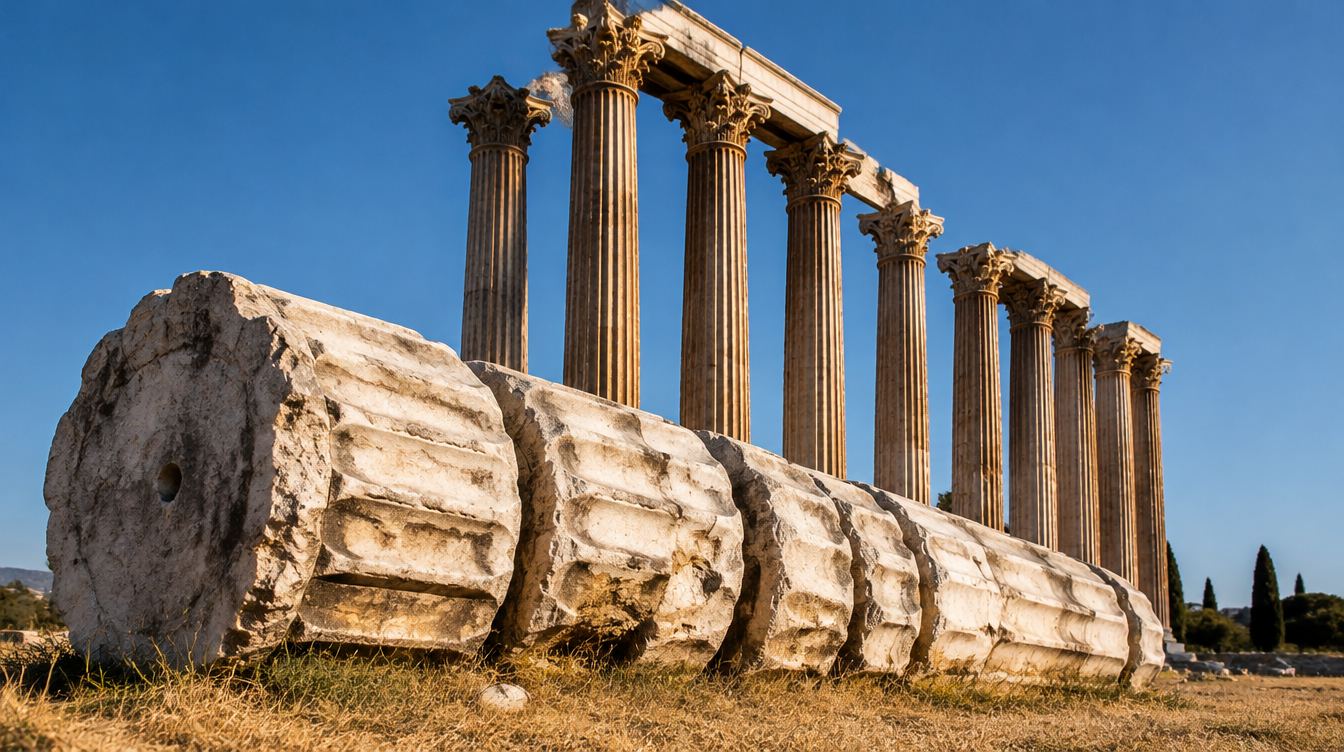
The Parthenon Athens is the headline, but it is not the whole show. If this is your first time in the city, our first-timer’s guide to Athens shows how to sequence the days so you are not exhausted by Tuesday. A short walk away, the Temple of Olympian Zeus is a good second act, a giant that took centuries to finish. And if you have a spare evening, the Changing of the Guard at Syntagma is a show with a lot of character.
For deeper reading, the encyclopedic overviews of the Parthenon, the sculptor Phidias and the Acropolis Museum are good places to continue.
What to Look For Once You Are Up There
Before you go, memorize a short list. It turns a crowded photo stop into a treasure hunt:
The curves. Crouch low at the corner of the platform and look along the step. You may catch the slight rise toward the middle.
The swelling. Look at a column from the side and compare its middle to its top and bottom.
The missing center. Notice where the roof and walls are gone, and remember the night of September 26, 1687.
The patches. The paler marble is the new stone, set in by restorers over decades.
The minaret that is gone. The minaret no longer stands, but now you know it rose at the southwest corner.
The Parthenon Athens rewards slow looking, and it rewards a little backstory even more. Five lives, nine years to build, one terrible night, and a repair crew that has not left in half a century. Not bad for a pile of white stone on a hill.
Illustrations in this article were created using AI in a photorealistic style.
Want to hold a piece of this history in your hands? Visit our official shop for digital albums, CDs, and restored vinyl records celebrating the golden era of rebetiko.