Balkan Music has a funny way of making people feel they’ve heard it before. A listener in Athens hears a Bulgarian dance tune and starts tapping the table. A wedding guest in Belgrade hears a Greek clarinet and nods along. A traveler in Istanbul hears a Serbian brass band and swears it sounds like something from Thessaloniki.
They are not imagining it. For centuries, Greeks, Bulgarians, Serbs, Albanians, Macedonians, Turks and many other peoples lived side by side, traded in the same markets, worked in the same fields and danced at each other’s weddings. Their music mixed along the way, until nobody could say who borrowed what from whom.
This final stop in our journey follows that thread, from the tavernas of Piraeus to the village squares of the Balkans, and shows why the sound of one region echoes in so many others.
Quick Facts
Region: southeastern Europe, from Greece to Croatia and Romania
Shared traits: odd rhythms, circle dances, wind instruments and expressive singing
Common influences: Byzantine, Ottoman, Slavic and Roma traditions
Famous rhythm: 7/8, the “limping” beat
Big idea: the same musical language, spoken with many accents
What Is Balkan Music? Not One Sound, But a Family of Sounds
It is tempting to talk about Balkan Music as if it were a single style. It isn’t. A Bulgarian women’s choir sounds nothing like a Bosnian love song, and a Greek island dance feels different from a Serbian brass band.
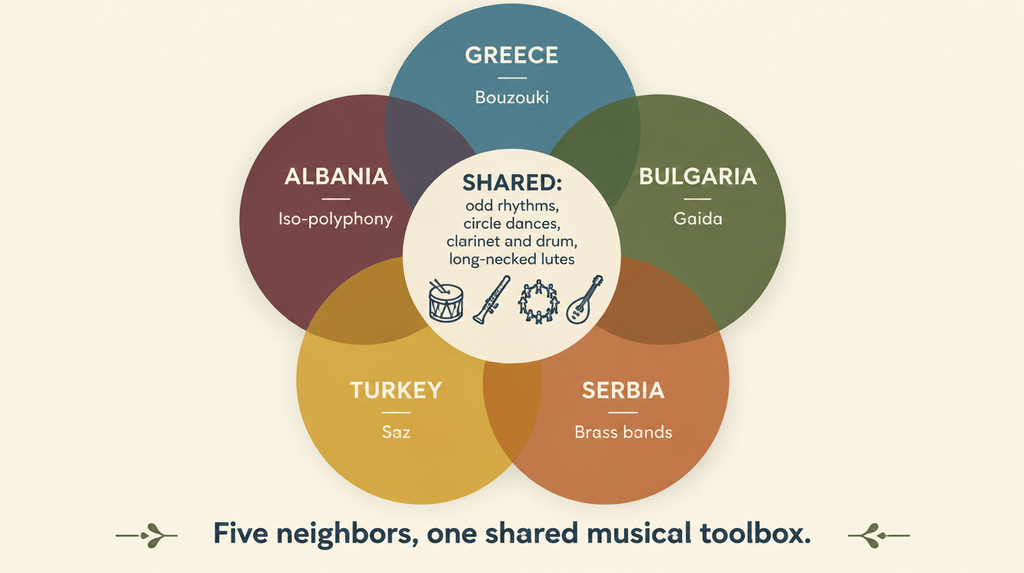
But look closer and you find a shared toolbox. Different countries use similar rhythms, similar scales and similar instruments, and they dress them differently. The easiest way to see this is on one page.
Element
Greece
Bulgaria
Serbia
Turkey
Circle dance
Choros / syrtos
Horo
Kolo
Halay
7/8 rhythm
Kalamatianos
Ruchenitsa
Various folk dances
Used in folk music
Wind instrument
Clarinet, zurna, gaida
Gaida
Brass, flute, gaida
Zurna
Drum
Daouli
Tapan
Large bass drum
Davul
Long-necked lute
Bouzouki, laouto
Tambura
Tamburica
Saz
Notice how many of the same ideas appear in every column, often with similar-sounding names. Those parallels are the fingerprints of a shared history.
Why Did the Music Mix So Much? A Short History
To understand the overlap, you have to look at who lived where.
For centuries, much of southeastern Europe was part of the same large states. First came the Byzantine Empire, then the Ottoman Empire, which governed Greece, Bulgaria, Serbia, Albania and neighboring lands for hundreds of years. Merchants, soldiers, craftsmen and musicians traveled freely across that vast space.
In towns and markets, people of different faiths and languages lived next door to one another. A Greek tavern musician might play for a Bulgarian merchant. A Roma band might be hired for a Serbian wedding one weekend and a Greek baptism the next. Songs that were sung in one language soon found new words in another.
Then came the modern borders of the 19th and 20th centuries, which drew clean lines through a very mixed world. The people moved, many by force, and the music went with them. That is the background to the great exchanges, including the 1922 population exchange between Greece and Turkey.
The Secret Ingredient: Rhythms That Limp
If one thing defines the sound, it’s the rhythm. Western pop usually counts in even groups: 1-2-3-4. Balkan and Greek dance music loves uneven groups.
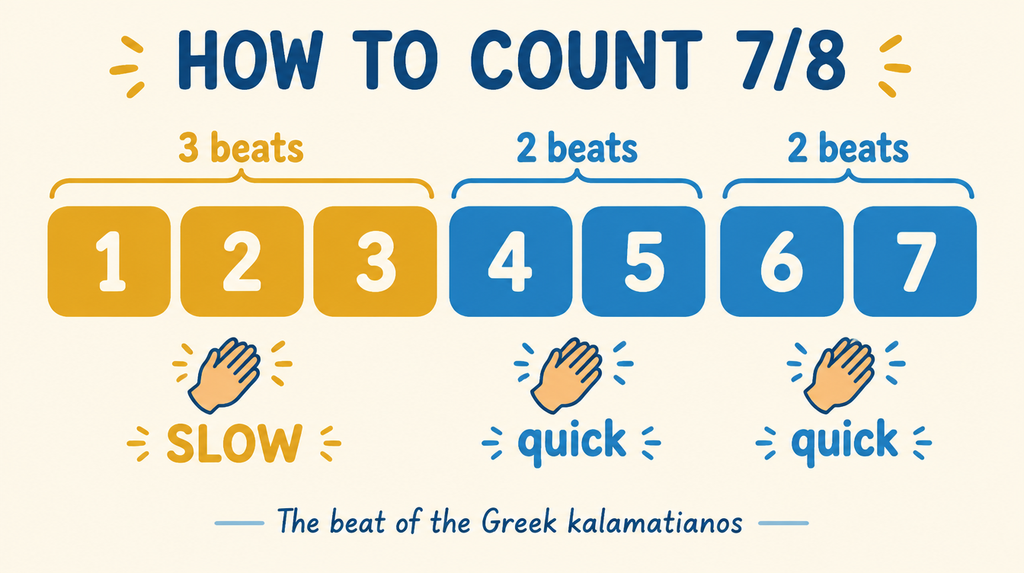
The most famous is 7/8, often counted in a pattern of 3 + 2 + 2, or in the folk way, “slow-quick-quick.” It feels like a gentle stumble, which is why some musicians call it a “limping” rhythm. Once it enters your body, even a stiff listener ends up rocking.
Another is 9/8, common in Greek karsilamas dances, in Turkish music and across the Balkans. It sways like a ship in a swell.
How to feel 7/8 in ten seconds:
Clap slowly: ONE two three
Clap quickly: FOUR five
Clap quickly: SIX seven
Repeat without stopping
That’s the pulse behind the Greek kalamatianos, the dance you’ve probably seen at weddings and festivals.
📖 Quick Glossary: “Aksak” is a Turkish word meaning “limping.” Musicians use it for rhythms built from uneven groups of beats, such as 7/8 and 9/8, which are central to Balkan Music.
One Word, Many Languages: How “Dance” Traveled
Here’s a small linguistic treat. The Greek word for dance, choros, is the ancestor of the word used in several Balkan languages. In Bulgarian it becomes horo, in Macedonian oro, in Romanian hora. It all comes from the same ancient Greek root, meaning a circle or group.
So when a Bulgarian wedding guest says “let’s join the horo,” they’re using an ancient Greek word without knowing it. Words, like melodies, move across borders without passports.
The Instruments of the Balkan Table
Many of the same instruments appear on both sides of every border. The list below will sound familiar if you’ve read about the bouzouki.
Instrument
Type
Typical Role
Clarinet
Wind
Leading dance melodies, especially in Greece, Albania and the Balkans
Zurna
Loud double-reed
Outdoor festivals and weddings
Gaida
Bagpipe
Mountain villages and folk dances
Accordion
Keyboard-reed
Rhythm and chords in modern village music
Tambura / tamburica
Plucked lute
Folk music in the western Balkans
Bouzouki and saz
Long-necked lutes
Songs and dance music in Greece and Turkey
Gusle
One-string fiddle
Epic storytelling in Serbia and Montenegro
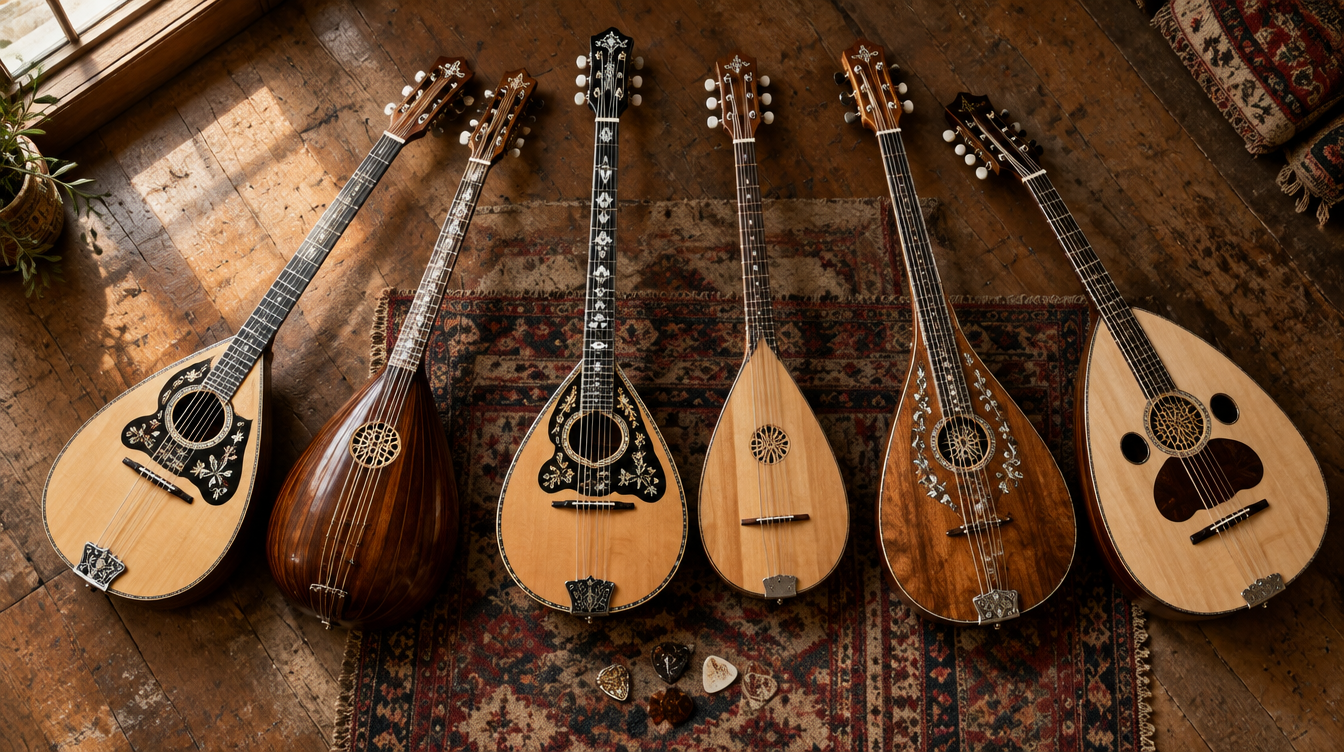
The long-necked lutes belong to the family we explored in our article on the Bouzouki Cousins. If you haven’t read it, it’s a nice companion to this one.
Brass, Roma Musicians and the Sound of Celebration
Any honest story of Balkan music must give credit to Roma musicians. For generations, Roma families have been among the region’s most gifted professional players, performing at weddings, festivals and baptisms across Greece, Serbia, Bulgaria, Romania and beyond.
They helped create the fast, virtuosic brass band style that many people associate with the Balkans, and their influence also shaped clarinet music in Greece and its neighbors. Wherever there was a celebration, there was usually a Roma band playing at the center of it.
🗣️ Say It Like a Local: “Opa!” (OH-pah) is the famous Greek cry of joy at a celebration. You’ll hear very similar exclamations at festivals across the Balkans, a small sign of how much the region shares.
A Wedding in Three Acts
To feel how this music works in real life, imagine a village wedding anywhere from northern Greece to Macedonia.
Act One: The procession. In the morning, the musicians gather at the bride’s house. The clarinet and drum lead a lively walk through the lanes, with relatives clapping and neighbors leaning from windows to shout their blessings.
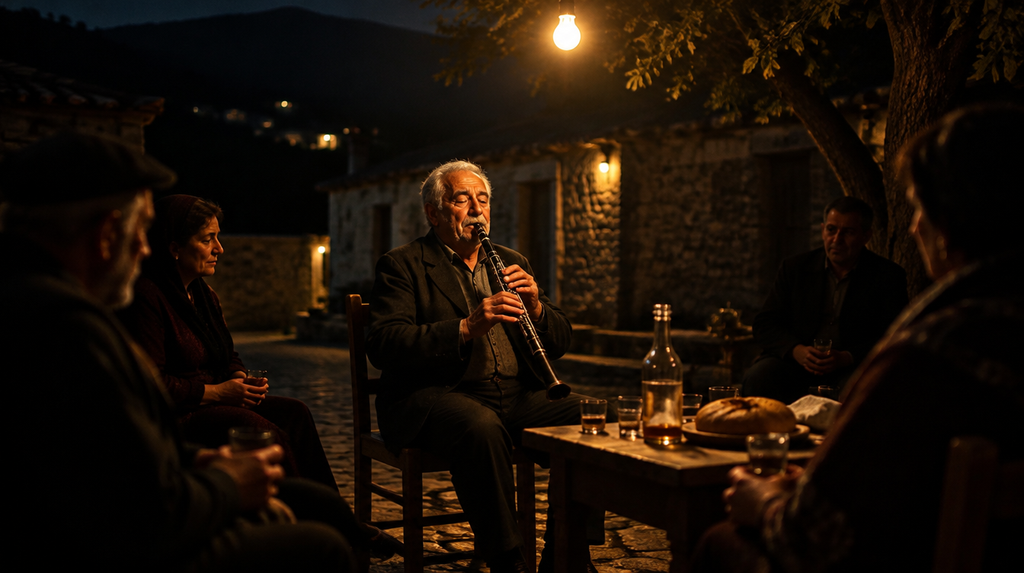
Act Two: The feast. By afternoon, long tables are set up in the square. The band plays slower songs now, while people eat, toast and tell stories. An older man stands up to sing a slow song about homesickness, and the whole table goes quiet.
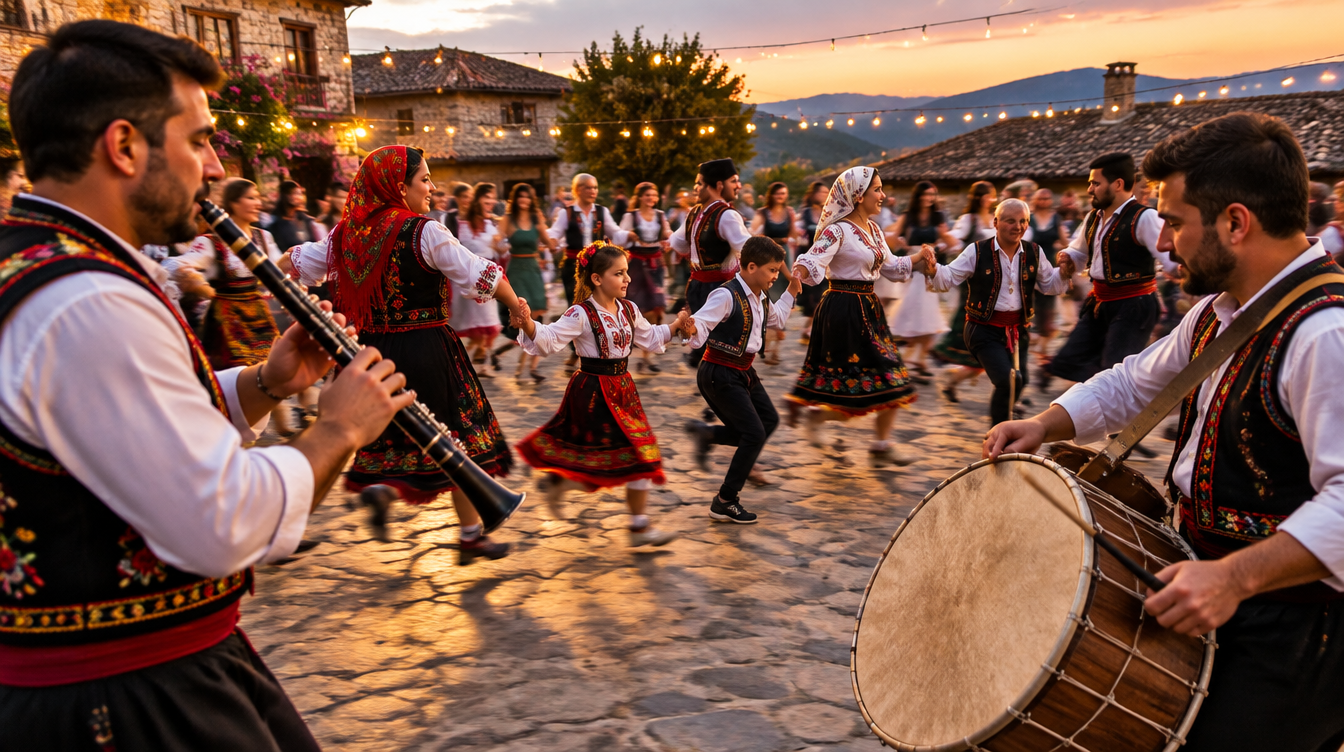
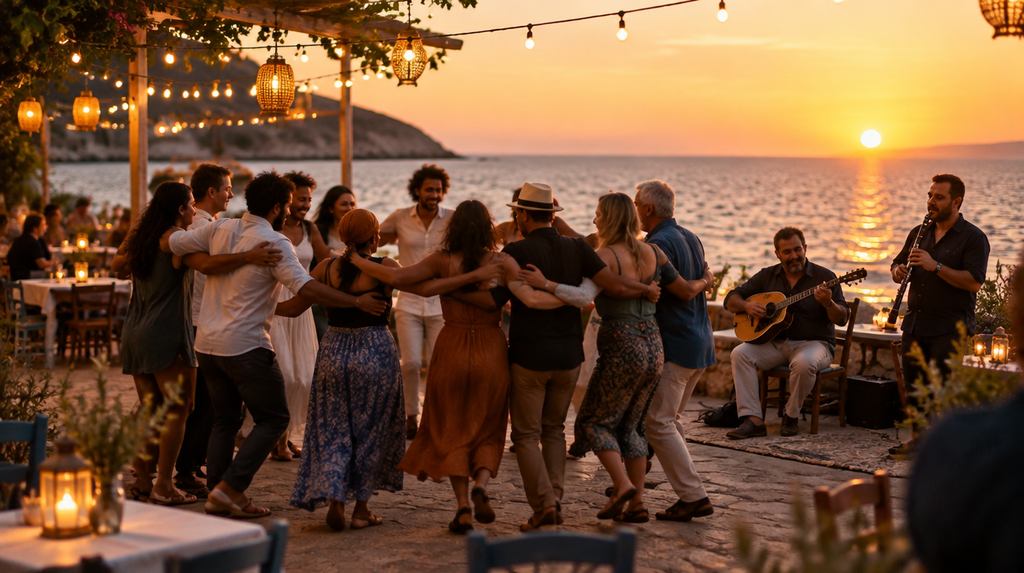
Act Three: The dance. As evening falls, someone calls everyone into the circle. The first dancer leads, waving a handkerchief, and the line grows as relatives, neighbors and strangers join. The rhythm stumbles forward in seven beats, and for a few hours nobody remembers they were tired.
That three-part rhythm of walking, eating and dancing is common across the region, and you can recognize it in a Greek village just as easily as a Bulgarian or Serbian one.
Voices That Speak the Same Language of Longing
Music in this region is not only for dancing. It’s also for feeling.
Bosnian sevdalinka: slow, deeply emotional love songs, often about longing and loss
Greek amanedes: improvised vocal laments, often punctuated with the cry aman, a word that appears in Turkish and Balkan music too
Epirus polyphony: layered group singing in northwestern Greece and neighboring southern Albania, where voices weave around a held drone note
Bulgarian women’s choirs: famous for dense, bright harmonies and powerful vocal technique
Different languages, different villages, but the emotion is shared: the ache of distance, love and memory.
Where Rebetiko Fits In
For readers of this site, here is the link. Rebetiko, born in the tavernas of Piraeus and the cafes of Smyrna, is a close cousin of Balkan and Anatolian music. It borrowed scales, rhythms and instruments from the wider region, then added its own urban, poetic voice.
The great turning point came in 1922, when refugees from Asia Minor brought their music into Greece. You can read about that in our article on the Asia Minor refugees of 1922. The sounds they carried merged with older Greek and Balkan traditions, and rebetiko grew out of that meeting.
The story did not stop at the Balkans, either. Wherever Greeks and their neighbors emigrated, from Australia to the United States, they took these songs along. Our article on the Greek diaspora and rebetiko across the oceans follows that long journey.
A Living Tradition, Not a Museum Piece
It would be easy to treat all this as folklore from a vanished world. It isn’t. Young musicians across Greece and the Balkans are reviving old songs, mixing them with jazz, rock and electronic sounds, and filling clubs and festivals. Wedding bands still play the old rhythms, and in the cities you’ll find students learning the clarinet, the tambura and the bouzouki side by side.
Part of the appeal is that the music asks for participation. You don’t just listen; you join. That is why it has survived wars, borders and every new fashion in pop music: it belongs to the people who dance to it.
A Mini Listening Map
Want to hear these connections for yourself? Try this short tour, using any streaming service.
A Greek kalamatianos (the 7/8 dance) and feel the limp
A Bulgarian ruchenitsa (also 7/8) and compare
A Serbian kolo with brass and drums
A Turkish halay with zurna and davul
A Greek rebetiko recording and listen for the shared scales
An Epirus polyphonic song and hear the layered voices
By the sixth track, you’ll notice the family resemblance without anyone pointing it out.
🧭 Local Tip: If you travel to the region in summer, look for village festivals and name-day celebrations. They’re the best places to hear this music live, in the setting it was made for.
Myth vs. Truth
Myth
Truth
Balkan Music is one single style
It is a family of related regional traditions
Greece is separate from Balkan music
Greece shares rhythms, dances and instruments with its neighbors
Traditions belong to only one nation
Many melodies exist in several languages with different lyrics
Odd rhythms are hard to dance
After a few minutes, almost everyone can follow them
When you step back, the story is a hopeful one. Nations argue over borders, history and who invented what. Yet when a clarinet starts playing, the arguments fade, and everyone moves in the same circle.
It is a reminder that culture has never respected the lines on a map. The people of this region have been sharing songs for a thousand years, long before anyone drew a border, and they will keep sharing them long after.
That is the spirit we hope this site has carried since the first post: music as memory, music as migration, and music as a bridge. Thank you for walking with us.
Illustrations in this article were created using AI in a photorealistic style.
Want to hold a piece of this history in your hands? Visit our official shop for digital albums, CDs, and restored vinyl records celebrating the golden era of rebetiko.